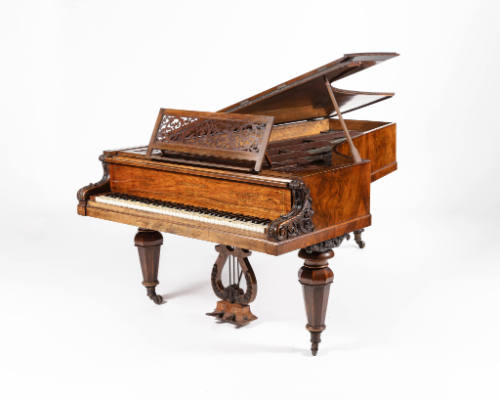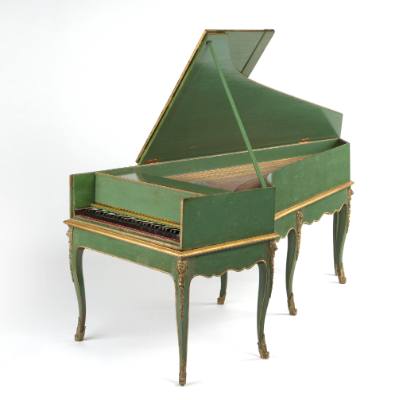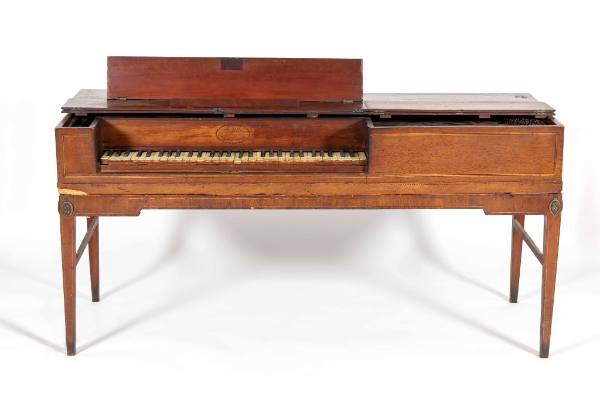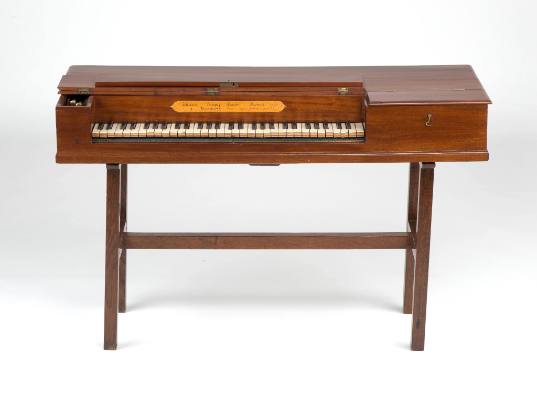

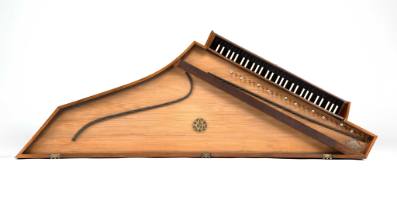
Spinet
Date1785
Place MadeStrasbourg, Alsace, France, Europe
SignedPrinted label with decoratively engraved and cut-out border, on bass side of soundboard in front of nut, the last two digits of year written in black ink:Jean henry Silbermann
Facteur de Forté-Piano &
de Clavecin 1785.
á Strasbourg
Written on one jack in black ink: S HMarkingsWhite leather register cover with each jack numbered in black ink
Each keystick numbered in black inkDescriptionJohann Heinrich Silbermann (1727-1799) learned instrument making from his father, the Strasbourg organ builder Andreas Silbermann, and in the 1740s he also worked in Saxony with his uncle, Gottfried Silbermann, the prominent German organ builder of the period who was also famous for his clavichords, harpsichords, and pianos.
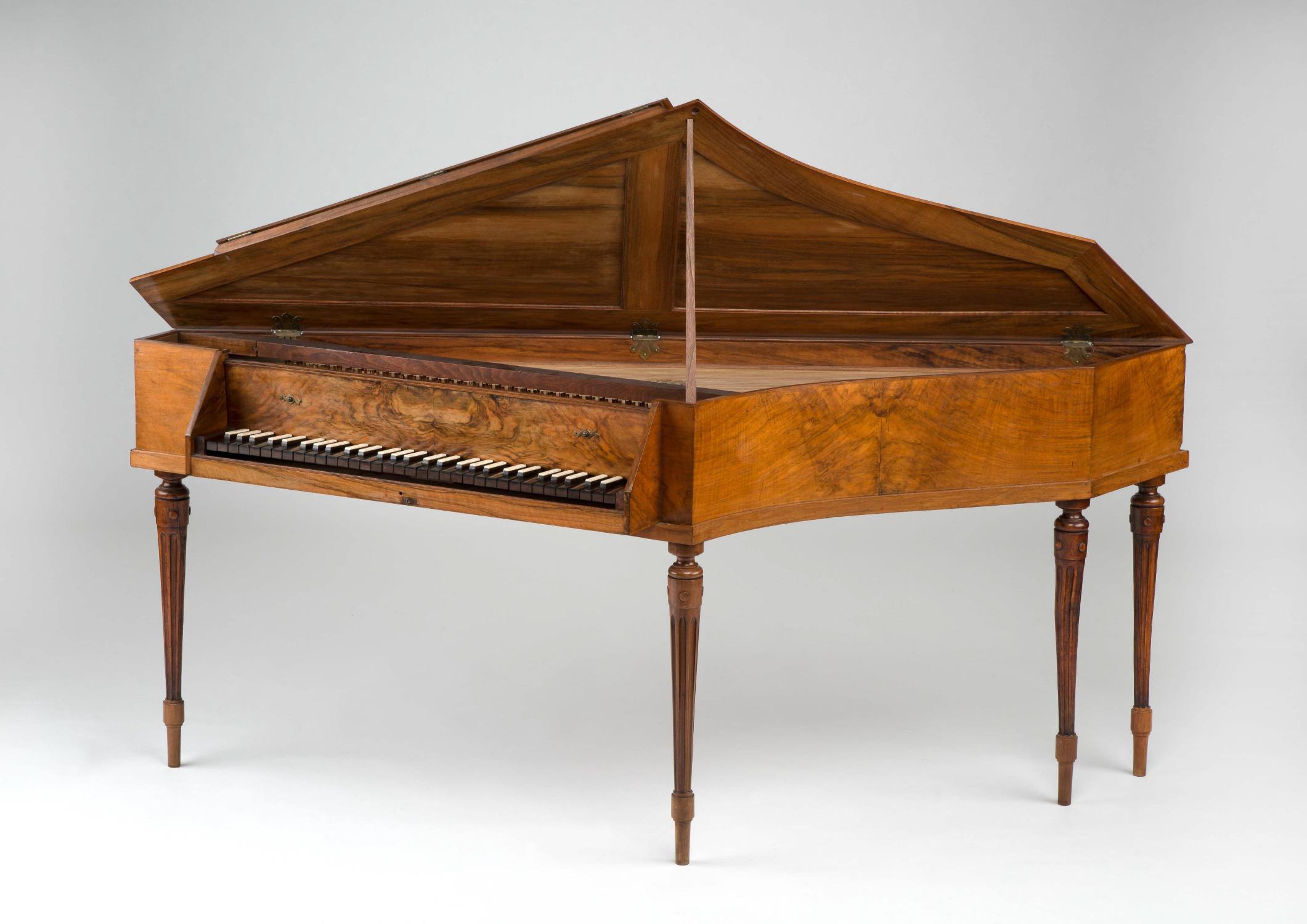
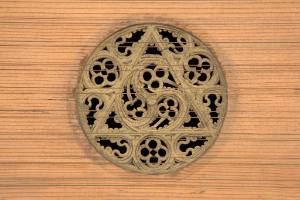
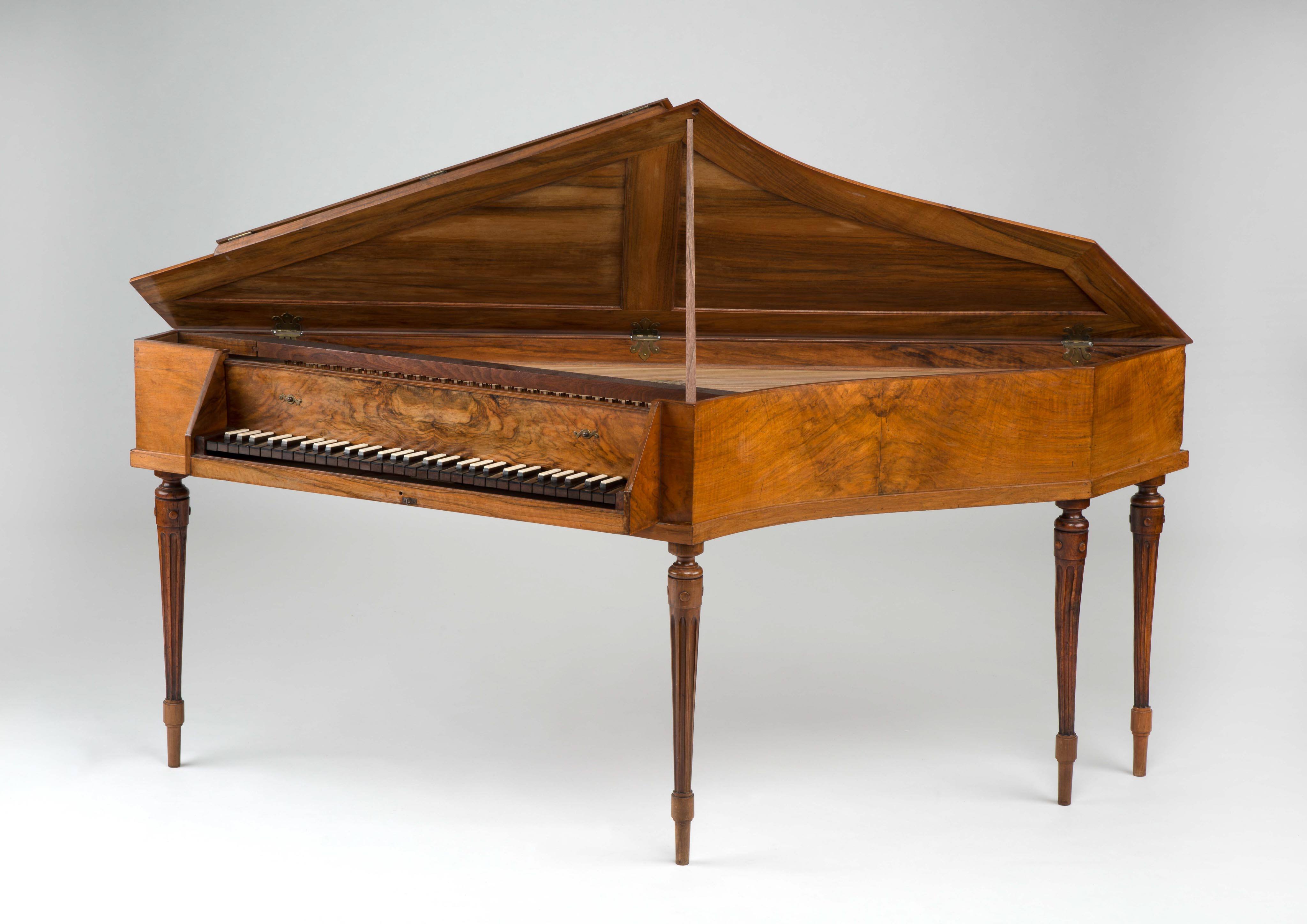
Beautifully veneered in book-matched walnut, the instrument rests on a stand with Louis XVI style fluted legs. Soundboard with fine gilt geometrical rose made of layers of cut parchment. As in many central-German instruments, the bridge and nut are stained black.
Single manual, FF-f3 (5 octaves)
2 X 8, brass stringing from FF to g, iron stringing from a to f3
Case: book-matched walnut with bent side and angled tail; lid with two panels; lid lock; oak spine; interior construction pine and oak; pine bottom board
Soundboard: medium grain spruce parallel to spine; a scribe line is visible from the nameboard to register between pins for notes e1 to f1
Rose: gold-painted three-layer pierced parchment, border piece now missing
Pinblock: oak
Hitchpin plate: walnut
Bridge and nut: black-stained hardwood
Jail rail: walnut
Keyboard: ebony naturals with rounded touchpiece edges and three scribed lines; bone-covered black-stained hardwood sharps
Keyframe: oak and pine with walnut end pieces
Keysticks: possibly linden
Keyfronts: plain hardwood
Jacks: original
Legs: four decoratively turned walnut on walnut and pine standDimensionsSpine length: 1915 mm
Left side length: 142 mm
Tail width: 351 mm
Straight line bent side length: 834 mm
Spine to faceboard / bentside joint: 646 mm
Faceboard width: 1144 mm
Keywell outside width: 894 mm
Body height: 215 mm
Total height from ground: 860 mm
Rose diameter: 83 mm
Register length: 809 mm
Register width: 26 mm
Total keyboard width: 823 mm
Three octave measure: 479 mm
Natural head length: 34 mm
Head width: 19-21 mm
Accidental head length: 69 mm
String lengths and plucking points:
FF: 1578 mm; 192 mm
C: 1448 mm; 171 mm
f: 1314.5 mm; 145 mm
c: 1118 mm; 125 mm
f: 906.5 mm; 89 mm
c1: 655 mm; 98 mm
f1: 471.5 mm; 91 mm
c2: 341 mm; 86 mm
f2: 257 mm; 72 mm
c3 183.5 mm; 64 mm
f3: 127 mm; 53 mmProvenancePurchased in 1999 from Wolfgang Ruf, Emmetten, Switzerland.Published ReferencesGermann, Sheridan. “Harpsichord Decoration: A Conspectus,” in Howard Schott, ed., The Historical Harpsichord, vol. 4 (Hillsdale, N.Y.: Pendragon Press, 2002), p. 177.
"Keyboards in Vermillion: with John Koster" (interview), Harpsichord & Fortepiano, 16, no. 2 (Spring 2012), p. 19.
Koster, John. "Rare 1785 Silbermann Spinet Only Example Outside of Europe," America's Shrine to Music Museum Newsletter, 26, No. 2 (May 1999), pp. 1-3.
-------. “Historical Organs in the Museum Context,” The Tracker 50, Nos. 3 & 4 (Summer/Fall 2006), pp. 32 and 35.
Credit LineRawlins Fund, 1999
Object number06205
On View
On view