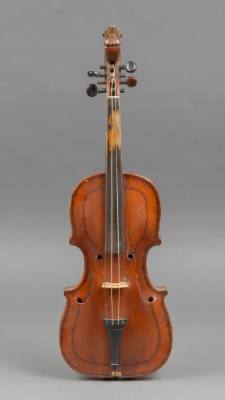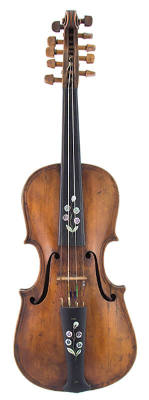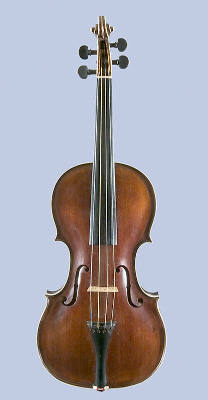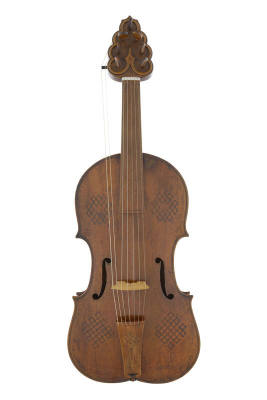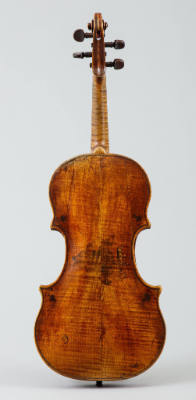
Hardingfele
Maker
Gunnar Olavsson Helland
Date1908
Place MadeBø, Telemark, Norway, Europe
SignedPrinted paper label with cut corners, oriented to be visible through treble f-hole, the last digit of year written in black ink: [illustrations of 8 overlapping medals, the text as follows: PARIS / BERGEN PORS GRUND PORSGRUND / 1898 18 88 1894 / 1900] /
Gunnar Helland, /
Violinmager. /
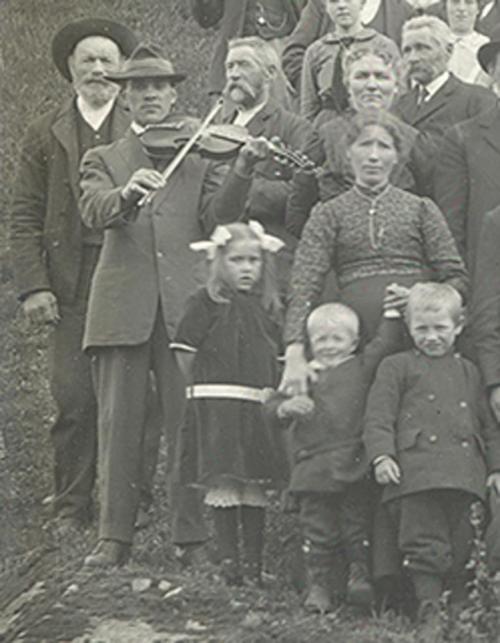
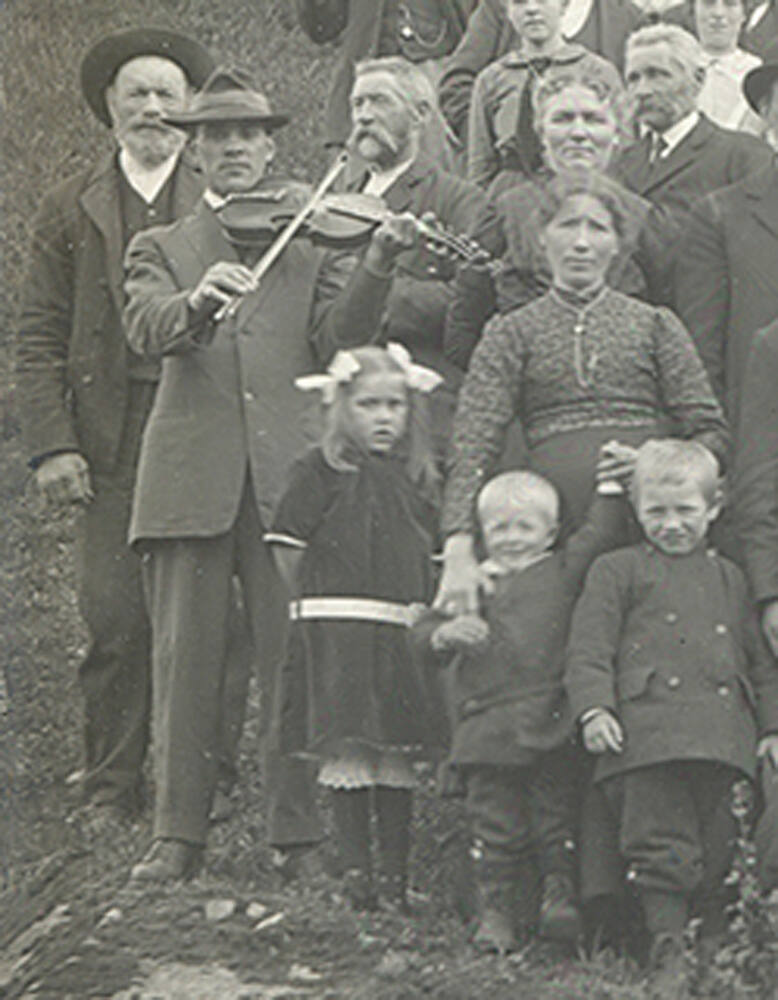
Bø, Telemarken. [empty space] 1908. [last digit handwritten]DescriptionThe hardingfele is a Norwegian form of the violin with both bowed and sympathetically vibrating strings running below the bowed strings. This hardingfele belonged to donor Esther Knutson’s father, Elias Johnstad (born Naustdal, Norway, 1889). Elias, shown holding this instrument in accompanying photo, came to America in 1907. He became a naturalized citizen of the United States on May 24, 1916, at Sisseton, South Dakota. Photo taken between March 20 – September 6, 1914, in Norway.
Four bowed strings, four sympathetic strings; top two strings are plain gut, D-string is gut with loose copper overspinning, G-string is aluminum-overspun gut
Top: one-piece spruce: irregular, medium grain, converging slightly at center joint in upper bout; arching rises abruptly from edges to flat central area
Back: two-piece maple cut off-the-quarter: irregular, narrow, horizonatl curl
Ribs: maple cut off-the-quarter: plain; one-piece lower rib
Head and neck: maple: plain; head terminates in lion-dragon with pointed, bone teeth, protruding tongue, and gold-painted crown and mane; flat pegbox back with black ink decoration
Arching: rises abruptly from edges to flat central area on top
Purfling: none
Decoration: extensive floral decoration in black ink on top, back, ribs, and head; geometric inked borders on pegbox; ink decoration is under the varnish
Varnish: medium orange-brown
Fingerboard: black-painted maple veneered with ebony, inlaid with geometric mother-of-pearl and bone inlay, the later with black-ink-filled incised line decoration; minimal curvature
Nut: ebony; shallow
Tailpiece: black-painted maple veneered with ebony, inlaid with geometric mother-of-pearl and bone inlay, the later with black-ink-filled incised line decoration; flared at lower end; ebony saddle; minimal curvature; sympathetic strings hooked to nickel-silver wire which passes through holes drilled in front of tailpiece, forming two hooks
Tailgut: steel wire; passes through holes drilled in front of tailpiece
Pegs: eight ebony with concave heads
Saddle: ebony; set into top
Endpin: ebony
F-holes: elongated; narrow wings; large eyes; no notches; inside edges of f-holes up to 9 mm higher than outside edges; inside edges overlap outside edges
Linings: maple; narrow
Corner blocks: spruce; small
Top block: spruce
Bottom block: spruce
Bassbar: narrow; low height
Bridge: original maple, with grain running parallel to top; non-flared feetDimensionsTotal hardingfele length: 598 mm
Back length: 350 mm
Upper bout width: 156 mm
Center bout width: 108 mm
Lower bout width: 199 mm
Upper rib height: 32-33 mm
Center rib height: 31-33 mm
Lower rib height: 32-33 mm
Stop length: 179 mm
Vibrating string length: 291 mm
Neck length (bottom of nut to ribs): 111 mm
ProvenanceThis hardingfele belonged to Esther Knutson’s father, Elias Johnstad (born Naustdal, Norway, 1889). Elias, shown holding this instrument in accompanying photo, came to America in 1907. He became a naturalized citizen of the United States on May 24, 1916, at Sisseton, South Dakota. Photo taken between March 20 – September 6, 1914, in Norway.
Credit LineGift of Wayne and Esther Knutson, 1990
Object number04928
On View
Not on view