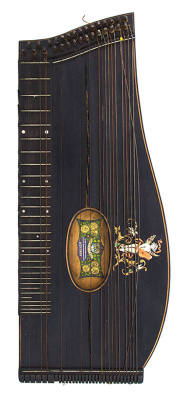
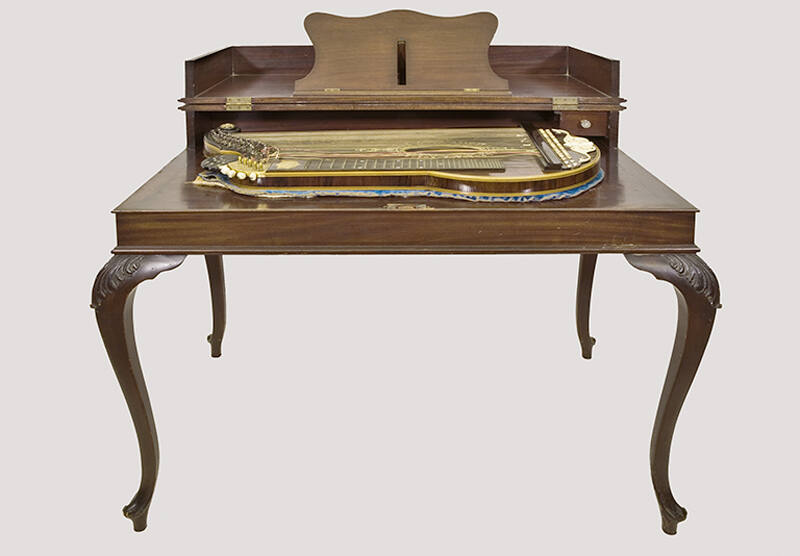









Arion harp zither
ALTERNATE NAME(S)
- Alpine zither
- Zither, Alpine, fretboard accompaniment, bass, and sub-bass string, pillar, rounded lower body
- Concert zither
Maker
Franz Schwarzer
Date1920 ca.
Place MadeWashington, Missouri, United States, North America
ModelSpecial Arion Harp Zither
Mittenwald form S
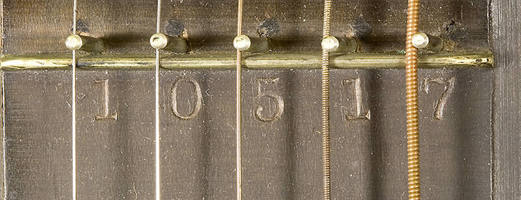
Serial No.10517
SignedSoundhole label: Black, rectangular paper label; gold, geometrical border; gold writing: (top left) [symbol] VIENNA 1873; (top left) [symbol] PROGRESS [symbol]; on right and left are paper circles resembling medallions glued to the label; left medallion has a profile of Franz Joseph I; encircling the profile in black print reads: FRANZ JOSEPH I KAISER VON OESTERREICH KOENIG VON BOEHMEN ETC APOST. KOENIG VON UNGARN; printed in gold in the middle: [scroll-like symbol] FRANZ [scroll-like symbol] SCHWARZER,/ [linear symbol]WASHINGTON, / MISSOURI. / [symbol] ; right medallion reads on top in white print: DEM FORTSCHNRITTE; the center is a depiction of 4 mythical gods; beneath reads in white print: WELTAUSSTELUNG 1873 / * WIEN *; bottom left reads in gold print: [line] [asterisk] FIRST [line] [asterisk]; bottom right reads in gold print: [line] [asterisk] PRIZE [line] [asterisk]MarkingsSoundboard decal: noneDescriptionThis alpine zither was custom made for Emma Lawrence Wellisch. The elaborate ivory and abalone inlay on this zither reflects the instrument’s importance to German immigrants, as well as the prominence of its owner.
Emma Lawrence Wellisch was well-known among German immigrant communities in Minnesota. Born to German and Swiss parents, she learned zither as a child in Wisconsin. After moving to St. Paul, Minnesota, Wellisch rose to celebrity status by promoting the zither as an emblem of traditional German culture. Through her playing and work with the Minneapolis Zither Society, she helped bond German immigrants into a community.
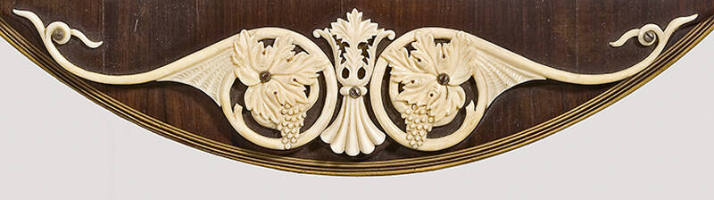
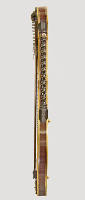
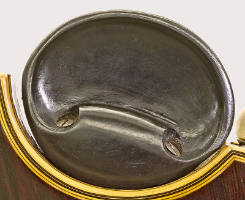
Mittenwalder form with ebony scroll and spiral pillar; rosewood veneer soundboard and back; tulipwood; sides; ebony fretboard; 2 soundholes, 1 oval, 1 smaller and round set to the right of the centered larger one; ebony saddle; carved ebony shell with 22 inlaid abalone circles; on bottom of front, carved ivory symmetrical overlay with grapes, a vine and leaves on both sides all attached with 2 screws; the center has a leaf-like piece of ivory attached with a single screw; encased worm-gear screws with ivory heads; plate underneath and screws are gold-plated and attached with 11 screws; ivory string holders on saddle with inlaid abalone circles; gold-plated flower made of 8 bi-color gold plated petals with round ivory center with inlaid circular abalone; gold-plated engraved shield on top section of fretboard which reads: Franz Schwarzer / Washington / Missiouri, U. S. A.; ebony pillar is inlaid with a singular gold line that follows up the pillar in the direction of the pillar’s spiral; rounded part of body, right side, entire edge of back and both soundholes have light, dark, light, dark, light inlaid-wood purfling; 3 ball-shaped ivory table-top rests with metal spikes (one missing); top of column has 8 bi-color gold-plated leaves; center, oval soundhole encircled by ornate inlaid ivory, abalone and mother-of-pearl decoration.
Table:
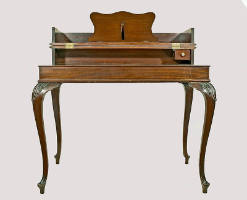
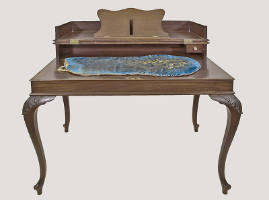
Accompanying resonating rectangular-shaped mahogany table intended to amplify instrument’s sound, attached top lid has a key-hole on the front center of top lid; lid is hinged at two places in the center to fold back allowing the music stand to fold up on two hinges and a back wood support when lid is raised; hinges are attached to wood with 6 screws; when lid is raised the zither is revealed with an accessory drawer to the right with clear glass carved knob; 4 legs are carved at upper portions and rounded at top; blue velvet cloth in the shape of the zither is placed underneath the zither to presumably protect the wood from the metal spikes of the table-top rests; velvet is embroidered with white, yellow-gold and brown to form a harp with flowers.
Strings:
43; several gut strings, 3 red strings, 5 melody strings; from left of soundboard—13th, 21st, 25th, 29th and 33rd string have tape wrapped around strings just above the saddle.ProvenanceCustom-built for Emma Wellisch, prominent zither virtuoso in St. Paul, Minnesota, who began performing as a child in the 1870s.
Credit LinePaul and Jean Christian Collection
Object number12881
On View
On view
1775-1800 ca.
1850-1890 ca.
1900-1925 ca.