






Roller organ
Distributor
Mechanical Orguinette Company
Date1880-1883 ca.
Place MadeWorcester, Massachusetts, United States, North America
ModelStyle E
Serial No.14209
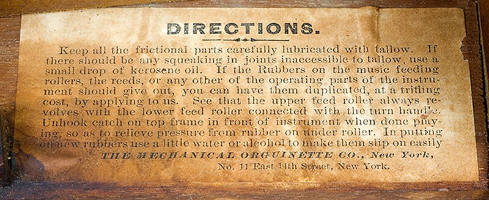
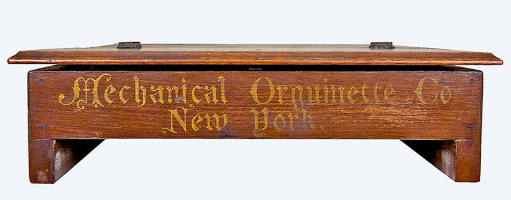
SignedWritten in gold-colored paint on the feeder-spool end of the upper box containing the reeds: Mechanical Orguinette Co / New YorkOn a paper label pasted in the interior of the bellows compartment there are directions for maintaining and using the instrument, at the bottom of which is:
THE MECHANICAL ORGUINETTE Co., New York, / No. 11 East 14th Street, New York.
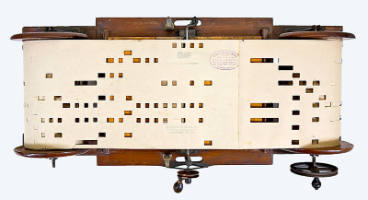
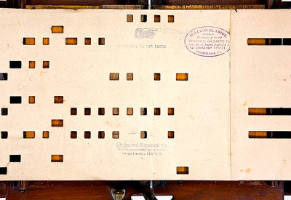
Rubber-stamped on the paper roll: Mechanical Orguinette Co., / SOLE MANUFACTURERS AND PATENTEES / No. 831 Broadway, NEW YORK.
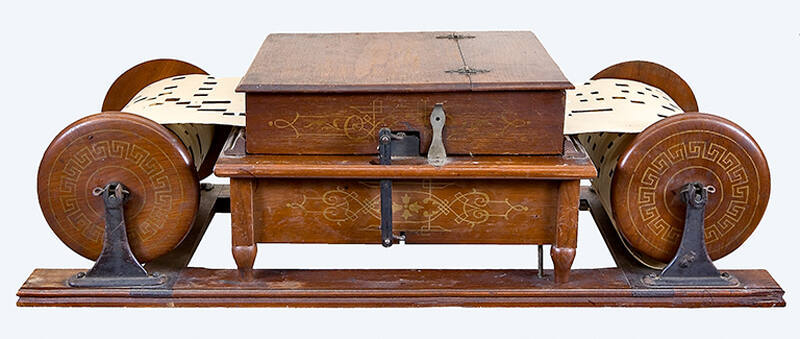
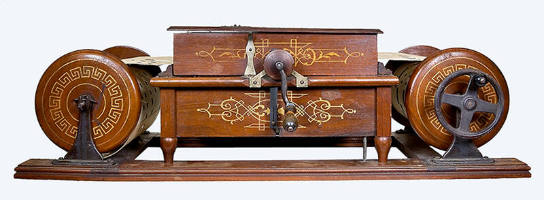
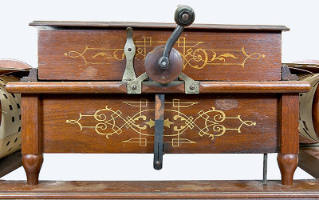
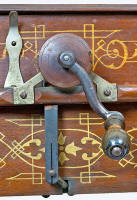
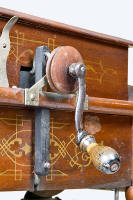
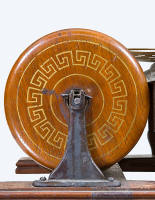
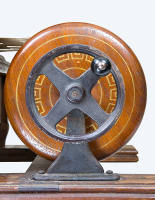
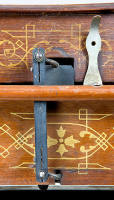
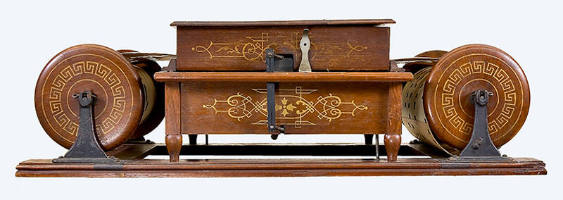
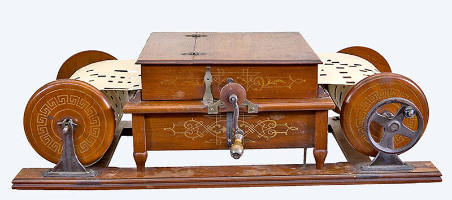
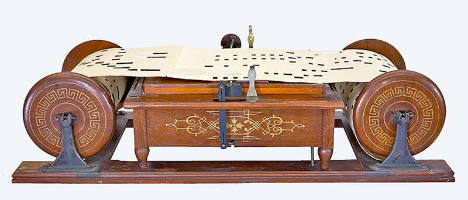
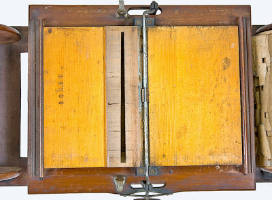
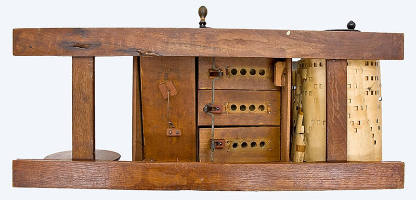
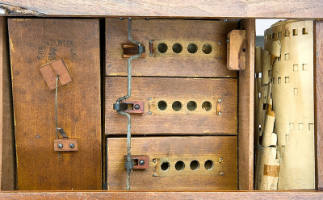
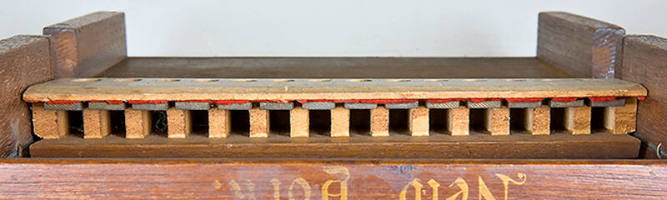
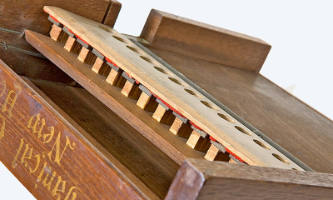
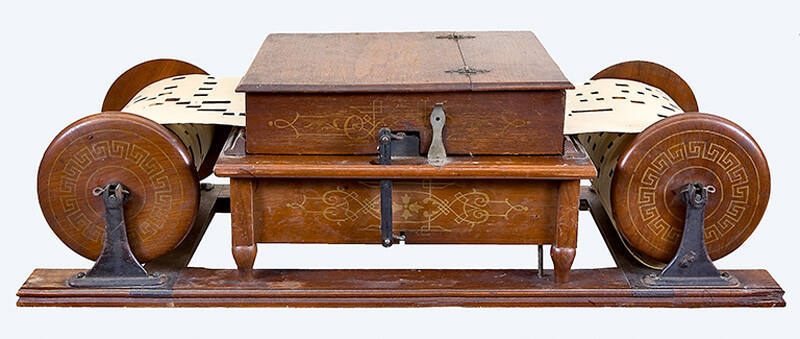
Also rubber-stamped on the paper roll: WILLIAM BLASIUS, / SOLE / Wholesale agt / for the / MECHANICAL ORGUINETTE CO. / In Pa. Del. West Va. & part of N.J. / 921 CHESTNUT STREET, / PHILADELPHIA, [PA.]MarkingsDie-stamped on the upper side of the box containing the bellows, on the surface over which the paper rolls: 14209Descriptionmechanical player organ with a compass of fourteen free reeds functioning on the suction system. A perforated paper roll pass from a spool at one end to a spool at the other. The lower portion of the box between the spools contains two suction bellows and a suction reservoir bellows. A hand-operated crank at the side of the box is connected to the two suction bellows and moves them alternately. A small wooden pulley on the axle of the crank was connected by a cord to a larger wooden pulley at the end of the takeup spool to the right. The paper roll passes across the top of the bellows box, over which is a shallow removable box serving as a cover. A wooden comb inside this upper box contains the reeds. Wire springs lightly push this this comb (somewhat resembling a large harmonica) against the paper roll. Sound is produced when perforations in the paper allow air to pass through the reeds into the suction reservoir.
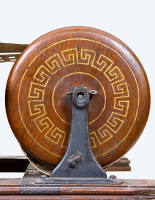
The visible woodwork is of mahogany. Decoration in gold-colored paint includes arabesques on both sides of the bellows box; arabesques on the sides and takeup-spool end of the upper box; and a Greek key pattern in a circle on each end of the spools.
Wholesale agent: William Blasius, Philadelphia, Pennsylvania
According to Bowers’s Encyclopedia (p. 740), the Monroe company of Worcester, Mass., made instruments for the Mechanical Orguinette Co. of New York. The date of this instrument can be estimated: 1) from the address on the Munroe label: according to Bowers, Munroe’s Union Street factory was completed in December 1879; and 2) from the rubber-stamped address of the Mechanical Orguinette Co., which, according to Gellerman’s Atlas (p. 156) moved from 11 E. 14th St. to 1831[sic: correctly 831, as stamped on this instrument and appearing in the trade card reproduced in the pianola Institute website, as copied below] Broadway in 1880 and to Greenpoint, Long Island, N.Y., in 1883. The latter address does not appear on this instrument. A date between 1880 and 1883, fairly early in the history of the Mechanical Orguinette Co., founded in 1878 according to Gellerman, is consistent with the low serial number, 14209, and the very high production rate of these instruments.
According to the pianola Institute website (page copied below), this is a style E instrument.Dimensionslength of skids forming the base of the instrument: 684mm
width of base: 276
height: 202ProvenanceFrom the collection of Fordyce Fox (died 1920-1990), formerly of Randolph, New York.
Credit LineFordyce and Frances Fox Collection, 2007
Object number13534
On View
Not on view