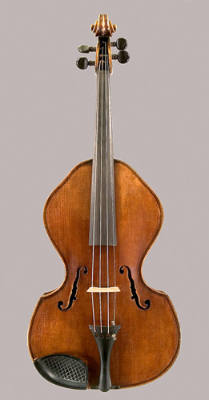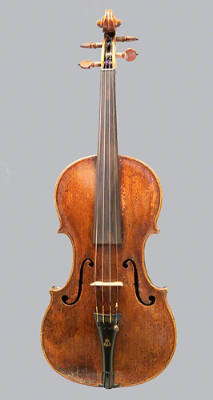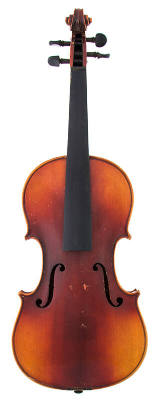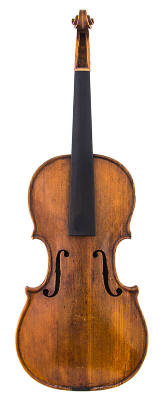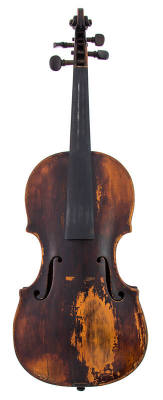
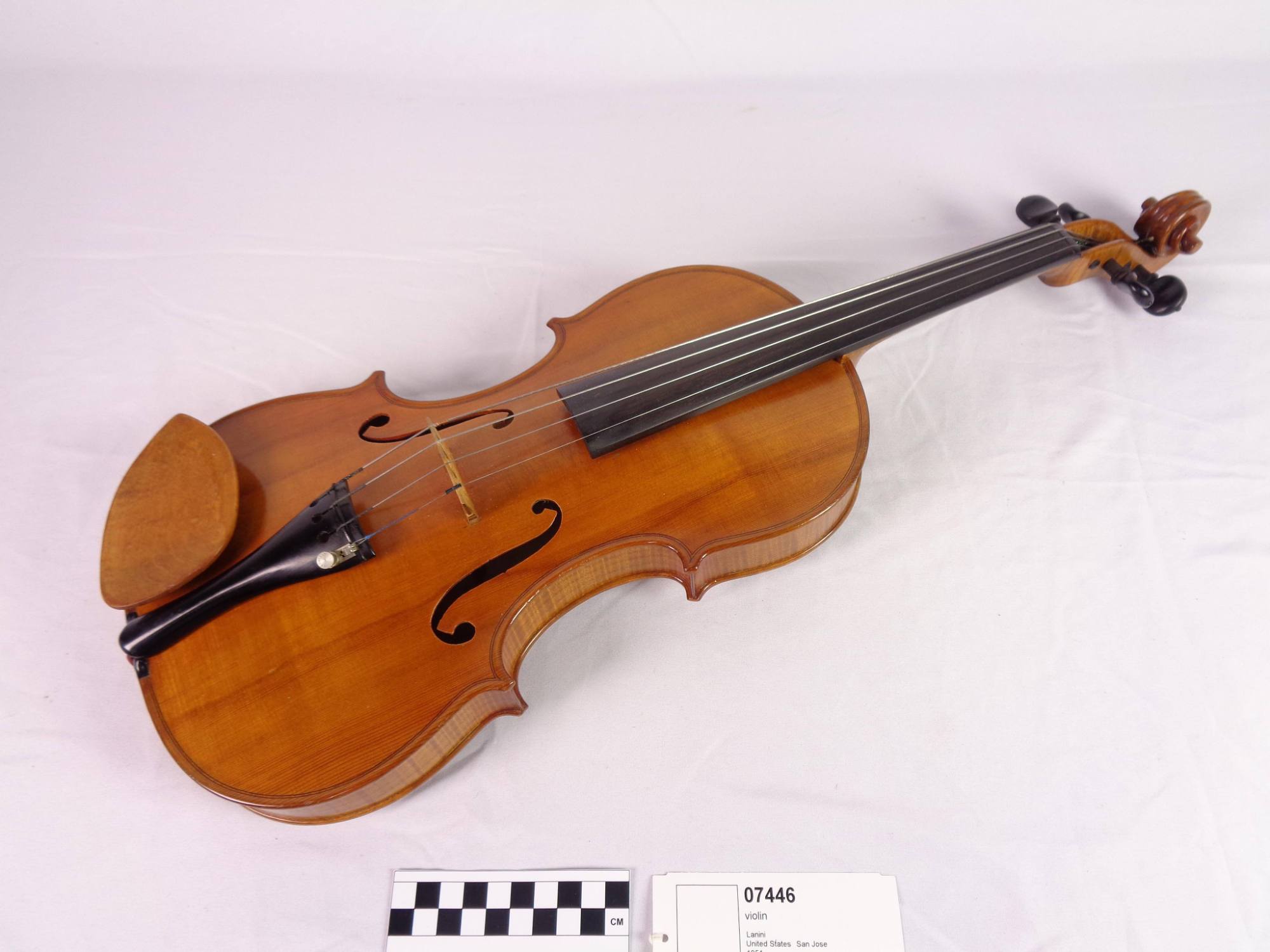


Violin
Maker
Alfred Eugene Lanini
Date1951
Place MadeSan Jose, California, United States, North America
ModelAccording to Henry Lanini, his father's violins made between 1920-1956 "were of his own model..."
Serial No.131
SignedWritten in black ink on paper label with border comprised of curved lines and small circles: Alfred Lanini / San Jose, California / i95i Written in pencil on inside of top, lower treble bout: Made by / Alf d Lanini [sic] / San Jose California / 1951
Stamped on 1) bottom rib below endpin; 2) top under fingerboard near neck; 3) and 4) top block (twice); 5) bottom block above endpin; 6) bottom block below endpin: A.LANINIMarkingsWritten in black ink on top block and center bass rib: 131 [Wenberg, p. 175, notes that Lanini also included the number of his instruments underneath the label, but this is not visible to the eye on this example.]
Illegible writing in pencil on inside of lower treble rib
Compass mark and illegible pencil inscription on inside of top between f-holes
Pencil line on inside of top between f-hole notches, underneath bassbarDescriptionAlfred Lanini (1891-1956) was a California-based American violin maker who studied with Romeo Antoniazzi in Milan in 1911, then Celeste Farrotti until 1914. He opened a shop in San Francisco in 1917 and soon moved to San Jose, where he worked until his death. Lanini also studied bow making with John Bolander, August Nurnberger-Suess, and Auguste Husson. This violin was purchased by the donor on the recommendation of her high school violin teacher.
Top: two-piece, quarter-cut Engleman spruce: very fine grain broadening slightly toward the flanks
Back: one-piece, semi-slab-cut Oregon maple: bird’s-eye and quilted figures; dark ray flecks; ebony-filled dowel-hole through back into top block; ebony-filled dowel-hole through back into bottom block; notches continue between button and edging
Ribs: quarter-cut Oregon maple: prominent, narrow curl, angled slightly to left on upper bouts and lower bass bout; not angled on center bass bout, angled slightly to right on center and lower treble bouts; wide grain; dark ray flecks
Head and neck: Oregon maple: faint, narrow curl; wide grain; dark ray flecks; long scroll ears; wide scroll and pegbox ridges; pegbox edges rounded
Arching: begins immediately at purfling
Edging: rounded edging continues under back button; very slightly scooped
Purfling: narrow outer strips
Varnish: amber; craquelure
Fingerboard: ebony
Nut: ebony
Tailpiece: varnished ebony; tulip-shaped
Tailgut: magenta gut
Pegs: four ebony with black glass or plastic pins
Saddle: ebony; finished with same varnish as body
Endpin: ebony
Bridge: top edge forming three flat surfaces of different angles; oval kidneys; original
Chinrest: maple: faint bird’s-eye figure; finished with same varnish as violin; nickel-plated steel hardware; original
F-holes: lower wings slightly channeled
Linings: spruce; three vertical, half-round, spruce support linings glued to lower bass bout between top and back to provide extra strength at chinrest position; linings continue shape of vertical support linings
Corner blocks: spruce; continues shape of lining
NMM 7446
Attachment III
Top: "two-piece, Engleman spruce, with a narrow grain widening at the flanks," according to maker's son, Henry Lanini. Wenberg, p. 175, notes that Lanini used domestic wood in many of his instruments made after 1930.
Back: "one-piece maple back of Oregon maple, cut on the slab, with a broad curl," according to maker's son. Pins visible at the top and bottom of the back.
Ribs, neck, and scroll: from a matching piece of maple, cut on the quarter, in contrast to the back.
Color: "amber on a yellow ground." "His instruments were always varnished with the [Riccardo] Antoniazzi 'Spirit' varnish," according to maker's son. Alfred Lanini studied violin making with Riccardo Antoniazzi in Milan "for six months," according to Wenberg, p. 175, who also notes that Lanini used a "fine transparent spirit varnish following the Antoniazzi formula." The varnish exhibits a delicate, fine cracqueleure, most evident on the belly.DimensionsTotal violin length: 583 mm
Back length: 350 mm
Upper bout width: 164 mm
Center bout width: 109 mm
Lower bout width: 205 mm
Upper rib height: 29-30 mm
Center rib height: 29-30 mm
Lower rib height: 30-31 mm
Vibrating string length: 325 mm
Stop length: 193 mm
Neck length (bottom of nut to ribs): 133 mm
(provided by Henry Lanini)
Length: 13-3/4"
Width of upper bout: 6-7/16"
Width of center bout: 4-1/2"
Width of lower bout: 8-1/8"ProvenanceAccording to the donor, Gwendolyn L. Callaway Moore, "The instrument was acquired through the influence of my high school music teacher, Jane Pope Roberts, and the instrument was used throughout my education. Even though I did not pursue a music career, I have enjoyed the violin during my lifetime." Published ReferencesAndré P. Larson, "Recent Acquisitions," America’s Shrine to Music Museum Newsletter 27, No. 2 (May 2000), p. 6.
Credit LineGift of Gwendolyn L. Callaway Moore, 1999
Object number07446
On View
Not on view