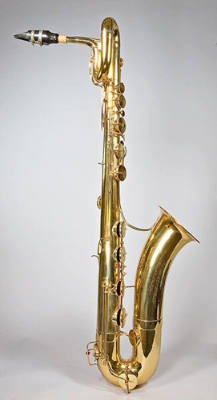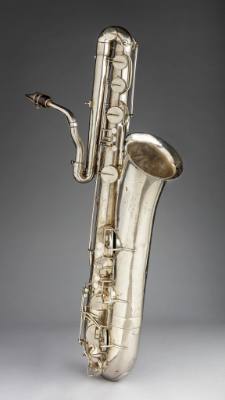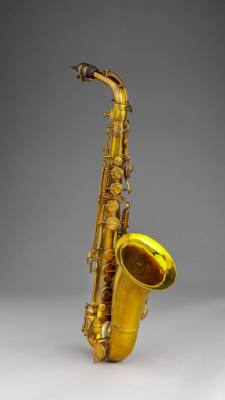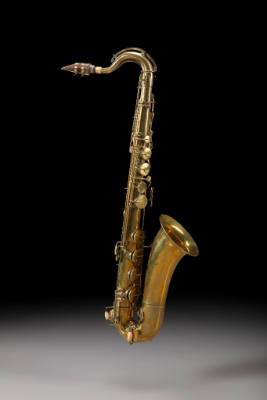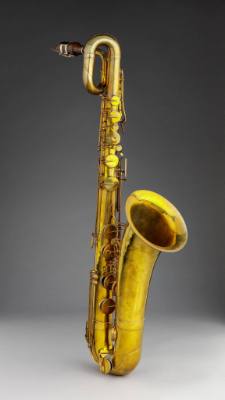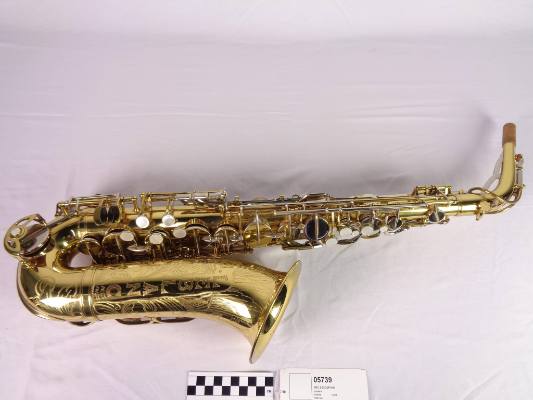
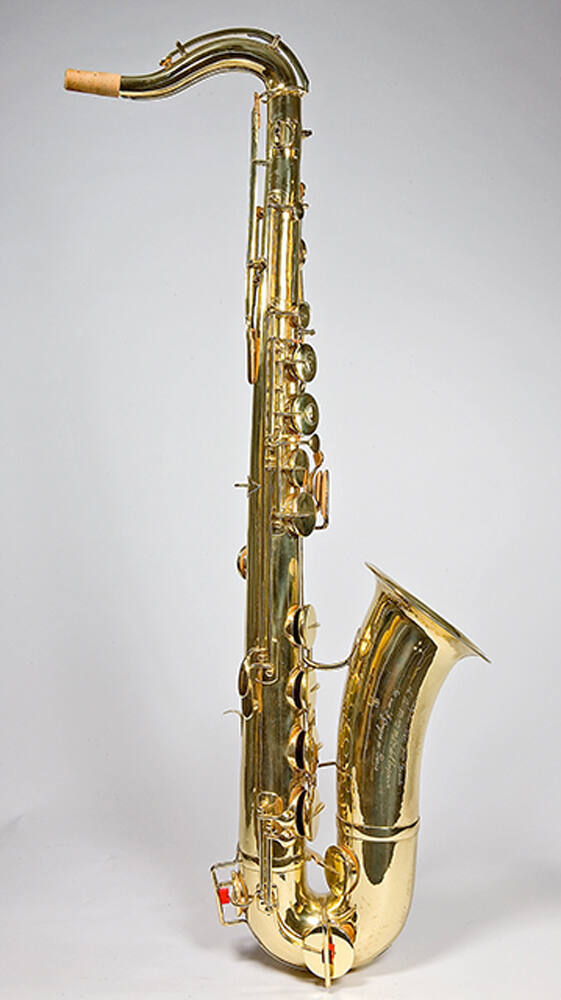

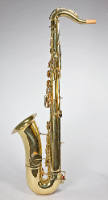
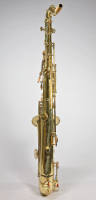

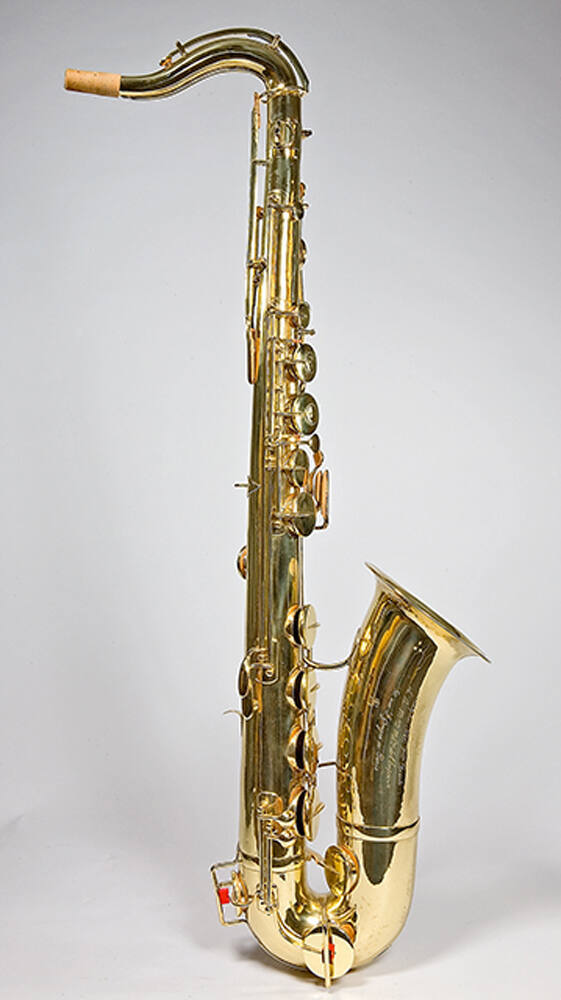
Tenor saxophone, B-flat
Makerby
Adolphe Sax
Date1865-1872
Place MadeParis, France, Europe
Serial No.36458
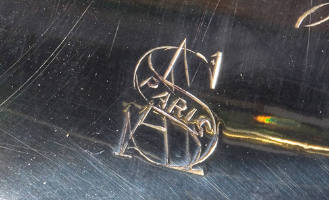
SignedEngraved vertically along right side of bell: No 36458 / Saxophone Tenor en Si / Adolphe Sax Fteur Breveté / de la Mson Milre de l[’]Empereur / 50, rue St Georges
Paris / AS (monogram)Markings[presentation engraving, vertically engraved on right side of bell near bow, below low B tone hole] No 22 / Donné
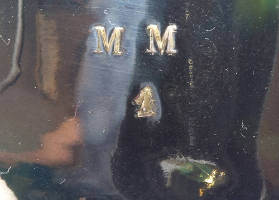
la Société de musique / de Bar-le-Duc, par Mr l’abbé Galle / Curé archiprêtre de Notre Dame / Juillet 1865 [Parisian military band stamp, stamped on bell, to left of signature] MM / 1DescriptionOne-piece body and separate neck. Brass. Restored, polished and lacquered (clear lacquer) by G. Leblanc Corp.. Thin, lightweight body construction, instrument is much lighter than modern instruments. Fingered range from low B-natural to high F. Dual octave keys. Side Bb only – no bis-Bb key or automated 1:1 Bb fingering combination. The Bb key tone hole is inline on the front of the instrument though, rather than along the right side as on Sax’ sopranos and modern instruments. No side C, forked Eb, alternate F# or G# trill keys. Eb/low C keys as well as G#/low C#/low B keys are “button” style and without touchpieces or rollers. Soldered tone holes. Has neck strap holder, probably not original. Thumbrest certainly not original. High E and F tone holes are distinctly smaller than on modern instruments.
Neck: Converted to low pitch by an extension on the lower end of neck.DimensionsOverall length: 797 mm (31 3/8 in)
Bell diameter: 137 mm (5 3/8 in)ProvenancePurchased by Dr. Hewitt A. Waggener, Omaha, from Couesnon & Cie, Paris, France, January 23, 1925. Later transferred to Cecil B. Leeson Collection, Muncie, Indiana. U.S.A. Published References"Four Original Adolph Sax Instruments Given to BSU." The Muncie Star, March 17, 1974.
Malou Haine and Ignace de Keyser. Catalogue des Instruments Sax au Musée Instrumental de Bruxelles. Brussels: Musée Instrumental, 1980. Page 245.
Mark Hulsebos, "Cecil Leeson Legacy is Preserved in Collections and Displays," The Saxophone Symposium 7, No. 4 (Fall 1982), pp. 18-19.
Mark Hulsebos, "Cecil Leeson Legacy is Preserved in Collections and Displays," Indiana Musicator 38, No. 4 (May 1983), pp. 11-12.
Robert S. Howe. “The Invention and Early Development of the Saxophone, 1840-1855.” In Journal of the American Musical Instrument Society. Vol. XXIX. Middleton, Wisconsin: American Musical Instrument Society, Inc., 2003. Page 176.
Phillip T. Young. 4900 Historical Woodwind Instruments. London: Tony Bingham, 1993. Page 204.
Credit LineTransfer from Ball State University, Muncie, Indiana, 1994
Object number05769
On View
Not on view