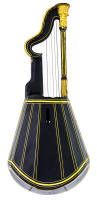
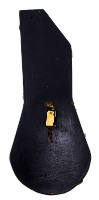
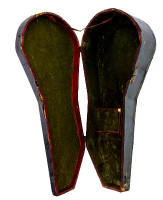
Richardson's improved harp lute
ALTERNATE NAME(S)
- Regency harp lute
- Dital harp
- Guitar
- Harp lute
- Harp lute
Maker
J. S. Richardson
Date1816-1820 ca.
Place MadeEngland, Europe
ModelRichardson's Improved Harp-Lute
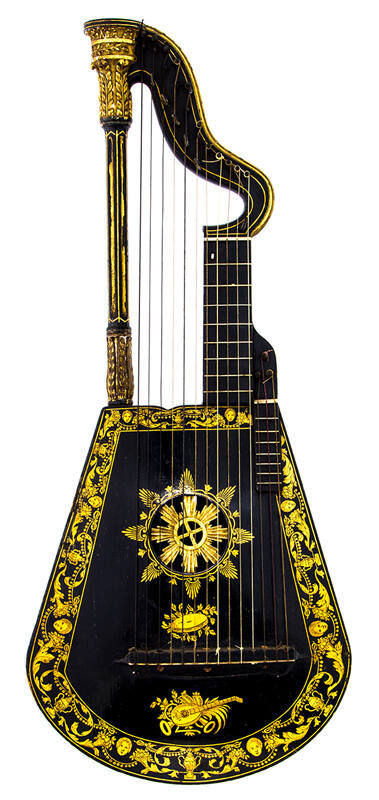
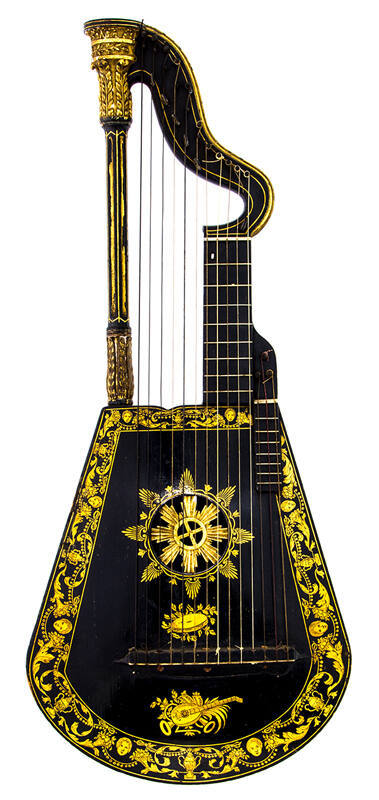
SignedPainted in gold on upper edge of soundbox: Richardsons / ImprovedDescriptionJ. S. Richardson, a musician, composer, music teacher, and inventor working in Bath and London, began advertising his "New Improved Harp Lutes" in 1816. The form of this instrument appears very similar to the regency harp-lute. The regency harp-lute was a form of harp lute with an extra fingerboard at the treble side of the instrument, an invention of Charles Wheatstone in 1816.Stringing: 14 gut strings; 3 strings on top fingerboard; 5 strings on lower fingerboard; 6 unstopped harp strings, the top 5 with gilded-iron ring stops; the center gut string of upper fingerboard is red; the second gut harp string is blue; the bottom three harp strings are iron-overspun gut
Soundboard: one-piece spruce, wide grain
Back and sides: 7 maple staves with one bent stave on bottom; slot-shaped soundhole through upper part of center stave
Neck and head: maple with harp-type pillar with foliate acanthus leaf gilded gesso decoration, Corinthian style
Fingerboards: two black-lacquer dark hardwood with ivory frets; top fingerboard for 3 strings with 7 frets; lower fingerboard for 5 strings with 8 frets; hole for capo on bass side behind 1st fret between fourth and fifth strings; brass single-string capo (still present) is placed in hole behind nut, between first and second strings of lower fingerboard when not in use
Nuts: ivory
Bridge: black lacquered tie bridge with decoratively cut lower edge and bone inset on lower edge of tie; three iron screws through bridge into blocks glued on inside of top
Tuners and levers: gilded iron pins
Rose: gilded over black painted hardwood relief carved rose in sunburst pattern
Finish: black lacquer with gold decorative striping and painted motifs
Linings: none
Neck block: black-painted hardwood
End block: none
Top braces: four transverse braces with tapered ends and triangular top profile, one above soundhole and three below, with bottom brace below bridge; three maple blocks glued to inside of top at bridge position, through which bridge screws pass
Back braces: two lateral braces on center stave, with concave tapered ends and triangular top profileDimensionsTotal regency harp-guitar length: 835 mm
Body length: 420 mm
Upper bout width: 192 mm
Waist width: 278 mm
Lower bout width: 359 mm
Maximum depth: 100 mm
Top fingerboard length: 96 mm
Lower fingerboard length: 177 mm
Neck length (nut to ribs): 177 mm
Neck width, nut: 51 mm
Neck width, heel: 55 mm
Soundhole diameter: 84 mm
Vibrating string length (nut to bridge edge), top fingerboard: 266 mm
Vibrating string length (nut to bridge edge), lower fingerboard: 444 mm
Vibrating string length top harp string: 554 mm
Vibrating string length bottom harp string 650 mmProvenanceArne B. Larson Collection, Vermillion, South Dakota, 1979.Published ReferencesAndré P. Larson, The National Music Museum: A Pictorial Souvenir (Vermillion: National Music Museum, 1988), p. 32.
Credit LineArne B. Larson Collection, 1979
Object number01294
On View
Not on view
1850-1890 ca.