Appalachian dulcimer
ALTERNATE NAME(S)
- Fretted zither
- Mountain dulcimer
Maker
James Edward Thomas
Date1912
Place MadeBath, Kentucky, United States, North America
Modelnone
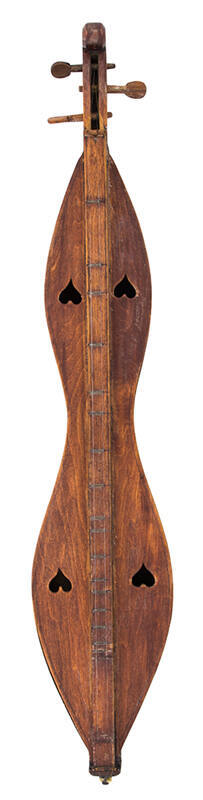
SignedHand-written on paper label glued inside lower right sound hole: Manufactured by / J.E. Thomas July 4 / 1912 Bath KyDescriptionAccording to dulcimer expert, Ralph Lee Smith, James Edward Thomas (1850-1933) "was Kentucky's great pioneer dulcimer maker. In the late 19th and early 20th Centuries, he was largely responsible for introducing the world to this beautiful folk instrument of the Appalachians." Thomas began making dulcimers in 1871. One of his latest known instruments, number 1380, is dated January 26, 1927. Researcher Smith notes that "Thomas' legacy is large and important. The 'Kentucky style' dulcimer pattern, with an hour-glass shaped body and heart-shaped soundholes, became the best-known form of the instrument during the post-World War II folk revival. Nowadays, everywhere in the world, when most people think of dulcimers, they think of the beautiful pattern that Thomas developed long ago in Knott and Letcher Counties [of Kentucky]."Hour-glass shaped
3 strings
Body: top back and sides of slab-cut birch; box body with top and bottom extending slightly beyond sides; sides tucked into slots cut into end blocks; body expands gradually from pegbox to top bouts, narrows to waist, expands to bottom bouts, and narrows to saddle
Pegbox: birch; carved-out, wooden pegbox, closed back; simplified scroll
Nut: possibly chestnut nut set into groove carved on fretboard-side of joint between fretboard and pegbox; three slits cut into nut as string guides
Bridge: possibly chestnut; stationary, wooden bridge set into groove carved on fretboard; multiple grooves cut (and fractured) into bridge
Saddle: steel wire saddle set into edge of wooden fretboard
Fretboard: solid birch fretboard glued to top; depressed portion of fretboard begins after last fret and extends to bridge; fretboard extends to ends of sound box; 17 steel wire frets extend part way across fretboard, leaving the drone string unfretted
Strings: three metal strings; tied around wooden end peg and wrapped at pegs
Pegs: possibly chestnut; three, laterally-inserted, wooden friction pegs - hand-carved, articulated grips
End peg: dark hardwood peg inserted laterally into end block on saddle end
Sound holes: four, hand-carved, heart-shaped sound holes; two at each bout, one on each side of fretboard
Sound posts: two wooden sound posts - one dowel placed near sound holes at both upper and lower bouts
Decoration: incised lines near edge of top and bottom, and on sides of fretboard; distance from fretboard suggests the incised lines were added after completing the construction of the sound boxDimensionsTotal length: 34.125 in (866.8 mm)
Width: 1.25 in (31.8 mm) expanding to 4.75 in (120.7 mm), narrowing to 3.06 in (77.7 mm), expanding to 6.5 in (165.1 mm), narrowing to 1.5 in (38.1 mm)
Total depth: 2.56 in (65 mm)
Body depth: 1.65 in (42 mm)
Vibrating string length: 28 in (712 mm)ProvenanceArne B. Larson Collection, Vermillion, South Dakota, 1979.Published ReferencesSmith, L. Allen. _A Catalogue of Pre-Revival Appalachian Dulcimers_. Columbia, Missouri: University of Missouri, 1983: 83.
Credit LineArne B. Larson Collection, 1979
Object number01122
On View
Not on view
1880 ca.

1800-1850 ca.