


Rubab
ALTERNATE NAME(S)
- Short-neck lute
- Robab
- Rabab
Date1875-1925 ca.
Place MadeAfghanistan, Asia
Serial No.none
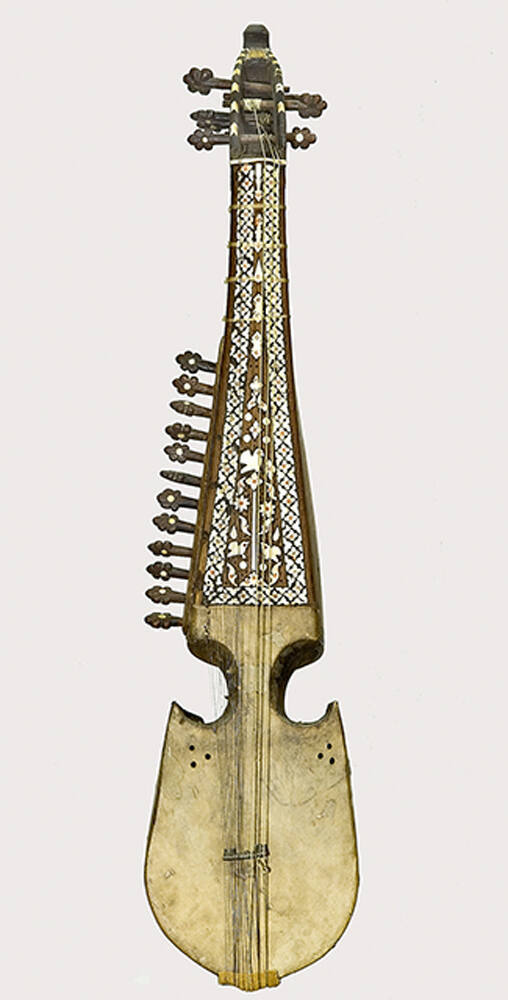
SignedNoneDescriptionCarved wood body, the lower portion covered with goatskin.5 playing strings, 12 sympathetic strings, 2 drone strings
Inlaid with bone and horn, the design on the fingerboard incorporating birds and flowers.
Body and neck carved from one piece of mulberry. The upper portion of top and fingerboard a separate piece of mulberry pierced with numerous small drilled holes. The lower portion is covered in goatskin with three pierced holes at each lower corner. The fingerboard and wood section of top are extensively inlaid in bone and horn floral and fauna motifs with some chevron patterns. Dots and circles engraved in surface of some bone inlay and filled with red pigment. Back of body decoratively carved and inlaid with a strip of bone and horn chevron inlay.
Head is decoratively carved and a separate piece of mulberry from the neck. Front of head has a decoratively carved bone plaque and upper sides of pegbox are inlaid with bone and horn in a chevron pattern.
Pegs are made from mulberry with heads carved in shape of abstract flowers with bone eye. 7 pegs in main pegbox and 12 pegs on body set into a separate piece of mulberry glued to body. The 7 plucked strings are a mix of gut (melody) and steel (drone), and the 12 sympathetic strings are steel.
The nut is bone and the bridge is horn, with holes drilled in its face, through which the sympathetic strings pass.
Strings pass over thick piece of tanned leather on lower edge of body and are affixed to two bone dowels in lower part of body. DimensionsTotal rubab length: 827 mm
Total neck and body length: 678 mm
Maximum body width: 172 mm
Maximum body depth: 208 mm
Plucked vibrating string length: 563-565 mmProvenancePreviously owned by William E. Gribbon, Greenfield, Massachusetts, who purchased it at Sotheby’s, London, 25 November 1976, lot 76. Sold by Gribbon to the NMM, 1977.Published ReferencesThomas E. Cross, Instruments of Burma, India, Nepal, Thailand, and Tibet, Shrine to Music Catalog Vol. II (1982), p. 17.
Thomas E. Cross, Instruments of Burma, India, Nepal, Thailand, and Tibet in the Collections of the Shrine to Music Museum, MM Thesis, University of South Dakota, 1983, p. 36, plate XIV.
Credit LineRingley Fund, 1977
Object number01502
On View
Not on view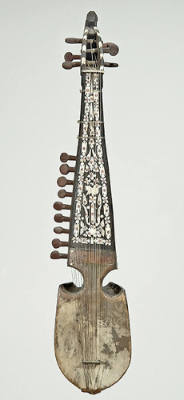
1875-1925 ca.

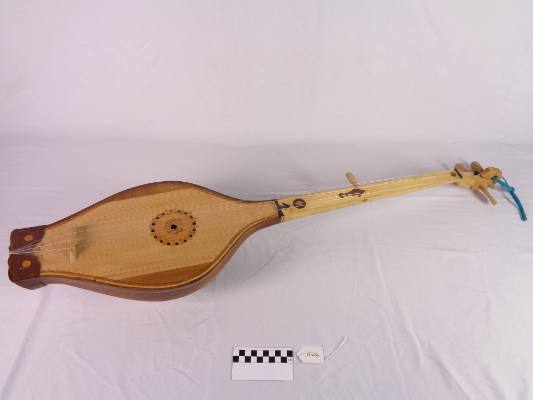
1997
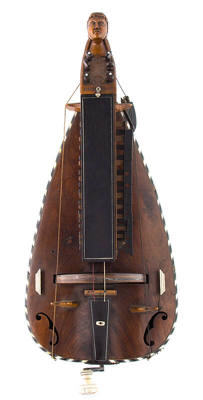
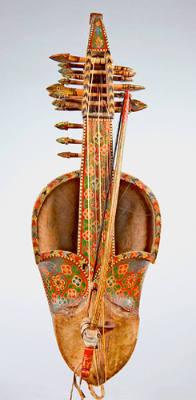
1880-1900 ca.
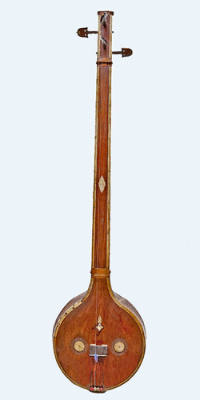
1900-1925 ca.