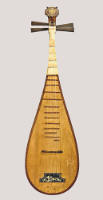
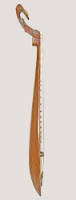
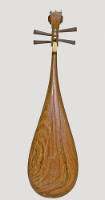
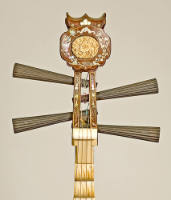
P’i p’a
ALTERNATE NAME(S)
- Short-neck lute
- Pipa
Date1850-1875 ca.
Place MadeChina, Asia
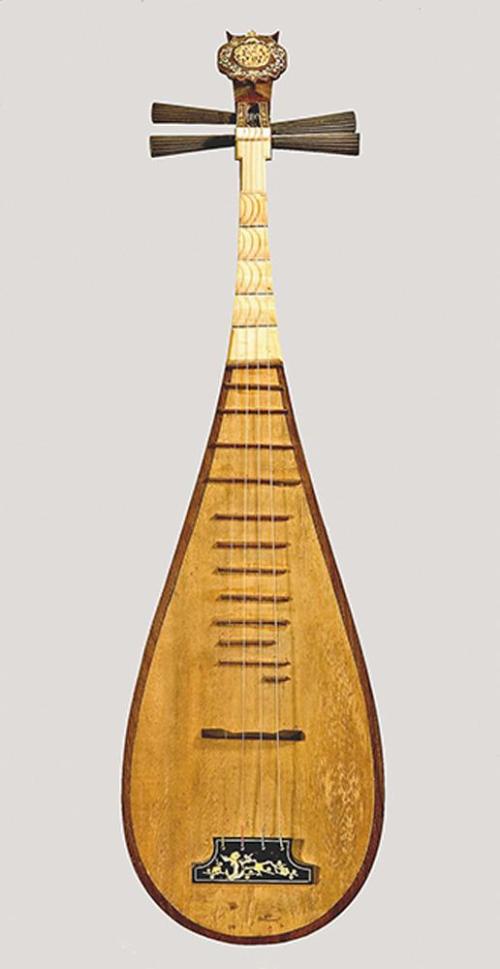
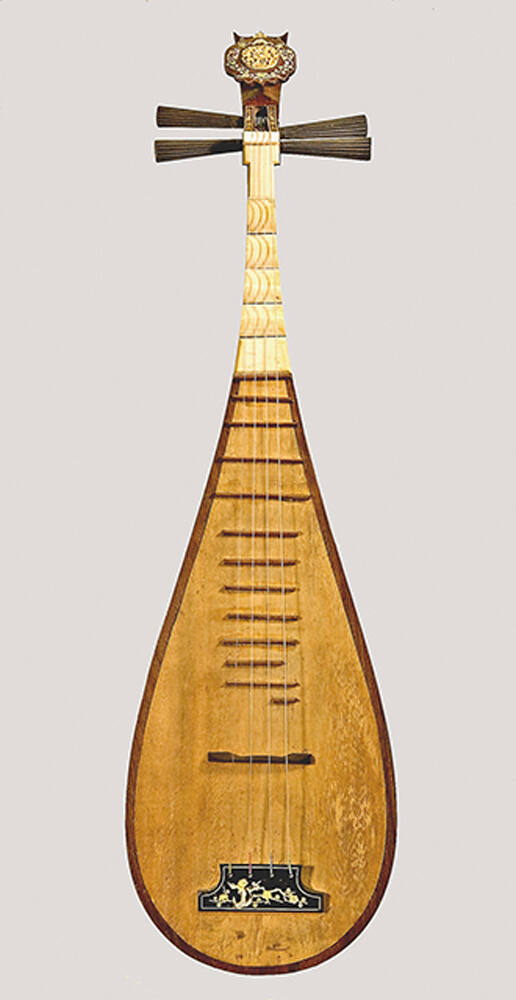
SignedNoneDescriptionShort-necked lute. Four strings. Four convex frets at upper end of fingerboard. Wooden body with ivory and mother-of-pearl ornamentation. Name literally translates "to play forward" and "to play backward." The earliest documented method for playing the p’i p’a, found in Liu Xi’s Shih Ming (Explanation of Names), dates from the Late Han Dynasty (206-220 AD). The p’i p’a name, originally referring to a variety of long- and short-necked, plucked lutes common to cultures along the Silk Road, developed into its classic form around 350 AD. Chinese folk tradition often presents the p’i p’a as an improvised instrument, created at a time of need to express the emotion of its country’s people. This is reflected in traditional p’i p’a music, which conveys epic stories through the musician’s playing technique. Experienced listeners recognize phrases conjuring images of trickling waterfalls, explosive battles, and the sound of the wind. Played vertically with finger picks or the fingernails.Four silk strings
Soundboard: one-piece slab-cut pawlonia (wutong)
Back, sides, and neck: carved from one piece of rosewood
Head: lower part integral with neck, upper part a separate piece of same type of wood; head in shape of abstract bat; front of head inlaid in chrysanthemum motif mother-of-pearl with flying bat at top with bone or ivory stringing around edges; front edges of pegbox inlaid with mother-of-pearl gourd motif with two flying insects with bone or ivory stringing around edges; center face of head inset with relief-carved bone plaque with floral motif
Pegs: four ebony in conical shape with reeded surfaces
Nut: bone
Fingerboard: four rounded ivory of separate pieces; 13 bamboo frets glued to soundboard
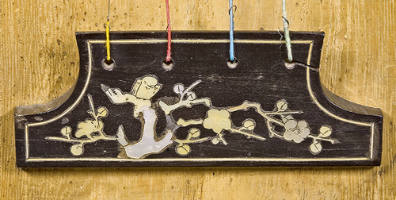
Bridge / string holder: ebony, inlaid on face with floral motif mother-of-pearl including a bird perched on a branch with bone or ivory stringing around edges
Bridge: ebonyDimensionsTotal p'i p'a length: 965 mm
Maximum body width: 260 mm
Maximum body depth: 37 mm
Vibrating string length: 590 mmProvenancePurchased from H. M. Lissauer, Melbourne, Australia, 1978.Published References“Chinese Instruments Shown in Sioux Falls,” The National Music Museum Newsletter 34, No. 1 (February 2007), p. 7.
Credit LineGrace L. Beede Fund, 1978
Object number02401
On View
Not on view
1880-1900 ca.