
Cornet, E-flat, [C], B-flat, [A], high pitch, low pitch
Maker
C. G. Conn & Dupont
Date1876-1877 ca.
Place MadeElkhart, Indiana, United States, North America
ModelFour-in-One
Serial No.162
SignedEngraved on bell: MADE BY / Conn and Dupont / ELKHART / INDEngraved on bell above maker's inscription: Presented to / Mr. B. J. Sutton / Leader of the / Dexter Cornet Band / by his friends / Dexter / Aug. 29th 1877
MarkingsStamped on valve casings respectively: 1 2 3
Stamped on second valve casing: 162
Valve slides marked with three scribe lines each to indicate how far the slides have to be pulled out for the keys of C, B-flat and A, respectively. Only at the second valve slide these scribe lines are numbered "1" (for C), "2" (for B-flat), and "3" (for A).DescriptionSilver-plated brass, burnished, valve caps, finger buttons, and water key on instrument gold-plated, bell decorated with stippled floral engravings
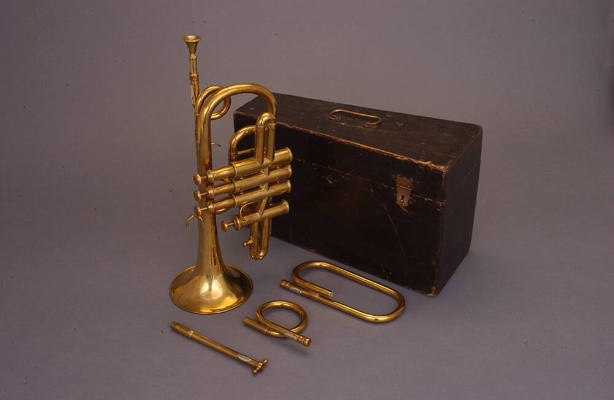
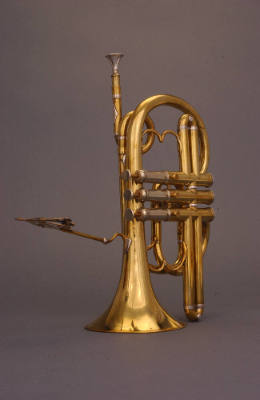
Single loop; leadpipe with ligature screw, serving as main tuning slide receiver for crooks; leadpipe enters third valve on right, continues to first valve on right via bridging tube with water key, knuckled out porting between first and second valve, main tubing exits second valve on left into bell bow
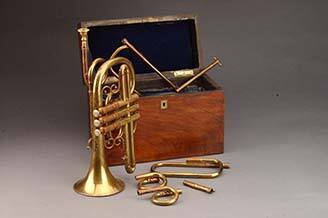
B-flat crook (requiring shank or bit for mouthpiece)
Two shanks, the longer one with almost cylindrical end
C crook missing
A crook or shank missing
Three top-sprung Périnet valves with spring outside stem; alignment by one key on piston; each with four passages to engage or disengage the "compensating bends" on the left side of the valve cases.
The four-in-one cornet, designed by C. G. Conn and Eugène Dupont, was patented (after this cornet was made) on January 22, 1878 (US patent # 199,516). It was intended to provide all common cornet keys (E-flat, C, B-flat, and A) in one instrument. The various keys are gained in the traditional way with removable shanks and crooks; the basic instrument is designed in the key of 3¼-foot E-flat. In the patent each key was gained by employing a crook of varying length, while surviving instruments suggest that a combination of shanks and crooks was used and some shanks were inserted directly into the leadpipe receiver. The B-flat crook of this particular cornet requires a shank to be functional and works with the shorter of the two shanks. The longer shank with almost cylindrical end is intended to be inserted directly into the leadpipe for the key of E-flat.
The most striking design feature of the four-in-one is that each valve casing has so-called "compensating bends" on the left side which are engaged only when the valves are not in use. The respective length is added to each valve slide and when any piston is depressed, the extra tubing is cut out. Conn and Dupont claimed that this design added the exact right valve slide length for each of the four keys by pulling out the valve slides according to the marks.
This is a presentation cornet and is engraved: Presented to / Mr. B. J. Sutton / Leader of the / Dexter Cornet Band / by his friends / Dexter / Aug. 29th, 1877. The mouthpiece with this cornet represents Conn's first musical product, the elastic-faced or rubber-rimmed mouthpiece, which the Colonel designed and began manufacturing in his shop at 22 Jackson Street, on the second floor above Kibbe's Drug Store, no later than October 1874. The merits of this invention were explained in his first patent: “Where the mouth-piece comes in contact with the lips it is soft, and hence does not destroy their sensibility by rendering them puffy, as does the metal mouth-piece; consequently it is never liable to produce a fuzzy tone.” A second patent (#190,558), for an improved rubber-rimmed mouthpiece model, was granted on May 8, 1877.
DimensionsHeight instrument: 319 mm
Initial internal diameter receiver instrument: 11.6 mm
Initial internal diameter B-flat crook: 11.5 mm
Initial internal diameter shanks: 9.6 mm (shorter shank), 9.4 mm (longer shank)
Bore diameter (internal diameter inner slides second valve): 11.84-11.71 mm (slightly tapering)
Bell diameter: 114 mm or 4.5 inches
ProvenanceUsed by the donor, Harold P. Sutton's father, B. J. Sutton, a bandleader in McCook, Nebraska, 1910.Published ReferencesMargaret Downie Banks and James W. Jordon, “C. G. Conn: The Man (1844-1931) & His Company (1874-1915),” Journal of the American Musical Instrument Society, Vol. XIV, 1988, pp. 65-67 (mouthpiece), pp. 66-67 (photos), p. 70-71 (photo).
Marshall L. Scott, The American Piston Valved Cornets and Trumpets of The Shrine to Music Museum, D.M.A. Thesis, University of Wisconsin, 1988, p. 109-110.
Margaret Banks, Elkhart’s Brass Roots (Vermillion, South Dakota: Shrine to Music Museum, 1994) p. 15.
Credit LineGift of Harold P. Sutton, 1975
Object number01196
On View
Not on view![Cornet, [E-flat, C, B-flat], A, high pitch, [low pitch]](/internal/media/dispatcher/41872/thumbnail)

Adolphe Sax & Cie
1846-1854 ca.