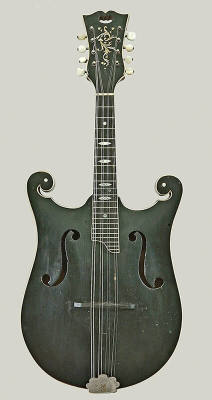
Neapolitan mandolin
Maker
John Brandt
Distributor
William Lewis & Son
Date1899-1905 ca.
Place MadeChicago, Illinois, United States, North America
ModelStyle A
Serial No.8062
SignedPrinted on paper label with single line border, the text enclosed in three decorative circles: Left circle: JNO. BRANDT. / MAKER / CHICAGO, ILL.
Middle circle: PAT.OCT.1899 / BRANDT / WARRANTED.
Right circle: WM. LEWIS. / SOLE / AGENT / CHICAGO, ILL.
Paper label with single line border on neck block, the style written in black ink, the serial number rubber-stamped in black ink: Style A / No. 8062MarkingsStamped on tuner plate near nut: [lettering curved downward at each end] J.BRANDT / PAT.AUG.23.98
Stamped on lower end of tailpiece cover: PAT.MAY 15-94DescriptionThe patent held by John Brandt for the head and tuners is U.S. Pat. No. 609,531, filed, Jan. 19, 1898 and awarded on Aug. 23, 1898. The label refers to Brandt’s second mandolin patent, U. S. Pat. No. 634,103, applied for on Apr. 19, 1899 and awarded on Oct. 3, 1899. This patent is for a bracing system incorporating spring steel. In spite of the reference on the label, this technology is not found on NMM 14927. Note that Brandt’s fourth mandolin patent, U. S. Pat. No. 798,869, applied for on Feb. 20, 1905 and awarded on Sept. 5, 1905, shows an alternative body design but the same scroll head and pegbox as his earliest patent. The 1905 patent is assigned to Lyon & Healy, who popularized the scroll headstock on their own mandolins. Given that William Lewis is listed as sole agent on NMM 147927’s label, it is safe to assume that the 1905 patent assignment to L & H is the terminus ante quem for the construction of NMM 14927.
Soundboard: two-piece spruce: fine grain broadening to very wide at the edges
Bowl: 21 rosewood staves, inner 19 ribs narrower, divided by maple stringing
Clasp: rosewood; festooned lower end
Head and neck: maple with faint narrow curl; violin-style scroll and pegbox
Binding: rosewood; trim on top comprised of eight-ply light and black hardwood
Fingerboard: ebony; 18 nickel-silver bar frets; bone side dots behind 3rd,5th, 7th, 10th, and 12th frets
Nut: bone
Bridge: ebony with inset bone saddle; six individual feet
Tuners: single enclosed nickel-plated brass worm gear tuner set with ivoroid heads; 1898 John Brandt patent design
Tailpiece: nickel-plated brass
Rosette: elliptical; comprised of fourteen-ply light and black hardwood with rosewood binding on inside of soundhole edge
Pick guard: imitation tortoiseshell-celluloid with festooned lower edge
Lacquer: slightly yellowed with craquelure
Bowl lining: black cloth
Neck block: covered in light brown paper
Top braces: spruce brace with tapered ends above soundhole; spruce braces with tapered ends below soundhole and at widest point of body; black cloth along center joint below lowest brace
Linings: noneDimensionsTotal Neapolitian mandolin length: 607 mm (23-29/32”)
Top length: 316 mm (12-7/16”)
Maximum body width: 195 mm (7-11/16”)
Maximum bowl height: 130 mm (5-1/8”)
Head length: 138 mm (5-7/16”)
Head width, top: 37 mm (1/15/32”)
Head width, bottom: 28 mm (1-3/32”)
Neck length (nut to ribs): 149 mm (5-5/8”)
Neck width, nut: 26 mm (1-1/32”)
Neck width, heel: 36 mm (1-13/32”)
Soundhole height: 46 mm (1-13/16”)
Soundhole width: 71 mm (2-13/16”)
Vibrating string length (nut to bridge edge): 342 mm (13-15/32”)
Scale length: 327 mm (12-7/8")ProvenanceNo known provenance
Credit LineGift of Gail Kursel, 2014
Object number14927
On View
Not on view