

Guitar
Maker
Ernst Scheibe
Date1913
Place MadeHannover, Germany, Europe
Serial No.1850
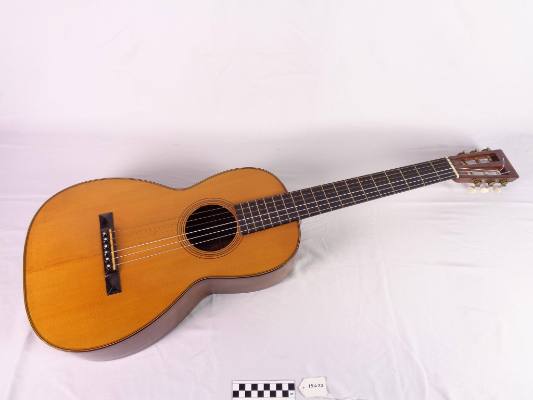
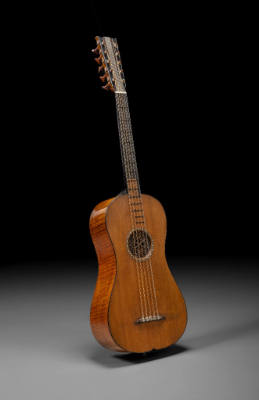
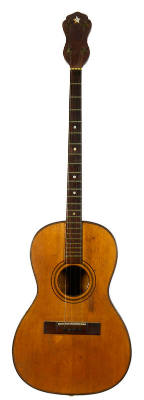
SignedPrinted in Fraktur on paper label with double line border, the serial number and year written in black ink: ERNST SCHIEBE / Geigen und Lauten=bau / 1850 HANNOVER 8./1913DescriptionThe maker of this guitar, Ernst Scheibe of Hanover, Germany, was predominantly a violin maker. This unusual guitar has angled, compensated nut, frets, and bridge saddle, but the scale lengths of the different sections are similar, so that this was probably an attempt at an ergonomic design for the left hand. The guitar also has a secondary soundboard on the interior, found on some other German guitars of the period. Stringing: six gut strings
Soundboard: two-piece spruce: narrow grain with knots in each upper bout; ebony trefoil inlay surrounded by purfling strip on each side below bridge; second soundboard inside instrument below first, affixed only at neck and end blocks
Back: one-piece slab-cut maple: narrow curl
Sides: two-piece quarter-cut maple: narrow curl angled to left on bass side, to right on treble side; lower ribs divided by ebony graft surrounded on each side by dark-light-dark hardwood strip trim
Head: mahogany slot head
Neck: mahogany; heel is separate piece and low
Heel cap: none; heel set in from back
Binding: none; two strips of purfling with space in between inlaid in top and back
Fingerboard: two-piece ebony, divided along center; 17 wide, angled nickel-silver T-frets, of different scales on each side; ivory dots behind 5th, 7th, 9th, and 12th frets
Nut: ebony; compensated
Bridge: ebony with trefoil ends and lower decorative element, the lower element also inlaid with bone; bone to-part compensated saddle; bone pin with green abalone eye
Tuners: two sets of worm gear tuners with bone rollers, decoratively rolled nickel-silver plates, and ivory heads
Endpin: ebony
Rosette: single strip of purfling set in from edge
Varnish: medium orange-brown
Linings: spruce; wide
Neck block: spruce with rounded corners
End block: spruce with rounded corners
Top braces: three spruce ladder braces with tapered ends set into linings, one each above and below soundhole and in lower bout; secondary top inside instrument has single spruce tapered brace in lower bout; spruce piece glued to secondary top screwed to neck block with two domed slot-headed screws; spruce piece glued to secondary top glued to end block; secondary top is otherwise floating around circumference
Back braces: two spruce ladder braces with tapered ends set into linings, one each in upper and lower boutsDimensionsTotal guitar length: 956 mm
Back length: 468 mm
Upper bout width: 280 mm
Waist width: 119 mm
Lower bout width: 358 mm
Rib height (including edging) at heel: 78 mm
Rib height, at waist: 91 mm
Rib height, at end block: 82 mm
Head length: 159 mm
Head width, top: 69 mm
Head width, bottom: 45 mm
Neck length (nut to ribs): 312 mm (treble side); 314 mm (bass side)
Neck width, nut: 48 mm
Neck width, heel: 57 mm
Soundhole diameter: 80 mm
Vibrating string length (nut to bridge edge): high E: 624 mm; G: 623 mm; D: 624 mm; low E: 625 mm
Scale length: high E: 626mm; G: 628 mm; D: 626 mm; low E: 628 mmProvenanceNo known provenance.
Credit LineGift of Michael E. Whitmore, 2015
Object number15012
On View
Not on view
1920-1930 ca.