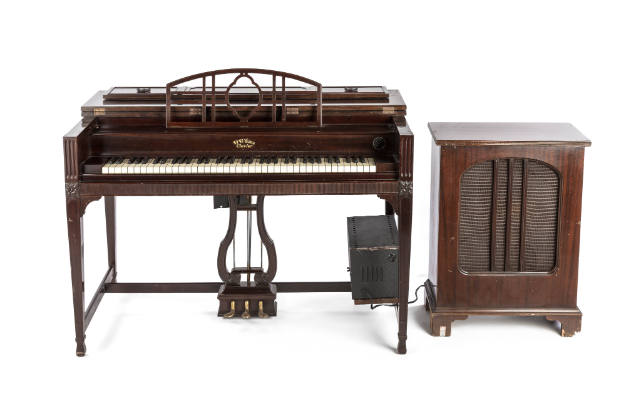
Polymoog keyboard
ALTERNATE NAME(S)
- Polymoog synthesizer
- Polymoog analog synthesizer
Maker
Moog Music Inc.
Date1977 ca.
Place MadeBuffalo, New York, United States, North America
Model203A
Serial No.3478
SignedIn raised lettering on front of instrument, colored in silver paint: Polymoog keyboard / [moog logo] / TMSilver and black sticker on back of instrument: [moog logo] / TM
Silver and black sticker on back of instrument: MODEL 203A / SERIAL 3478 / 115 / 230 VAC-50 / 60 Hz-60W / [moog logo] TM / MOOG MUSIC INC. / BUFFALO, N.Y. / MADE IN USAMarkingsSilver and black sticker on back of instrument: [oblit.]PRODUCT IS MANUFACTURED / [oblit.] ONE OR MORE OF THE / FOLLOWING U.S. PATENTS: 3,475,623 / 3,733,955 3,[oblit.] OTHER PATENTS / PENDING. PN 96-725-1
Silver sticker on back of instrument with black lettering, black single-line border: CAUTION- TO PREVENT ELECTRICAL SHOCK, / DO NOT REMOVE CHASSIS. NO USER SER- / VICEABLE PARTS INSIDE. REFER SERVICING / TO QUALIFIED SERVICE PERSONNEL. DescriptionThe Polymoog is a polyphonic analog synthesizer that was manufactured by Moog Music Inc. from 1975 to 1980. The Polymoog was based on fixed-frequency divide-down oscillator technology similar to electronic organs and the Hammond Novachord but with additional voltage-controlled modules that expanded its controllability to rival the capabilities of synthesizers with voltage-controlled tone generators.
It features a three-section weighted keyboard with individual section volume, universal oscillator waveform controls, a three-band graphic equalizer with three filter types with an integrated envelope, LFO, and sample/hold circuit. The Polymoog featured 8 preset voices, each with a variation mode and full real-time control, and control voltage connections for an optional Polypedal unit that offered pedal-based control of the VCF and VCA.
The Polymoog model 203A hit retail in 1975, and despite its ingenuity, was initially a failure. The extremely expensive and innovative integrated circuits used in its polyphonic architecture had a horrendous failure rate. Luce’s design was too ambitious for its time. However, its flexibility and previously unknown features such as preset recall with variation, unlimited polyphony, and fully expressive weighted keyboard control (with a dedicated chip deciphering each key’s input) made the Polymoog a huge hit with musicians. Manufacturing problems were corrected as they became obvious and reliability was no worse than any other complicated electronic device of the time once production had hit full swing in 1976.
This instrument belonged to Sharon Gray of Vermillion, who wrote the following about her reasons for choosing the Polymoog and her musical journey with it:
"in a nutshell, I began playing piano when I was 3 and began writing music when I was 6. When I was a senior in high school, the PolyMoog hit the market. Up to that time, synthesizers were monophonic, meaning you could only play one note at a time. So, I took out a "car" loan to purchase what was at that time the only polyphonic synthesizer. Plus, the PolyMoog had 71 keys rather than the typical one or two octaves. I was an avid fan of Yes and Rick Wakeman (who, himself, owned a PolyMoog) and I hoped to create space music. During the late 80s, I made it on to Jerry Cooley's New Age Collage (which aired on SDPB the hour before Hearts of Space), but kids and my day-job ended up taking precedence over trying to strike it big in space music. ;-)”
Case: Black molded plastic with leather texture, woodgrain and aluminum trim
Compass: 71 notes; 5-9/10 octaves, E to d4
Modules, part 1 from left:
FINE TUNE BEAT: knob from -2 to +2
EXT KB GLIDE: slider from 0 to 10
MASTER GAIN CONTROLS: sliders from 0 to 10:
AUX, DIRECT, MODE, RES, VCF
OCTAVE BAL: sliders from 0 to 10
1-2, 3-4, 5-6
Buttons below previous group of modules, from left to right:
LOWER KEYBOARD WAVESHAPE: [sawtooth illustration], [square wave illustration] [sawtooth and square wave illustration]
UPPER KEYBOARD WAVESHAPE:
LOWER KEYBOARD WAVESHAPE: [sawtooth illustration], [square wave illustration] [sawtooth and square wave illustration]
FOOTAGE:
[sawtooth illustration] RANK 8' and 4'
[square wave illustration] RANK 16' and 8'
Module Part 2 from left:
[sawtooth illustration] RANK TUNE: sider from -6 to +6
Buttons below previous:
VAR, PRE
Modules Part 3, from left:
[sawtooth illustration] FM: RATE slider and AMT slider from .05 Hz to 10 HZ
[square wave illustration] FM / PM: RATE slider and AMT slider from .05 Hz to 10 HZ
Buttons below previous:
VAR, PRE, FREE, LOCK
Modules Part 4, from left:
[square wave illustration] SHAPE / MOD:
SHAPE LOWER KEYBOARD slider from 5% to 50%
AMT LOWER KEYBOARD slider from 0 to 10
SHAPE UPPER KEYBOARD slider from 5% to 50%
AMT UPPER KEYBOARD slider from 0 to 10
RATE UPPER KEYBOARD slider from 5 to 25 HZ
Buttons below previous:
VAR, PRE
Modules Part 5, from left
[sawtooth illustration] RANK MIX: UPPER KEYBOARD and LOWER KEYBOARD sliders from 0 to 10
Buttons below previous:
VAR, PRE
Modules Part 6 from left:
Polymoog Keyboard
10 buttons:
1 STRING, 2 PIANO, 3 ORGAN, 3 HARPSI, 5 FUNK, 6 CLAV, 7 VIBES, 8 BRASS, 9 VAR, . PART / FULL
Touchbar below previous: PITCH CONTROLLER
Modules Part 7 from left:
LOUDNESS CONTOUR: sliders below from 0 to 10
KB DYN LOWER KEYBOARD
ATTACK LOWER KEYBOARD
D/R LOWER KEYBOARD
D/R UPPER KEYBOARD
SUSTAIN UPPER KEYBOARD
Buttons below previous:
VAR, PRE
FINAL DECAY: LOCK, MAN
Modules Part 8 from left:
RESONATORS:
PASS MODE 3-way switch: HIGH, BAND, LOW
LOW:
sliders: CF: 60 to 300 Hz; EMF: .5 to 10; GAIN
MED:
sliders: CF: 300 Hz to 1.5 KHz; EMF: .5 to 10; GAIN
HIGH:
sliders: CF: 1.5 to 7.5 KHz; EMF: .5 to 10; GAIN
Buttons below previous:
KEYBOARD: LOWER, UPPER, ALL
ON, OFF
Modules 9 from left:
VOLTAGE CONTROLLED FILTER
sliders from 0 to 10: CUTOFF, EMPH, KB
MODULATION, sliders from 1 to 40: RATE, AMT, S & H
CONTOUR:
AMT, slider from 0 to 10
ATTACK, slider from .01 to 10 SEC
DECAY, slider from .01 to 10 SEC
SUSTAIN, slider from 0 to 10
Buttons below previous:
ON, OFF
VAR PRE
KEYBOARD:
LOWER, UPPER, ALL, SPLIT
Cables in and out on back:
S-TRIG OUT
KB OUT [next to knob marked KB OUT SCALE]
MOD AMT
EXT SYN ON / OFF
TRIG MODE ON / OFF
S-TRIG IN
SWELL
FILTER
PITCH
SUSTAIN ON / OFF
GLIDE ON / OFF
OUTPUTS:
BAL MIX
MIX
MODE
VCF
DIRECT
RES
INPUTS:
AUX
VCF
RES
Two plugs:
DC ACCESSORY POWER +5, +_ 15VOC, 50MA PER SOCKET
On right: power cord in
[power] LINE SELECTOR [set at 115]
ON toggle switchDimensionsWidth: 1130 mm
Depth: 557 mm
Height: 134 mmProvenancePurchased new by donor, who noted: "When I was a senior in high school, the PolyMoog hit the market. Up to that time, synthesizers were monophonic, meaning you could only play one note at a time. So, I took out a "car" loan to purchase what was at that time the only polyphonic synthesizer."
Credit LineGift of Sharon Gray, 2021
Object number15181
On View
Not on view