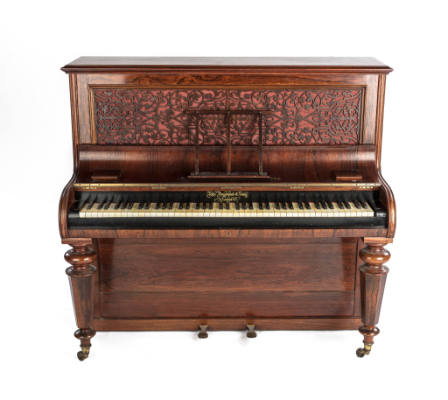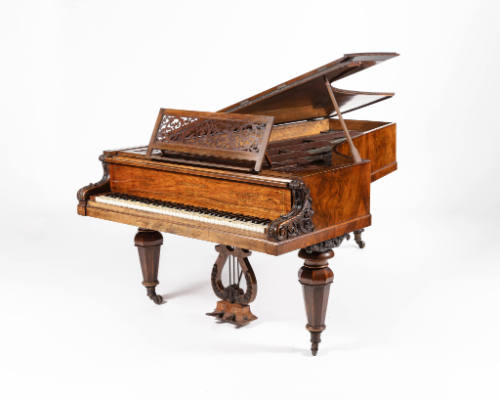
Upright piano
Maker
Erard
Date1851-1852 ca.
Place MadeLondon, England, Europe
Model1851 London Exposition model
Serial No.2812
SignedGold decal enclosed in oval border on fallboard: GREAT EXHIBITION 1851. / the only / COUNCIL MEDAL / For Pianofortes, / TO ERARD, OF LONDONBranded on pinblock veneer, in reverse color: ERARD's / PATENTMarkingsStamped on pinblock veneer: 243
Stamped on pinblock veneer: 2812
Note names and wire gauges are branded on pinblock veneer
Hammer butts are stamped with consecutive numbers
Partially removed sticker on isnide of lid recording tunings on 12/10/1984, 1/31/1985, and 8/21/1985DescriptionThis Erard upright piano bears fallboard text celebrating the London branch of the firm's award in the 1851 London Great Exhibition. The firm's upright piano model received special recognition in Newton's London Journal of Arts and Sciences, 1851. A similar model of upright had already been made by the firm's Paris branch in the 1840s, but it is possible that the Exposition marked the introduction of the model to the London branch. Important technical innovations included the introduction of trichord stringing in the treble, an iron hitchpin plate, and a tape check action of the type that is still used in modern pianos. Thus this model introduced three critical features that became standard in the upright piano.
Compass: CC-a4 (6-10/12 octaves) 82 notes
Two pedals: left: moderator; right: damper
Construction:
Case veneered in rosewood
Iron 3/4th plate
There are two square bridges: 19-note bass bridge CC-F-sharp; treble f-a4
The square tuning pins are pierced.
Soundboard grain mostly horizontal, angled slightly higher on treble side. Soundboard is completely cut away in bass, such that one can see through the piano. The cutaway is trimmed with birds-eye maple
Seven diagonal beams all three-ply with pine in center and smaller oak beams on outsides, except most treble beam with is two pieces of oak
Ribs intersperse beams
The upper front panel frames are ornamental fretwork originally with cloth backing, now missing.
Back originally covered in dark green, glossy cloth
Lower panel now missing fretwork
The legs are hexagonal and turned at the top and bottom.
Folding rosewood music desk
Action:
Tape-check action
The hammers shanks are round and are made of cedar
The hammer moldings are of light hardwood and are covered with three layers of leather and one thick layer of felt from CC-a2, two layers of leather and one layer of felt from b-flat2-b3, and one layer leather and one layer of felt from c4-a4.
Keyboard:
Ivory naturals with no fronts
Ebony sharps
Stringing and scaling:
Straight strung
CC-EE: Single strung
FF-F-sharp: Double strung
G-a4: Triple strung
All strings have individual loopsDimensionsHeight from floor: 1138 mm (44-3/4")
Height from bottom of case: 1107 mm
Width: 1498 mm
Depth: 580 mm
Three-octave measure: 496 mm
Sharps: 95 mm long and 12 mm wide
Heads 45 mm long and 23 mm wideProvenanceNo known provenance.Published ReferencesSheets, Arian. "Creating a Modern American Piano: Antecedents, Launch, and Reinvention of Mason & Hamlin's Piano Line Through 1905." M.M. thesis, University of South Dakota, 2026: 24.
Credit LineGift of Tony Nuspl, 2025
Object number15904
On View
Not on view