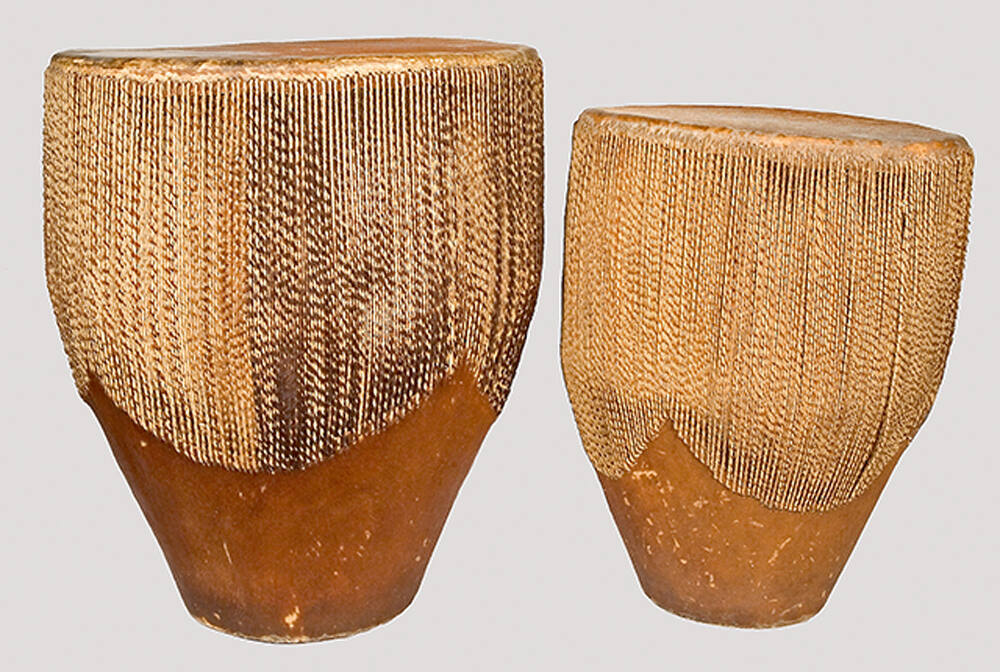

Entenga drum
Date1910 ca.
Place MadeUganda, Africa
SignedNoneDescriptionConical drum with stretched cowhide head, made as part of a set of tuned drums, like those traditionally played in the royal court of Buganda, present day Uganda.The Museum’s entenga drums are from about 1910, a time when representatives from American and European natural history museums raced around the world collecting belongings from “primitive” (non-white) cultures. One of those collectors was Carl E. Akeley, (1864-1926) hailed in his lifetime as the “father of modern taxidermy.” Akeley specialized in hunting and mounting animals, and then displaying them in detailed dioramas. He got the drums on one of his five expeditions to Africa, demonstrating the prevalent racist view that animal specimens and cultural belongings were somehow equivalent.DimensionsHead diameter: 23 in
Height: 27.5 inProvenanceIn 1966, from the estate of Mary L. Jobe Akeley (1878-1966), Carl E. Akeley's widow, passed to their niece, Marian A. (Akeley) Miller and her husband, Melville H. Miller. This was the daughter and son-in-law of Carl's elder brother, Lewis Ellsworth Akeley.Published References"Collected by Carl Akeley . . . Rare African Drums Acquired," Shrine to Music Museum, Inc. Newsletter 10, No. 4 (July 1983), pp. 1 and 3.
AMIS Newsletter, February 1986, p. 15.
André P. Larson, The National Music Museum: A Pictorial Souvenir (Vermillion: National Music Museum, 1988), pp. 15 and 31.
Credit LineGift of Melville H. Miller, 1983
Object number03179
On View
On view
1910 ca.
1630-1680 ca.
1875-1900 ca.