


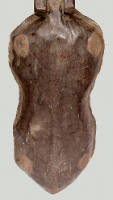


Domu
Vernacular Name
- Domo
ALTERNATE NAME(S)
- Arched harp
- Nadomo
Maker
Mangbetu people
Date1910-1920 ca.
Place MadeUele river region, Democratic Republic of Congo (Belgian Congo), Africa
Serial No.None
SignedNoneDescriptionThe twisted copper wire depicts the geometric, dotted, linear body painting favored by Mangbetu women. The elongated heads represent the Mangbetu's Queen Nenzima and King Yangala.Mangbetu pinnacle of splendor between 1815-1873; however, the majority of ornately carved harps come from after the American Museum of Natural History expedition by Lang and Chapin (1909-1915), as they “introduced” the world to the art of the Mangbetu.
5 strings
Neck and body carved from a tropical wood and painted black
Belly is skin and is attached to some sort of cloth and adhered to the body with some sort
of hardened material (adhesive?)
Strings are attached to pegs (1 missing) & through holes in the belly, to small pieces of
wood
Six sets of soundholes which consist of nine small holes in a circular pattern with one hole in the middle of each circle
Whole instrument is decorated with twisted copper wire, including five rings of this wire,
tightly wound in a circular fashion- looking like rope coils- on the back of the resonator
Neck terminates in 2 heads, one slightly larger than the other, similarly decorated with
twisted copper wire as necklaces, tattoos on the faces, hair-bands, etc.
One head is male, the other, femaleDimensionsNeck length: 29¾" longest string: 34¼”
Body length: 25½" shortest string: 15¾"
Width, upper bout: 10-5/8"
Width, lower bout: 10¾"ProvenanceProprietor of the Grasshopper antique shop (Madison, NY) noted that she obtained this instrument from another dealer who got it from a collector of African art in “upstate New York.” She believed this harp was from Nigeria.Published References“Harp: African Harps,” New Grove Dictionary of Musical Instruments ed. Stanley Sadie New York; Macmillan Press Unlimited,1984, Vol 2, pp. 156-158.
Margaret Downie Banks, "Anthropomorphic Harp a Link to Zaire's Colonial Past," The Shrine to Music Museum Newsletter 23, No. 3 (January 1996), p. 5.
Credit LineBoard of Trustees, 1995
Object number05893
On View
Not on view

1850-1900 ca.