



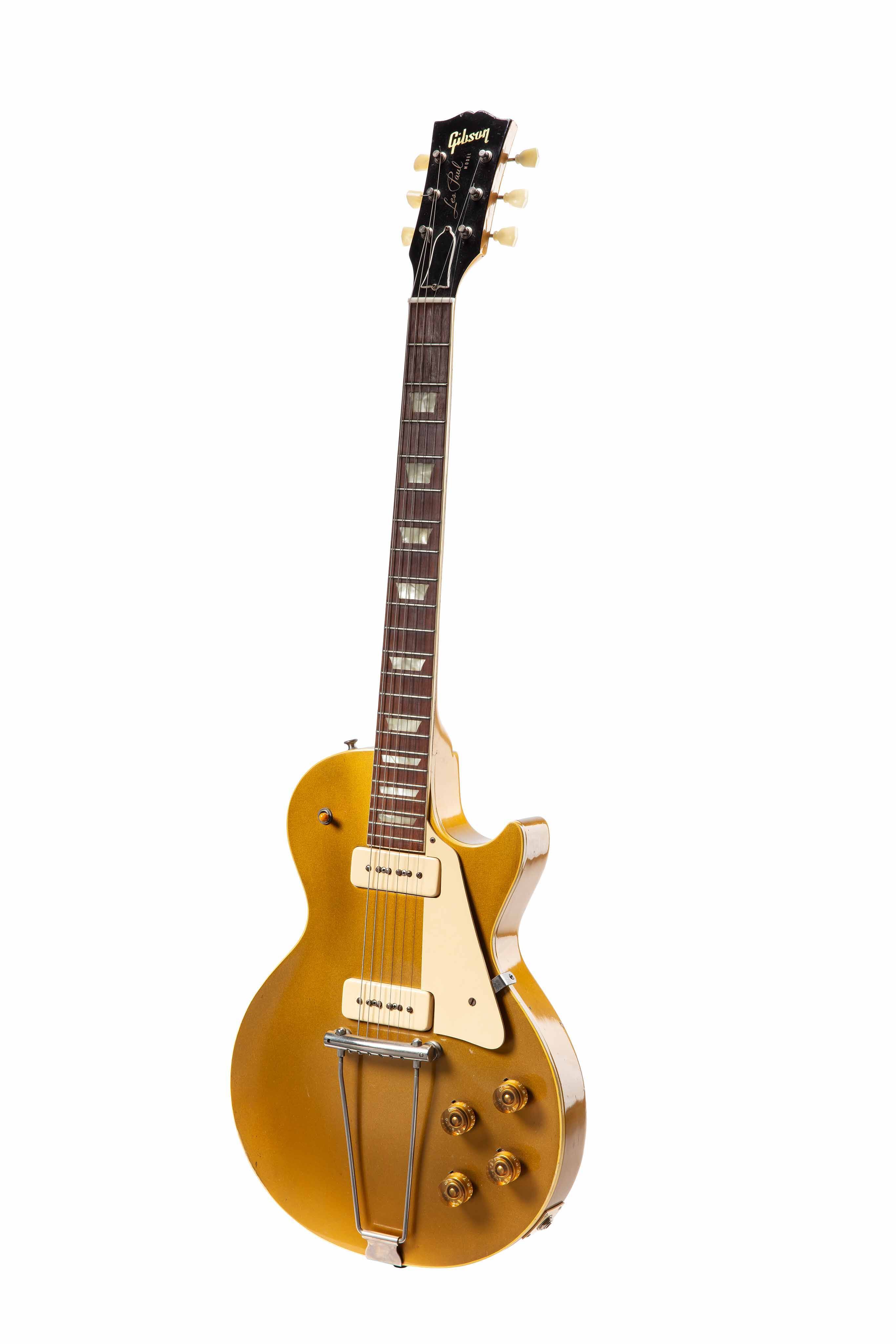
Electric guitar
Maker
Gibson, Inc.
Maker
Gibson
Date1952
Place MadeKalamazoo, Michigan, United States, North America
ModelLes Paul Gold-top
Serial No.None
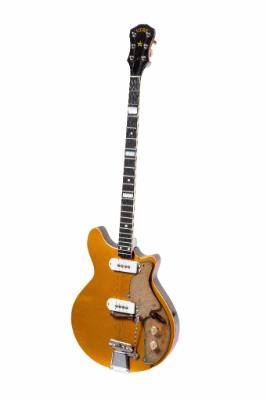
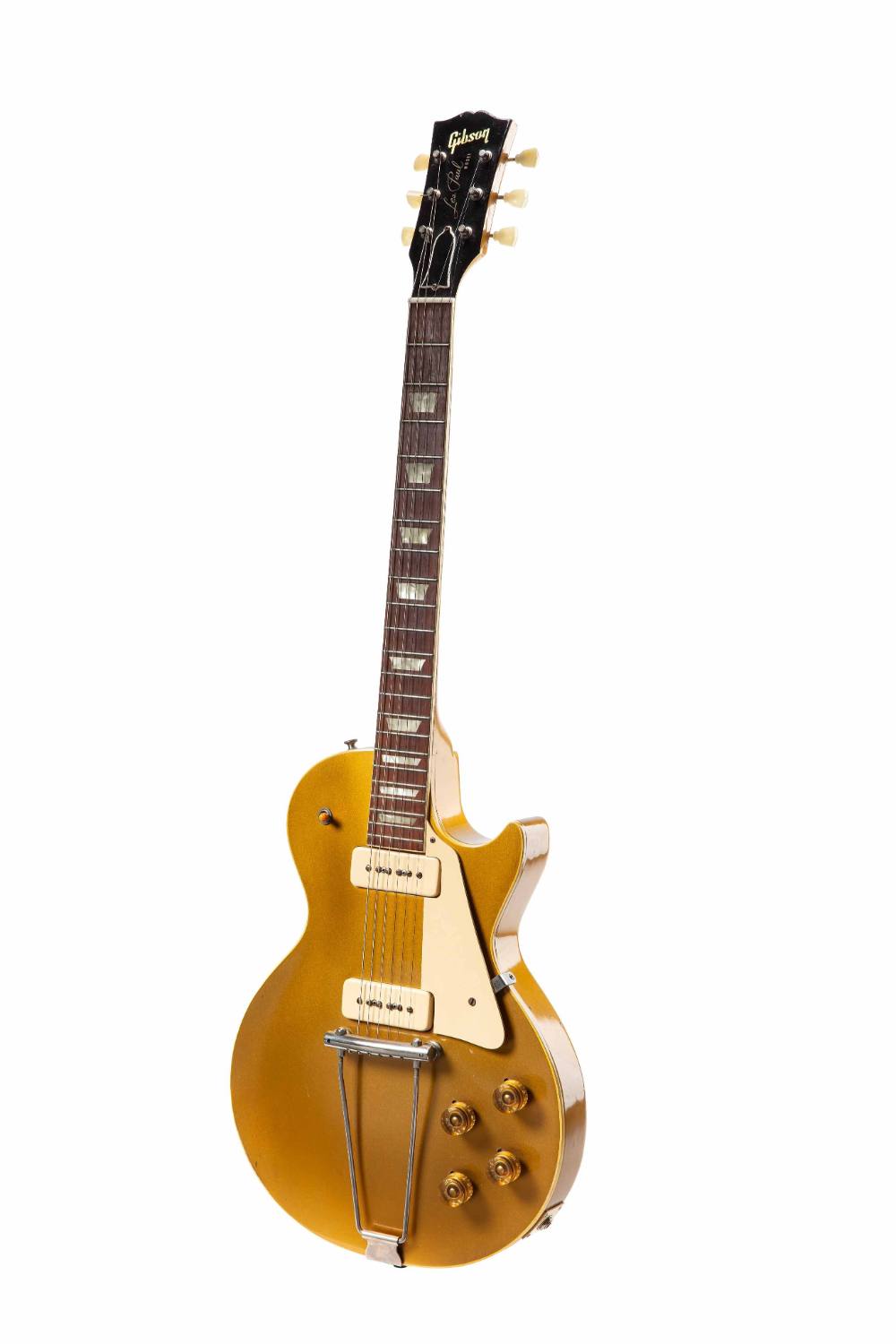
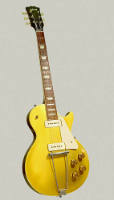
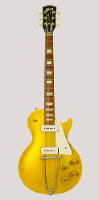
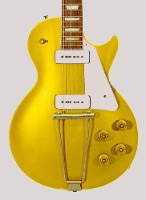
SignedInlaid in mother-of-pearl on head: GibsonSilk-screened in gold on head, text perpendicular to "Gibson" logo: Les Paul / MODELMarkingsStamped on tailpiece plate where affixed to lower edge: PAT. / PENDINGDescriptionThe Gibson “Les Paul” is one of the most copied electric guitar models ever made. Introduced in 1952, it was Gibson’s first solid-body, electric Spanish-style guitar and was named for its endorser. The success of Fender’s Esquire and Telecaster models pushed Gibson into launching this competing product. In the first year-and-a-half of production, the guitar featured a trapeze-style tailpiece (string holder) patented by Les Paul.
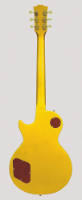
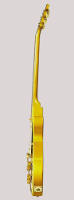
The solid-body Les Paul guitar, made from mahogany with a maple veneer, originally came in a gold metallic finish on the top with a clear lacquer on the back or, more rarely, with an all-gold finish, as on NMM 5916. The 1952 instruments feature a modified version of the trapeze tailpiece-bridge combination that Les Paul (Lester Polfuss) patented in 1952. However, disputes with Gibson resulted in the strings being wrapped under the upper tailpiece bar rather than over the upper side, as Les Paul intended. This caused the strings to be difficult to damp with the player's hand, so it was replaced in 1954 with a top-mounted bridge and string holder.
Stringing: six steel strings
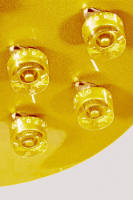
Pickups: two P-90 single-coil pickups with individual pole pieces, volume and tone potentiometers with clear plastic knobs painted gold on the underside with ivory numbers, the levels from 1 to 10, and three-way with tan plastic knob; ivory plastic trip around jack plug
Body: cutaway upper treble bout; solid mahogany with maple top piece; two brown plastic covers over electrics cavities
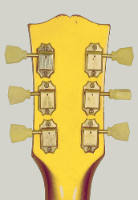
Head: mahogany; integral with neck; black-over-white-black two-ply plastic bell-shaped truss rod cover secured to head with two nickel-plated steel domed Philips’ head screws
Neck: maple; integral with head
Binding: ivory plastic on top
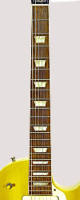
Fretboard: rosewood with 22 nickel-silver frets; pearloid trapezoidal fret markers with in-curved sides behind 3rd, 5th, 7th, 9th, 12th, 15th, 17th, 19th, and 21st frets; single black plastic dots and side dots behind, 3rd, 5th, 7th, 9th, 15th, 17th, 19th, and 21st frets; double black plastic dots and side dots behind 12th frets
Nut: bone
Bridge and tailpiece: integral, patented bridge and trapeze tailpiece combination of nickel-plated brass and steel, affixed to lower edge with two nickel-plated, dome-headed Philips head screws
Tuners: six individual Kluson nickel-plated steel covered worm-gear tuners with clear and ivory marbled tulip-shaped plastic heads
Pickguard: ivory plastic with nickel-plated steel bracket, dome-headed nickel-plated steel Philips head screw near neck; flat, slot-headed steel screw securing pickguard to bracket; dome-headed nickel-plated steel Philips head screw securing bracket to side of guitar
Strap buttons: nickel-plated steel secured to body with domed, nickel-plated steel Philips’ head screws
Finish: gold sparkle lacquer over whole body neck, and back of head; black on head face
DimensionsTotal guitar length: 991 mm (39-1/32“)
Back length at neck joint: 441 mm (17-3/8“)
Upper bout width: 234 mm (9-7/32“)
Waist width: 184 mm (7-1/4“)
Lower bout width: 330 mm (13“)
Side height at heel: 51 mm (2“)
Side height, at center: 50 mm (1-31/32“)
Side height, at end: 49 mm (1-15/16“)
Head length: 154 mm (6-1/4“)
Head width, top: 50 mm (1-31/32“)
Head width, bottom: 67 mm (2-5/8“)
Neck length (nut to body): 375 mm (14-3/4“)
Neck width, nut: 43 mm (1-11/16“)
Neck width, body joint: 53 mm (2-3/32“)
Vibrating string length (nut to bridge edge): 624 mm (24-9/16“)
Scale length: 624 mm (24-9/16“) ProvenanceNMM Board of Trustees purchased guitar from Gruhn Guitars, Nashville, Tennessee, 1995.Published ReferencesAchard, Ken. The History and Development of the American Guitar. London: Musical News Services, Ltd., 1979.
--------. “Gibson Turns 100,” Music Trades, (August 1994), p. 94.
Bacon, Tony and Paul Day. The Ultimate Guitar Book. London: Dorley Kindersley,
1991, pp. 80-81.
Bacon, Tony. s.v., “Gibson,” New Grove Dictionary of Musical Instruments, II, p. 45,
(1988).
--------. s.v., “Guitar,” New Grove Dictionary of Musical Instruments, I, pp. 651-654,
(1988).
Brosnac, Donald. The Electric Guitar, its History and Construction. San Francisco:
Panjandrum Press, 1974, p. 23.
Carter, Walter. Gibson Guitars. Los Angeles: General Publishing Group, 1994, pp. 188-191.
Evans, Tom and Mary Anne. Guitars. New York: Paddington Press, 1977, pp. 348-349.
Gruhn, George and Walter Carter. Electric Guitars and Basses: A Photographic History. San Francisco: GPI Books, 1994, pp. 148-149.
Gevik, Bryan (2021, May 14) 1952 Gibson Les Paul vs. '58/'67 Explorer - Old Guitars and the Local Musicians Who Love Them [Radio broadcast]. SDPB. https://www.sdpb.org/blogs/images-of-the-past/1952-gibson-les-paul-vs-5867-gibson-explorer-old-guitars-and-the-local-musicians-who-love-them/
Gevik, Brian, "Images of the Past: Old Guitars and the Local Musicians Who Love Them," SDPB Magazine (June 2021), cover, pp. 4-5
Credit LineBoard of Trustees, 1995
Object number05916
On View
On view