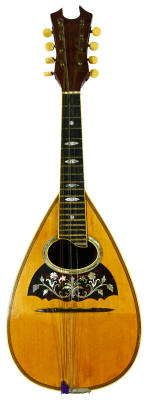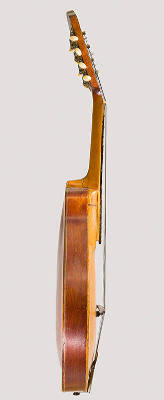
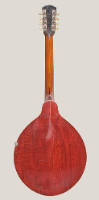



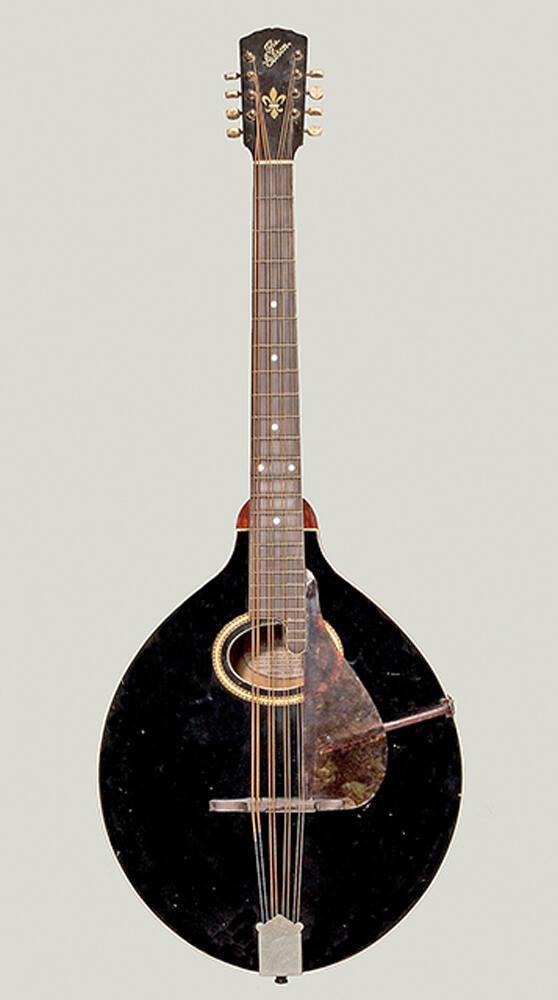
Mando-cello
ALTERNATE NAME(S)
- Mandolin
- Mandocello
Maker
Gibson
Date1914
Place MadeKalamazoo, Michigan, United States, North America
ModelK-2
Serial No.17984; 2037 (factory order number)
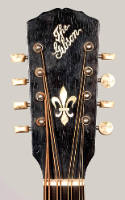
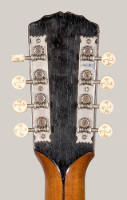
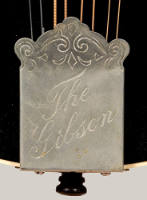
SignedMother-of-pearl inlay on peghead face, in cursive text: The / Gibson Engraved into tailpiece, in cursive text: The / Gibson
Label inside instrument, in black text with underlined text handwritten in black ink:
Patented Feb. 1, ’98 / “ March 30, ’06 / Other Patents Pending / GibsonMando-Cello StyleK-2- / Number17984 is hereby / GUARANTEED / against faulty workmanship or material. Should / this instrument, with proper care and usage, go wrong, / we agree to repair it free of charge at our factory, or / to replace it with another of the same style or value. / GIBSON MANDOLIN-GUITAR CO. / (Manufacturers) / Kalamazoo, Mich., U. S. A.MarkingsStamped onto neck block: 2037
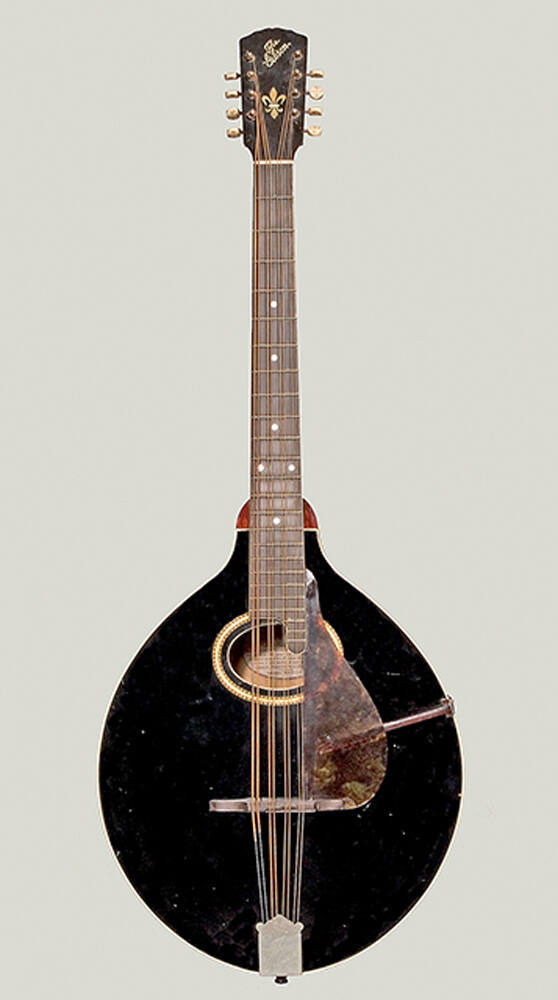
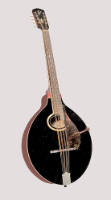
Stamped into pickguard: PAT. MAR .30 .09DescriptionThe mando-cello is a baritone mandolin with the same tuning as a violoncello and was created to fill out the range of the mandolin orchestras that were popular early in the twentieth century. The Style K-2 was one of the initial models offered by the Gibson Mandolin-Guitar Manufacturing Company, when it was formed in 1902. The Style K-2 had the same design and features as the top-of-the-line, pear-shaped Style A-4 mandolin and Style H-2 mandola. It was discontinued in 1922, as the popularity of mandolin orchestras began to fade and players switched to banjos and guitars.
Stringing: eight steel-wound strings
Soundboard: ebonized spruce
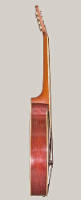
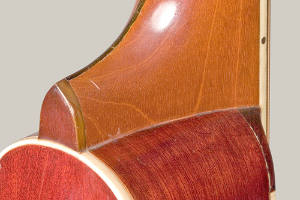
Back: one-piece, maple with red-stained mahogany veneer
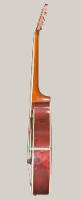
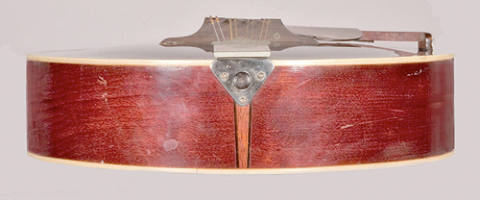
Ribs: two-piece, maple with red-stained mahogany veneer; connected at base of instrument with three-ply rosewood/mahogany/rosewood stripe
Head: mahogany; integral with neck; veneered on either side with black-stained mahogany; mother-of-pearl fleur-de-lis inlay on front face
Neck: mahogany; integral with head; brown-stained mahogany center stripe
Heel cap: rosewood
Binding: ivoroid on top and back edges
Fretboard: brown-stained maple bound in ivoroid; 21 nickel-silver bar frets under C and
G courses, 22 under D course, 24 under A course; single-dot mother-of-pearl inlays behind 5th, 7th, 10th, and 15th frets; two mother-of-pearl dots inlaid behind 12th fret; imitation tortoiseshell celluloid side dots inlaid behind 5th, 7th, 10th, 12th, and 15th frets
Nut: bone
Bridge: brown-stained maple; saddle creates different vibrating length for each course of strings
Tailpiece: nickel-silver or nickel-plated brass
Tuners: two sets of worm-gear machine tuners with nickel-plated brass plates, nickel-plated brass rollers, and ivoroid heads inlaid with nickel-silver curlicues and mother-of-pearl circles and five-pointed stars
Endpin: ebony
Rosette: oval soundhole bound in ivory celluloid; trim comprised of ivoroid stripe bound
on either side by five-ply rosewood/maple/strip of alternating maple/rosewood rhombi/maple/rosewood
Pick guard: imitation tortoiseshell celluloid “elevated guard-plate or finger-rest with German [nickel-] silver clamp (patented July 4, 1911…)” [from 1912 Gibson instrument catalog, p. 66]
Varnish: clear lacquer
Linings: kerfed spruce on top and back
Neck block: mahogany; integral with neck
End block: light hardwood, possibly maple or birch [limited visibility]
Top bracing: spruce brace with tapered ends below soundhole
Back bracing: none
Grafts: vertical spruce braces around ribsDimensionsTotal mando-cello length: 960 mm (37-13/16”)
Back length: 473 mm (18-5/8”)
Width at heel: 86 mm (3-3/8”)
Width at widest point: 363 mm (14-9/32”)
Rib height (including edging) at heel: 87 mm (3-7/16”)
Rib height, at waist: 85 mm (3-11/32”)
Rib height, at endpin: 85 mm (3-11/32”)
Head length: 172 mm (6-25/32”)
Head width, top: 72 mm (2-27/32”)
Head width, bottom: 61 mm (2-13/32”)
Neck length (nut to ribs): 331 mm (13-1/32”)
Neck width, nut: 41 mm (1-5/8”)
Neck width, heel: 52 mm (2-1/16”)
Soundhole height: 62 mm (2-7/16”)
Soundhole width: 90 mm (3-17/32”)
Vibrating string length (nut to bridge edge): A course – 628 mm (24-23/32”); D course – 629 mm (24-3/4”); G course – 631 mm (24-27/32”); C course – 632 mm (24-7/8”)ProvenancePreviously owned by Neal Penner, a former Gibson representative, Enid, Oklahoma. In 1980, Denner sold this instrument, along with 32 others, to Pete Wagener, Savage, Minnesota. By 1997, owned by Curtis Teague and Lorette Simone, Minneapolis, Minnesota. Purchased from Teague and Simone, 1997.
Credit LineBoard of Trustees, 1997
Object number06085
On View
Not on view