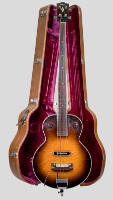
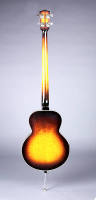
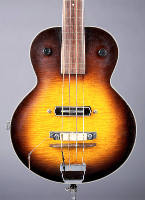


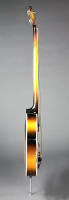
Electric bass
ALTERNATE NAME(S)
- Electric mandobass
Maker
Gibson, Inc.
Maker
Gibson
Date1938 ca.
Place MadeKalamazoo, Michigan, United States, North America
ModelElectric Model J
Serial No.none visible
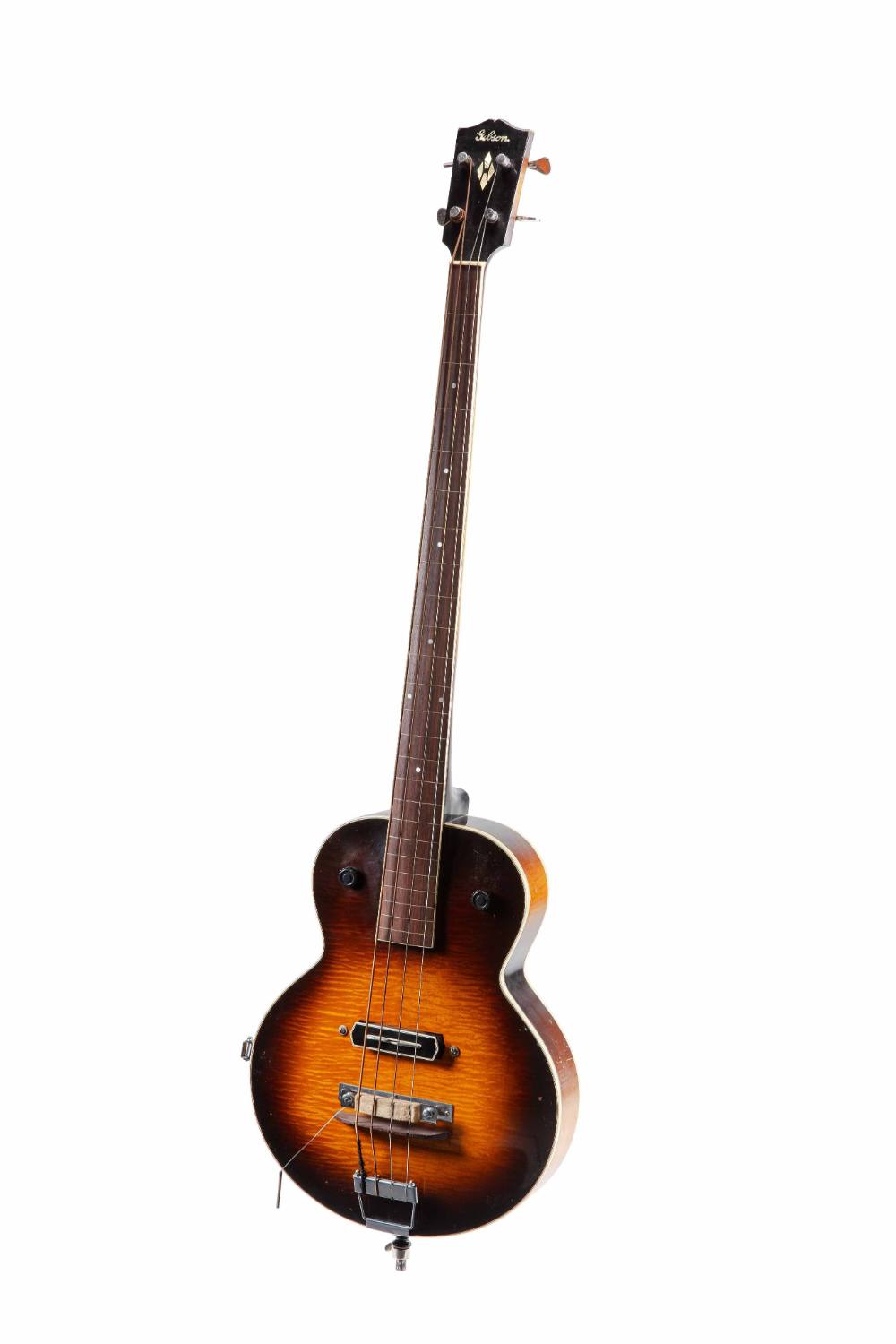
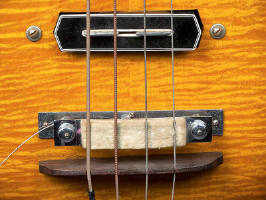
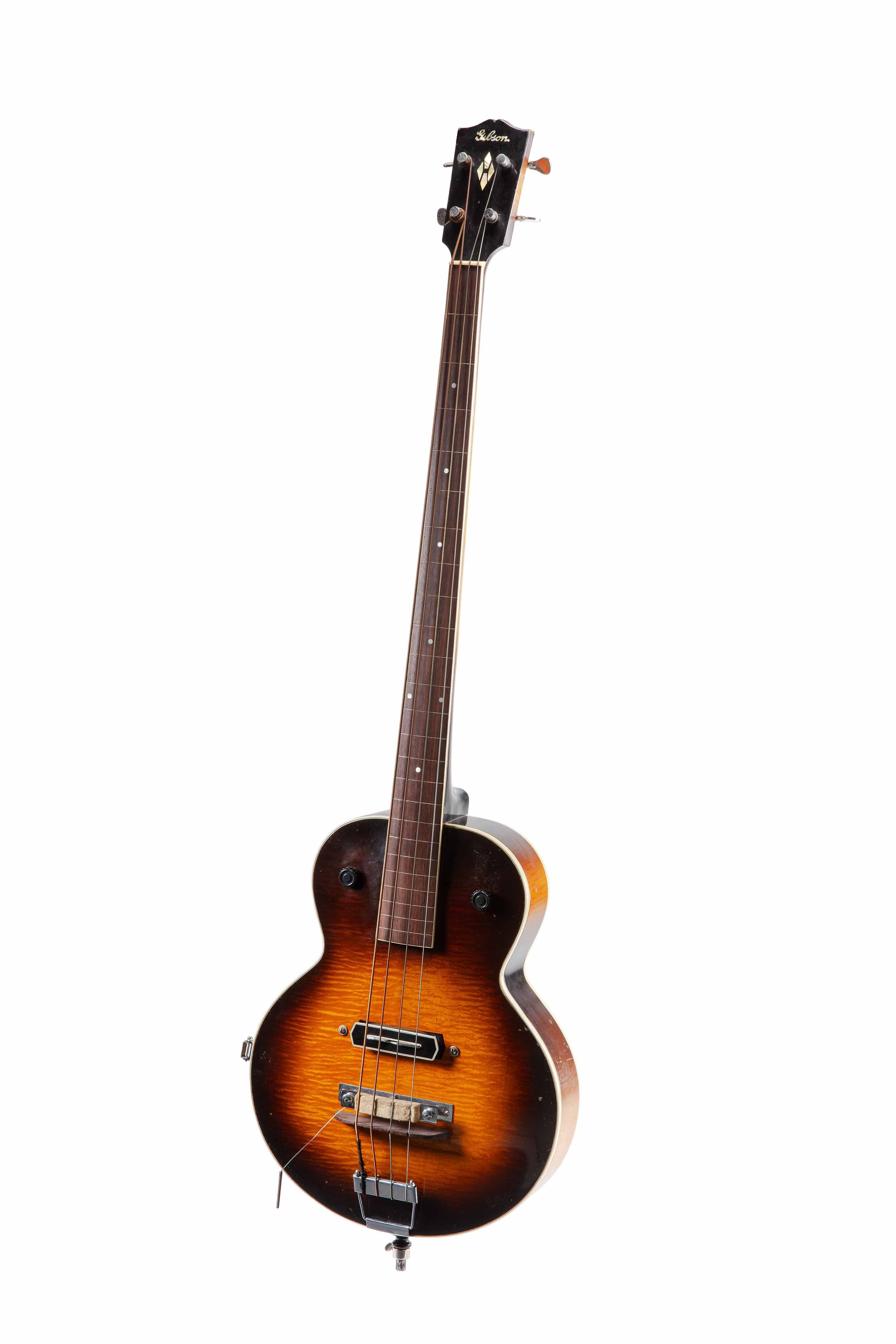
SignedInlaid in abalone on head: GibsonDescriptionIn the 1930s, Gibson, Inc. realized that the unexpected success of the Electro String Instrument Company's "frying pan"—an aluminum electric Hawaiian guitar—could not be ignored. Gibson introduced a competing electric Hawaiian guitar with a metal body in 1935, though it soon changed the body to a wooden one with sunburst finish. In 1936, Gibson introduced the matching ES-150 electric Spanish guitar and the EM-150 electric mandolin. It even made a few dozen electric plectrum and tenor banjos. The NMM's bass is one of five or more electric basses made by Gibson in the late 1930s, but these instruments were never mass produced. This instrument survives with an original Gibson case - only one of the five 1930s electric basses listed in the Gibson shipping ledgers was shipped with a case, and that instrument is described as an electric Model J, suggesting that Gibson thought of it as an electric mandobass at the time. The hollow-bodied instrument has no sound holes, only an early blade pickup with hexagonal housing, often called the "Charlie Christian" pickup, after the jazz artist who was an early adopter of Gibson's ES-150 electric arch-top guitar. Although the instrument appears surprisingly modern for its age, it has a long string length suited to upright rather than seated playing, and it is fitted with an extendable endpin (short scaling and guitar-style playing were hallmarks of Fender's revolutionary Precision Bass, the first commercially successful electric bass, introduced in 1951). It also has a unique, pedal-operated, felt string mute that presumably would dampen the strings enough to imitate the sound of an acoustic bass. The instrument features a beautifully figured maple body with shaded sunburst lacquer and a mando-bass-type neck with flush frets.
Two other 1930s Gibson electric basses survive. One was purchased second-hand by Mrs. Theodore E. Snow from the Honolulu Conservatory of Music in 1940, who as a teenager performed with her family's musical ensemble, the Hawaiian-themed Tropical Islanders. This bass, now at the Experience Music Project in Seattle, has a larger guitar-shaped body and no string mute. Gibson did not bring any electric basses to the mass market until the violin-shaped Gibson Electric Bass (EB-1) in 1953.
The third bass recently resurfaced, with a body similar to the Experience Music Project instrument and a damper system like the bass at the NMM.
Stringing: four steel strings, the top two nickel-silver overspun, the third copper-overspun, and the bottom bronze overspun
Soundboard: arched, two-piece maple cut off-the-quarter: horizontal medium curl; pith flecks
Back: arched two-piece slab-cut maple with faint, irregular curl; pith flecks
Ribs: two-piece maple cut off-the quarter: narrow, irregular curl; pith flecks
Head and neck: three piece: two maple sides (irregular, faint curl) with mahogany center strip; head veneered with ebony, a bisected abalone diamond inlaid at center
Heel cap: none
Binding: white celluloid with two-ply black and white strip trim on top and back
Fingerboard: rosewood with radiused surface bound in white celluloid with two-ply black and white strip trim; 24 flush bone frets; mother-of-pearl dots behind 3rd, 5th, 7th, 10th and 15th frets; two mother-of-pearl dots behind12th fret
Nut: bone
Bridge: rosewood
Mute: chrome-plated steel and white felt mute with springs and pulley system with braided steel cord, to be disengaged via foot pedal, now missing
Tailpiece: chrome-plated steel trapeze shape, secured to lower rib with two nickel-plated steel slotted dome head screws
Endpin: extendable; black-painted wood collar with nickel-plated steel hardware
Tuners: Four nickel-plated steel worm gear tuners with nickel-plated steel heads
Endpin: missing
Soundholes: none
Pickup: one single-coil "Charlie Christian" bar pickup; two chrome-plated steel blades; black celluloid coil cover bound in white plastic with two-ply white and black plastic strip trim; black plastic volume and tone knobs, one on each side of fingerboard in upper bout; jack plug on lower bass rib
Lacquer: dark brown sunburst
Other: chrome-plated steel hoop screwed to lower bass rib, with top surface indicative of soldered component now missingDimensionsTotal electric mandobass length: 1379 mm (54-9/32")
Back length: 520 mm (20-15/32")
Upper bout width: 285 mm (11-7/32")
Waist width: 239 mm (9-13/32")
Lower bout width: 451 mm (17-3/4")
Side height (including edging): 89 mm (3-1/2")
Head length: 190 mm (7-15/32")
Head width, top: 93 mm (3-21/32")
Head width, bottom: 79 mm (3-1/8")
Neck length (nut to body): 673 mm (26-1/2")
Neck width, nut: 43 mm (1-11/16")
Neck width, body joint: 68 mm (2-11/16")
Vibrating string length (nut to bridge edge): 1049 mm (41-5/8")
Scale length: 1078 mm (42-7/16")ProvenanceA 1976 letter by Julius Bellson, Gibson Historian, stated that just two of these basses were made by the Gibson Company; however, shipping ledgers show at least five. This bass belonged to Les Paul's longtime friend and brother-in-law, Wally Kamin, who provided bass background in many of the recordings by Les Paul and Mary Ford.
Purchased in 2003 from Elderly Instruments, East Lansing, Michigan.Published ReferencesArian Sheets, "Early Rumblings for an Electric Bass; NMM Acquires Gibson's Prototype Electric Bass Guitar, ca. 1938," National Music Musuem Newsletter 32, No. 2 (May 2005), pp. 4-5.
Credit LineBoard of Trustees, 2003
Object number10474
On View
Not on view