
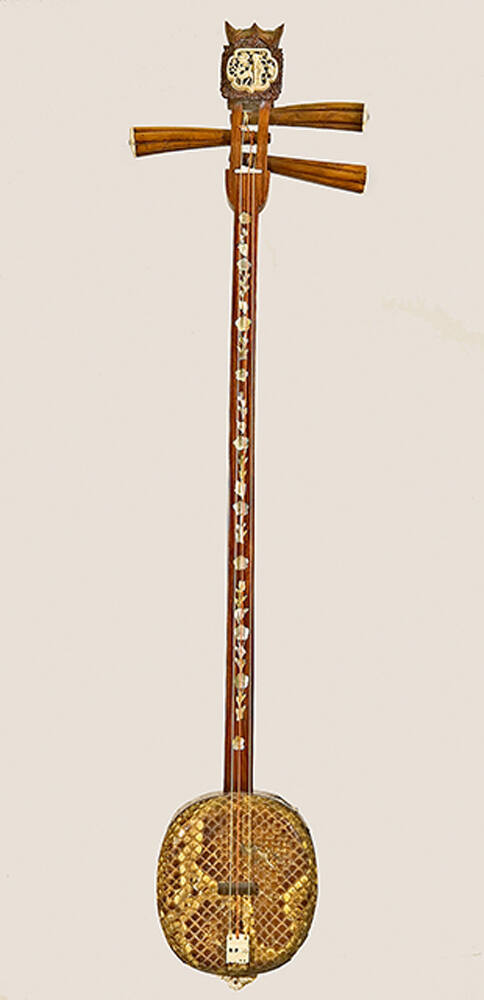
Sanxian
ALTERNATE NAME(S)
- San-hsien
- Long-neck lute
Maker
Ran Yong
Date1850-1875 ca.
Place MadeChina, Asia
Serial No.none
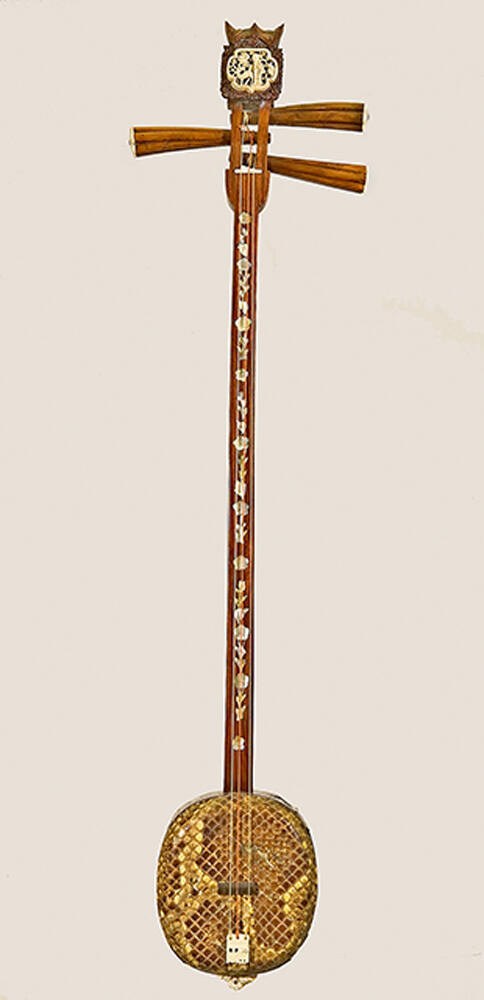
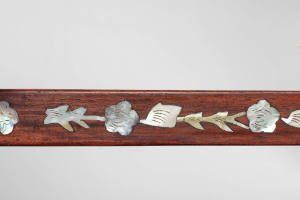
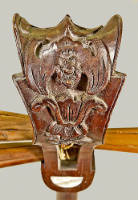
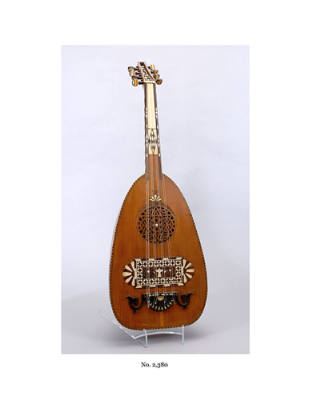
SignedIncised on abalone inlay on back side of peghead: 然詠(Ran Yong) 造 (made)DescriptionMany cultures in Southeast Asia regard the bat as a harbinger of good luck. Floral, mother-of-pearl inlay on neck and resonator. The sanxian’s use in accompanying narrative song and as a low voice in ensemble playing has guaranteed its role in Chinese music tradition.Three strings
Neck: dark tropical hardwood, similar to rosewood, the front inlaid with engraved abalone in floral motif
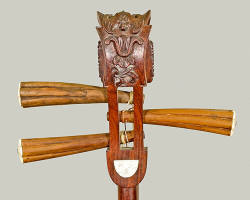
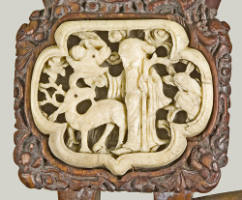
Peghead: integral with neck; back carved into flying bat over a lotus; front inset with carved garden scene in bone, possibly adapted from an older piece and filled in on back with ivory; half-round abalone plaque with engraved signature inlaid at base of peghead; two engraved abalone flowers inlaid on each side of base of peghead
Pegs: three light hardwood with reeded profile, caped in bone on ends with ebony eye
Head: snakeskin on front and back
Nut: bone
Bridge: black hardwood
Rim: dark tropical hardwood, similar to rosewood, with the grain perpendicular to heads; inlaid with with engraved abalone in floral motif
Tailpiece: decoratively carved ivory
Endpin: ivory carved in shape of crouched batDimensionsTotal sanxian length: 855 mm
Body length: 152 mm
Body width: 136 mm
Body depth: 67 mm
Neck length, nut to body: 544 mm
Vibrating string length: 610 mmProvenancePreviously owned by an unidentified elderly couple in Philadelphia, Pennsylvania, who purchased this instrument, along with several others, to be played for therapeutic reasons. By 1976, all were sold to William Gribbon, Greenfield, Massachusetts, who sold this instrument to the NMM.Published References“New Gallery Being Developed at USD,” Newsletter of the American Musical Instrument Society Vol. IV, No. 3 (October 1977), p. 4.
“Gallery IV Development Underway,” Shrine to Music Museum, Inc. Newsletter 5, No. 1 (October 1977), p. 1.
“Documentary Film Features the Shrine to Music Museum,” Shrine to Music Museum, Inc. Newsletter 8, No. 1 (October 1980), p. 2.
The Music Connection, (Parsippeany, New Jersey: Silver Burdett Ginn), 1995, p. 366.
Credit LineRawlins Fund, 1976
Object number01432
On View
Not on view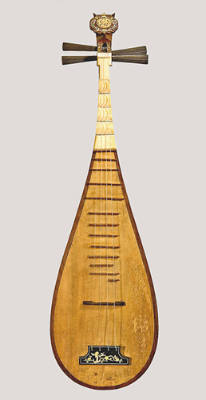
1850-1875 ca.

1880-1900 ca.