



Raberi
Vernacular Name
- Raveli
ALTERNATE NAME(S)
- Folk volin
Date1980-1989 ca.
Place MadeChihuahua, Mexico, North America
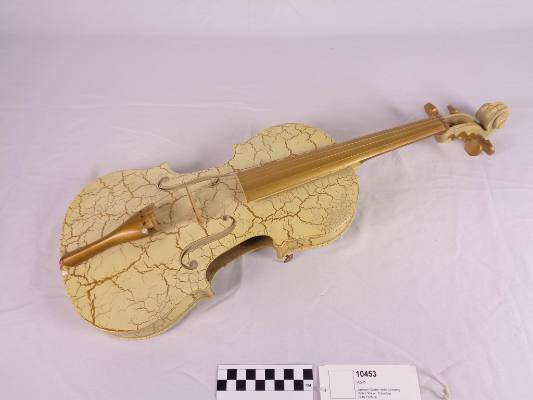
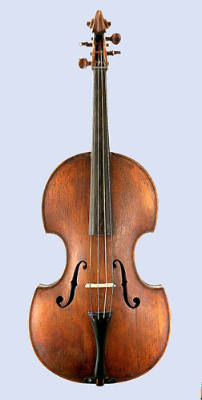
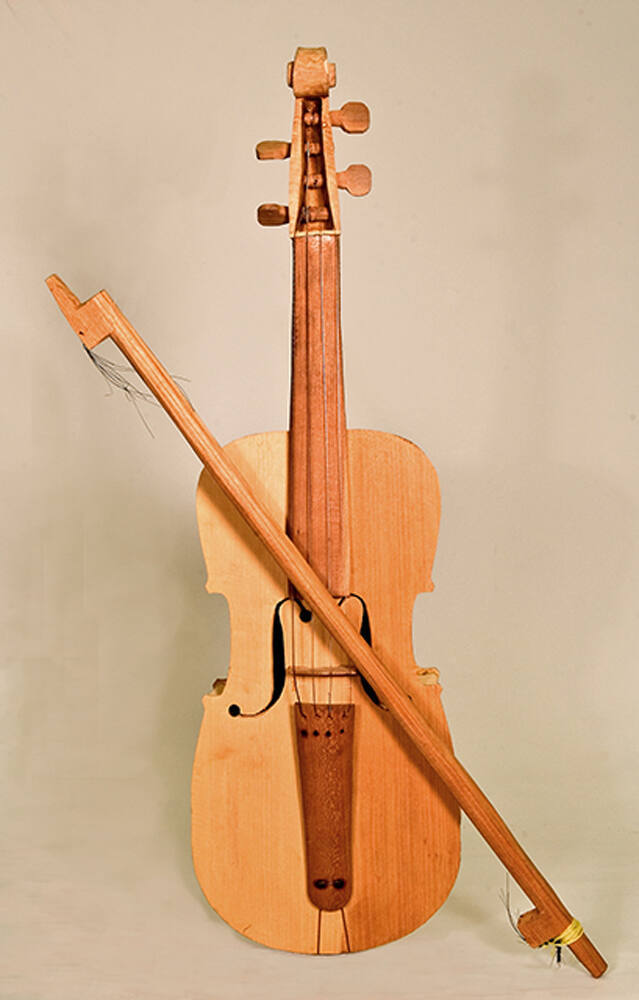
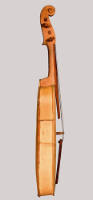
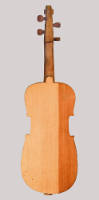
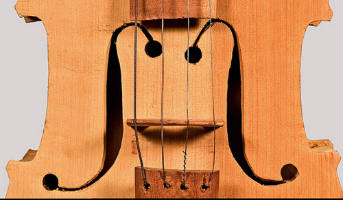
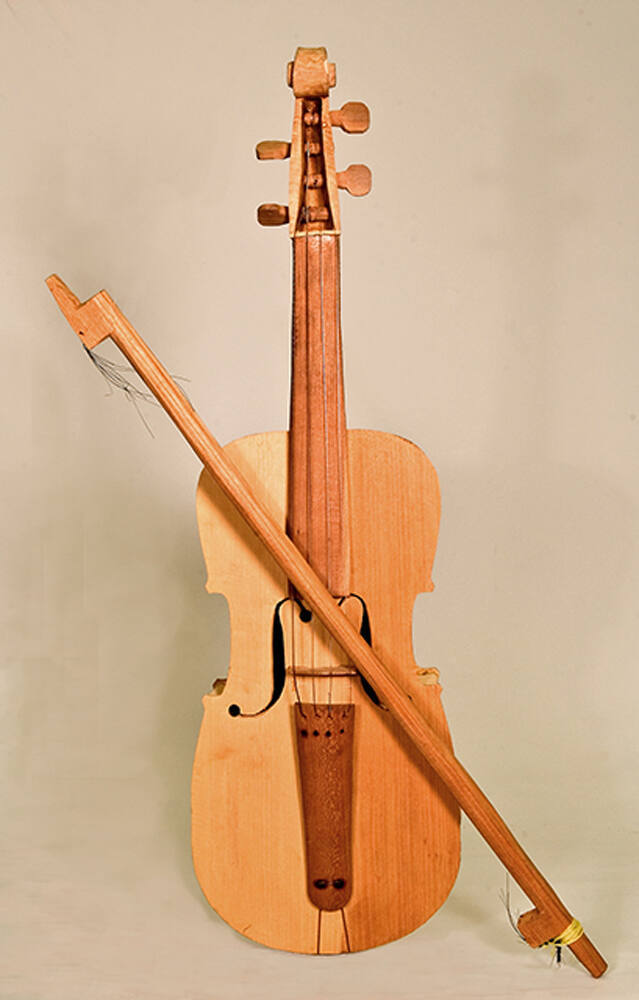
SignedNoneDescriptionViolin of the Rarámuri (Tarahumara) people of Chihuahua, Mexico. Modeled after Baroque violins introduced into the region during the 17th and 18th centuries, the Rarámuri utilize species native to Copper Canyon, including indigenous orchids known as strong adhesives. The instruments have the basic European violin shape although the size and proportions vary; some are as large as a viola. Traditionally, the four strings were made from goat gut, but nowadays nylon and metal strings are normal. Local woods such as ash, maple, pine, and willow are used for the top and back, and fresh, green wood that bends easily is used for the bouts, which can have a distinctly squared shape. Traditionally, the woods are glued with gum from the roots of the ŕako plant.Typically, the fingerboard, of inóko (a local hardwood), extends to the top of the C- or f-shaped soundholes. The soundholes often end in a small circle or a cluster of two or three small circles. The tailpiece is attached with cord or wire to an extension of the back; there is no endpin. The bow is a straight stick about 50 cm long. Horsehair (sometimes woven into strands) is tied with a thong at the proximal end; there is no tightening mechanism.
The violins are held below the collarbone and are played with guitars to accompany the matachín dance and for other winter festivals. The raberi is distinctly different from the chapareke, a traditional stick fiddle.
Top: one-piece, quarter-cut, light-colored wood: wide grain; darker on treble side
Back: one-piece, quarter-cut, light-colored wood: wide grain; darker on bass side
Ribs: slab-cut, light colored wood; one-piece lower rib; center ribs overlap upper and lower ribs at joints
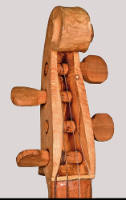
Head and neck: light brown hardwood; scroll with single raised disk on sides rather than volute; no fluting
Arching: low, no re-curve
Edging: no re-curve
Purfling: none
Varnish: none
Fingerboard: brown hardwood with highly visible rays; wedge-shaped
Nut: light hardwood with open pores
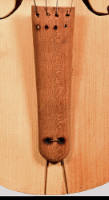
Tailpiece: light brown hardwood, same material as fingerboard; two sets of string holes drilled, the lower with burned edges; tailgut passes through holes drilled in top
Tailgut: copper wire
Pegs: four light brown hardwood; carved rather than turned
Saddle: none
Endpin: none; tailgut loops around rectangular protrusion on bottom edge of back
F-holes: upper and lower eyes with burned edges; no notches
Linings: none
Corner blocks: none
Top block: integral with neck; wider at top
Bottom block: none
Bassbar: carved from top; low height; long; centered between f-holes
Other: assembled with fibrous glue
Bow: light hardwood with integral frog and black hair; stick is slightly arched and tip is elongated; hair is held in head with wood dowel extending through head sides; hair is tied to frog using scrap of white, orange, and black printed clothDimensionsTotal violin length: 557 mm
Back length: 324 mm
Upper bout width: 148.5 mm
Center bout width: 109.7 mm
Lower bout width: 166 mm
Upper rib height: 34.2-36.7 mm
Center rib height: 35.4-36.4 mm
Lower rib height: 36.4-37.7 mm
Stop length: 153 mm
Vibrating string length: 267 mm
Neck length (nut to ribs): 117 mm
Bow length: 407 mmProvenanceAcquired by the donor, Adrian R. Dempster, in Divisadero, Chihuahua Province, Mexico, in the late 1980s.Published ReferencesSilva, Ana Sofia. "Digging the Fifties: A Curatorial Perspective on 50 Objects from the NMM Collections." NMM Notes (October 2023): 20-21.
Credit LineGift of Adrian Dempster, 1999
Object number06750
On View
Not on view
1640-1750 ca.