


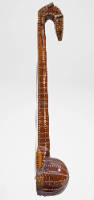


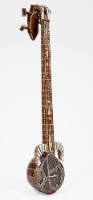


3/4-size rawap
ALTERNATE NAME(S)
- long-neck lute
- Child's rawap
Date1990 ca.
Place MadeEastern Turkistan, China, Asia
Serial No.None
SignedNoneDescriptionThis instrument is a long-necked barbed lute, using terminology from the New Grove Dictionary of Musical instruments. The instrument is entirely made of wood, possibly mulberry (most sources say that is the typical wood for this instrument). The body is a hollowed out bowl shape. At the top of this bowl, where the neck joins the body, there are two curved "barbs" (NGDMI terminology) that project out and down towards the body of the instrument. These two "barbs" resemble the shape of ram's horns. The barbs and the body of the instrument are all carved out of the same piece of wood. The belly of the instrument is snakeskin, and Gerald Trimble (the seller) suggested that he thought it might be python skin.
The entire instrument is made of two pieces of wood: 1) the body and barbs, 2) the neck and the integral curved pegbox. The two pieces are fitted together in V-cuts and glued.
Neck: The top of the neck and pegbox curves back on itself in the shape of a shepherd's crook. The entire neck is hollowed out, and, according to the NGDMI, this is standard practice, resulting in the creation of a secondary sound chamber. The back of the neck is not round, but instead comes to a rounded off V in the center of the back.
Pegs: Lateral pegs are arranged three on one side and two on the other. The pegs are each T- shaped, and are made from a single piece of wood.
Strings:. According to NGDMI, this instrument would normally have 5 strings, two double courses and one single string. This instrument at present has four strings, with a fifth string that appears to be broken that is wrapped around the third peg. With this string, this instrument would be consistent with the NGDMI article. Pictures of similar instruments (Buchner p. 213; Vertkov, Blagodatov, Yazovitskaya pp. 334, 343, 355) show a range of typically 2 to 5 strings. The strings are made of single-strand wire and are fastened to three handmade nails hammered into the bottom of the body.
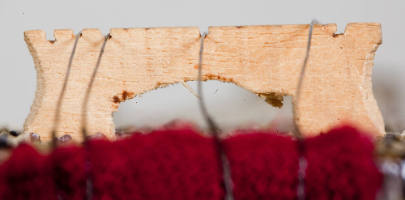
Bridge: The bridge is a small piece of unvarnished wood. It is approximately 26 mm long, and 8 mm high. It is widest at the base where it touches the belly and thins towards the top where the strings pass over it. It forms a rounded off, upside-down V. There are 9 notches for the strings to pass over it.
Frets: The frets are made out of plastic, like a fishing wire line. Even though there is evidence that many of them has been moved, they may all be original. Each of the frets is tied in an absolutely identical noose-knot, which are all lined up on the side of the fret board.
Decoration: This instrument is very elaborately decorated. The instrument is inlaid with black horn and white bone geometric figures.
Body: The belly of the instrument is covered with snakeskin. The back (or bowl) of the instrument is a complex wheel design. The spokes of the wheel are an alternation between the inlaid black wood and bone features, and raised cords.
Barbs: The barbs are decorated with a white ivory background and black double course lines and triangles.
Fingerboard: Black and white geometric figures.
Back of fingerboard and barbs: The back of the fingerboard and barbs are decorated with 5 lines that are evenly spaced through the back. The lines on each side are arrows on the outside and then diamonds slightly farther down. The line directly in the middle is a line of black and white diagonals.
Pegbox: The pegbox decoration starts at the nut with a white inlaid decoration featuring black triangles. When the decoration reaches the pegs however, it turns into an alternation of black and white zigzags.
Pegs: The pegs are T shaped. Each peg is carved from one piece of wood. The top of the T is a rounded, "barrel" knob. Each peg is decorated with three evenly spaced black-and-white zigzags. The two ends of the pegs are decorated with a black dot on a white background.DimensionsTotal length: 575 mm
Vibrating String length (nut to bridge): 471 mm
Fingerboard length (nut to barbs, a little past the last fret): 375 mm
Fingerboard widths:
Top: 26 mm
Bottom (at barbs): 32 mm
Belly diameter: 104 mm
Body depth: 90 mm
Barb length (each individually): 65 mm
Fret Measurements:
Fret width on the fingerboard: 1.8 mm
Fret # Distance of fret from nut (mm); Distance of fret from previous fret (mm)
1. 24 mm; 24 mm
2. 45 mm; 19 mm
3.* 70 mm (66 mm); 23 mm (18 mm)
4.* 95 mm (88 mm); 24 mm (20 mm)
5.*114 mm (106 mm); 17 mm (20 mm)
6.*132 mm (128 mm);15 mm (21 mm)
7.*155 mm (151 mm);18 mm (23 mm)
8. 177 mm; 15 mm
9. 194 mm;15 mm
10.*212 mm (210 mm); 14 mm (13 mm)
11.*228 mm (226 mm); 16 mm (15 mm)
12.*243 mm (249 mm); 12 mm (23 mm)
13.*258 mm (264 mm); 12 mm (15 mm)
14. 280 mm; 20 mm
15. 296 mm; 14 mm
16.*315 mm (317 mm); 17 mm (19 mm)
17. 332 mm 14 mm
18. 347 mm 13 mm
19. 363 mm 12 mm
* This fret has been moved from where it was originally located. The first measurement is taken where the fret is currently positioned, and the measurements in parentheses were taken where the notches suggest the fret was previously located.ProvenanceAcquired by Gerald Trimble, Kansas City, Missouri, at the Coyote's Paw store in St. Louis, 1993.
Credit LineBoard of Trustees, 2000
Object number09932
On View
Not on view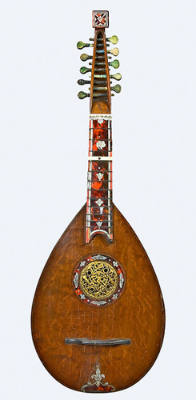
1880-1920 ca.
