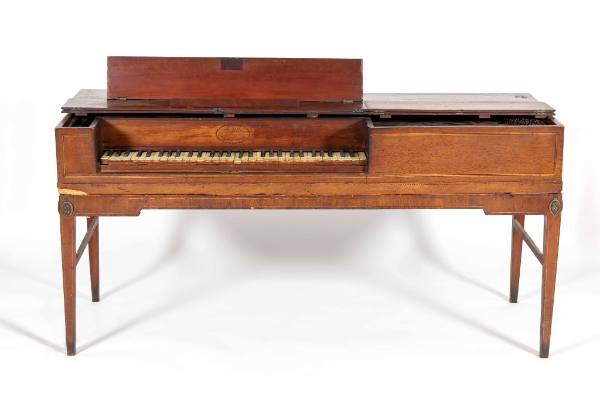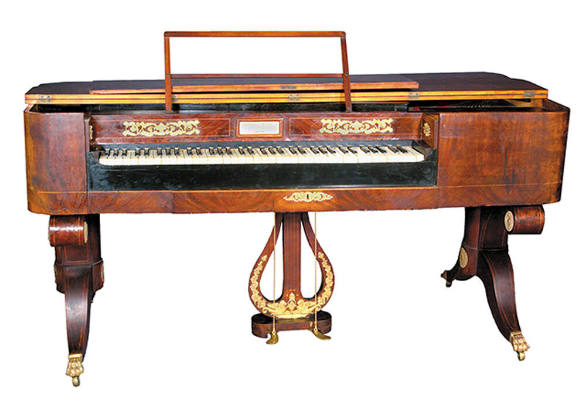
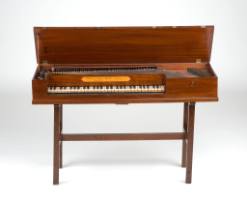
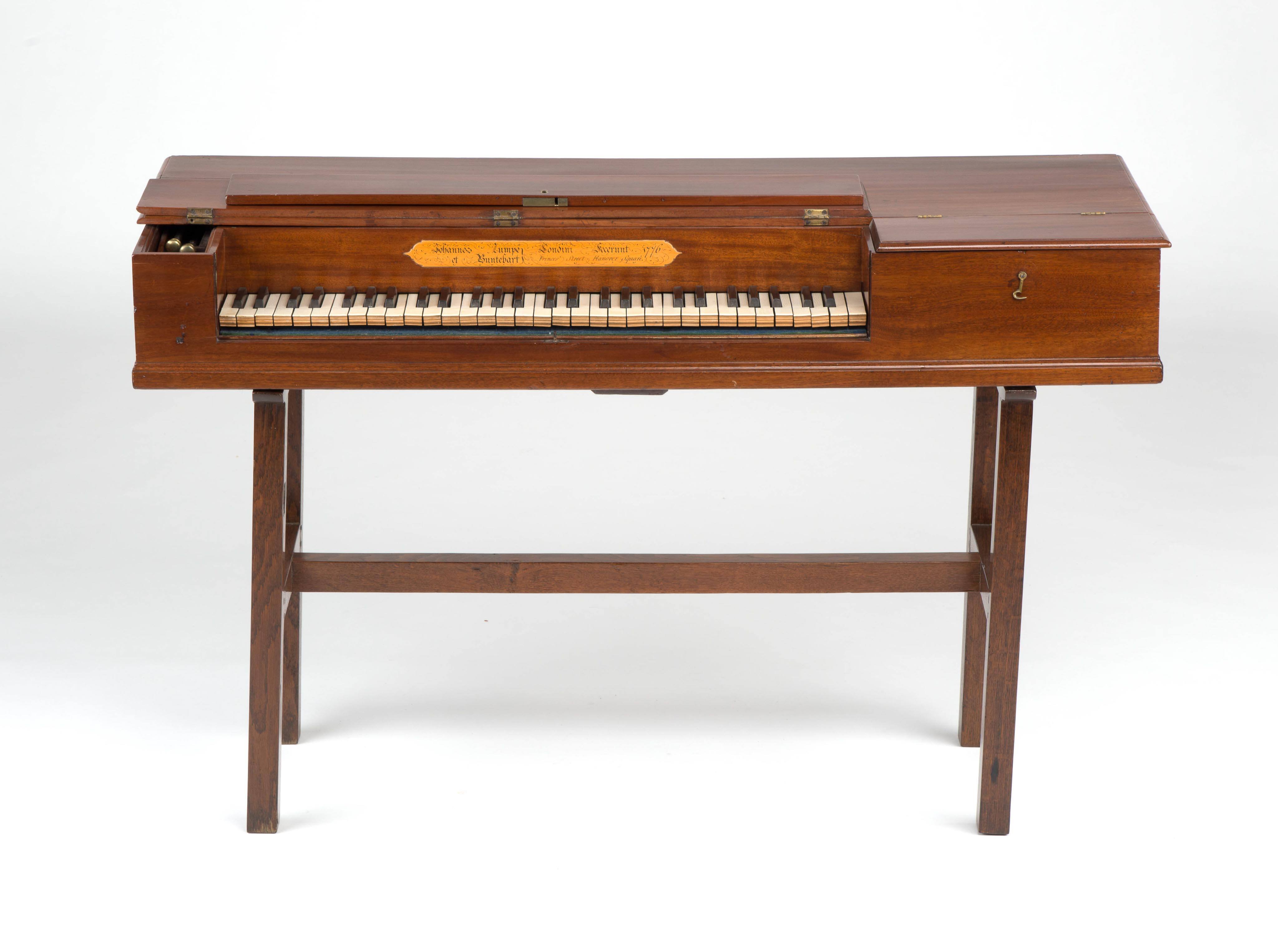
Square piano
Date1776
Place MadeLondon, England, Europe
Serial No.none
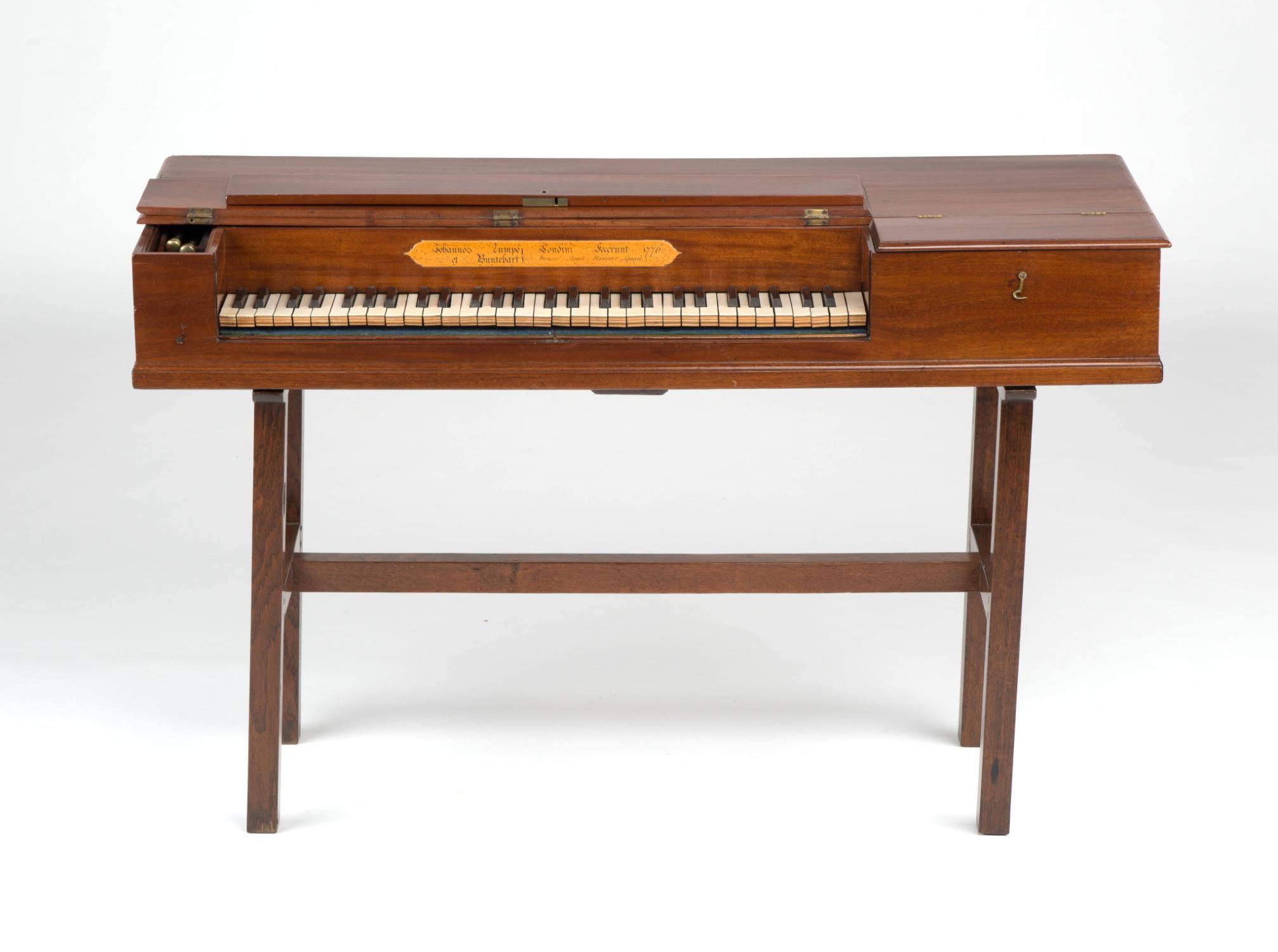
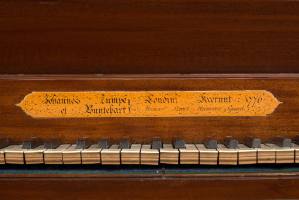
SignedOn nameboard, in ink:Johannes Zumpe Londini fecerunt 1776
et Buntebart Princes' Street Hannover SquareDescriptionCompass: GG-f3 (dummy GG#, 58 notes)
English single action without escapement.
Case: mahogany
Hand stops:
Right: sustain, c-f3
Middle: buff (leather)
Left: sustain, GG-b
Stringing: bichord throughout.
Construction:
The case is made of solid mahogany. The side walls are 18mm thick, back 22mm thick; both have moldings cut into the wood. The bottom (pine?) is 33mm thick and is attached to the bottom of the sides. It is surrounded by a mahogany molding which was glued and nailed. (One section on the left side has been replaced.) The corners are mitered dovetails. One the underside of the bottom (front to back) is a pine (?) crossbeam, 37mm thick and 97mm wide. It is attached with four screws.
A raised holly cartouche adorns the nameboard and contains the makers' signature in ornate script.
The case sits on a trestle stand made of oak with four squared legs.
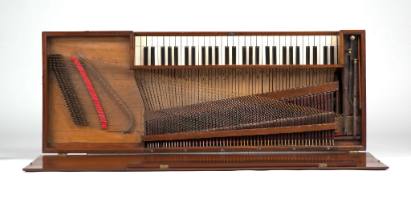
Rectangular tuning pins unpierced (one pierced pin is a replacement); on right side of case, arranged in 29 rows of four, with letters indicating notes appearing on both sides of each row
Soundboard extends over wrestplank, and, like clavichords, the tuning pins were driven through the soundboard into the wrestplank.
All of the edges where the soundboard meets the case have small mahogany moldings, except for one larger rectangular molding along the back.
Soundboard grain left to right
Belly rail (pine?) has a rectangular cutout, which increases sound volume.
One-piece bridge is beveled, cut to its curve, and single pinned. It is nailed in place from the underside of the soundboard. The ends of the bridge are undercut about 2mm and extend beyond the strings about 15mm in the bass and 10mm in the treble. The bass end is 19mm high and 14mm thick; the treble end is 15mm high and 12mm thick.
One rib is visible on the left side of the bridge, roughly parallel to it.
Hitchpin rail reinforced with three screws through the back of the case. Interestingly, there is one extra pair of hitch pins at the extreme treble, which would indicate either a design modification or a lack of precision. The 1767 Zumpe piano in the Victoria and Albert Museum has similar anomalies, including an extra pair of tuning pin holes and one extra hitchpin.
Action:
English single action
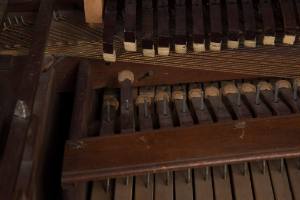
Wire jacks have threads at both ends. One end is screwed into the key and the other end is screwed into a small, semi-circle leather-covered wooden molding (often referred to as "the old man's head"), which contacts the hammer shank when the key is depressed. The leather on this molding was coated at some time in order to decrease the friction between the molding and the hammer shank.
The rectangular hammer shanks are of mahogany, 3mm thick, 9mm wide; the undersides are rounded off at the hammer end. They are leather hinged to the hammer rail (some of the hinges have been replaced),
The section of the shank that contacts the jack is reinforced on the underside with a small, leather-covered wooden block.
The hammer rail is angled (front left, back right), corresponding with the strings (back left, front right); the hammer shanks and damper levers decrease in length from bass to treble.
The hammer shanks are guided by vertical guide pins which extend from the hammer-rest rail through slots in the hammer shanks.
The hammer moldings are crudely cut semicircles which are glued to the flat hammer shankes. They are slightly graduated from bass to treble and are covered with two layers of sheepskin, skin side out.
The molding of the lowest hammer is 9mm thick. The total thickness of the leather is 2mm.
Some leather not original
No escapement mechanism or backcheck; the hammers simply strike the string and fall back on the jack. When the key is released, the hammer returns to its original position on a leather-covered hammer rest rail.
Dampers:
Dampers encompass entire range of piano
Rectangular damper levers made of mahogany
Dampers consist of layers of leather which were glued together (often called the "mopstick"): one layer of hard leather with four layers of soft leather in the bass, and one layer of hard leather with two layers of soft leather in the treble (bass damper length 8mm, width 5mm; treble damper 5 x 5 x 5mm).
The damper levers are hinged with leather between the back of the case and a board which was let into the back of the case and attached with six vertical screws. When the key is depressed, the back end of the key (covered with thin leather) pushes a wire which is pinned to the damper lever. (The wire passes through slots in the hitch-pin rail).
A damper stop rail prevents the dampers from hitting the lid when the lid is closed (the damper wires won't actually fly out of their slots if the stop rail is removed).
When the key is released, gravity and a whale-bone spring which is hinged to the back of the case force the damper back to the string.
The dampers can also be engaged by brass stop knobs, reminiscent, once again, of harpsichords. Sliding battens on wedges simply lift the dampers off the strings.
A sliding batten also operates the lute stop, which consists of small pieces of leather that touch the strings.
Keyboard:
The naturals are covered with ivory; sharps with ebony
There is a straight-line molding on the natural fronts
The ivories have two score lines
The keys are stopped by the front rail and guided by vertical wooden slips at the end of each key lever which move in a slotted rack in front of the hitchpin rail.
Key levers unweighted
Stringing:
Double strung throughout.
Strings not original.
GG-C# brass loosely wound with copper
D-f3 ironDimensionsLength: 1271 mm
Width: 475 mm
Overall height: 785 mm
Height of case: 175 mm
Keyboard:
Three-octave measure: 485 mm
Length of heads: 41 mm
Width of heads: 22 mm
String lengths, striking points:
GG: 1085 mm, 83 mm
C: 1001 mm, 72 mm
c: 756 mm, 51 mm
c1: 521 mm, 35 mm
c2: 301 mm, 28 mm
c3: 147 mm, 18 mm
f3: 107 mm, 22 mmProvenancePurcahsed in 1985 from Jackson Piano Store, Inc., Rockford, Illinois.Published ReferencesClinkscale, Martha Novak. Makers of the Piano 1700-1820 (Oxford: Oxford University Press, 1993), p. 333.
Helyard, Erin. "Clementi the Heresiarch and a 'Black Joke' of English Domestic Keyboard Culture," Keyboard Perspectives (the Yearbook of the Westfield Center for Historical Keyboard Studies) IV (2011), pp. 1-26, specifically 17 (detail of the keyboard).
Kelly, Rodger S. A Catalog of European Pianos in The Shrine to Music Museum, M.M.Thesis (University of South Dakota: 1991), pp. 67-75.
Kuronen, Darcy. "Keyboard Instruments at The Shrine to Music Museum," Early Keyboard Studies Newsletter, Vol. VI, No. 1 (October 1991), p. 10.
Credit LineRawlins Fund, 1985
Object number03586
On View
On view