Guitar
Maker
Gibson, Inc.
Maker
Gibson
Date1940
Place MadeKalamazoo, Michigan, United States, North America
ModelRay Whitley custom
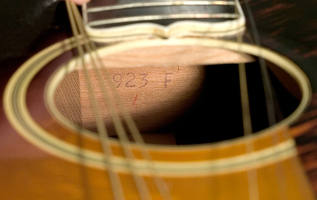
Serial No.923-F (factory order number)
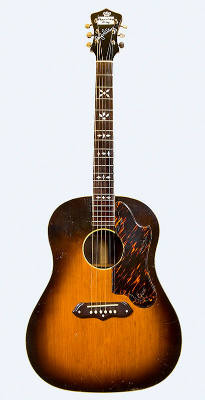
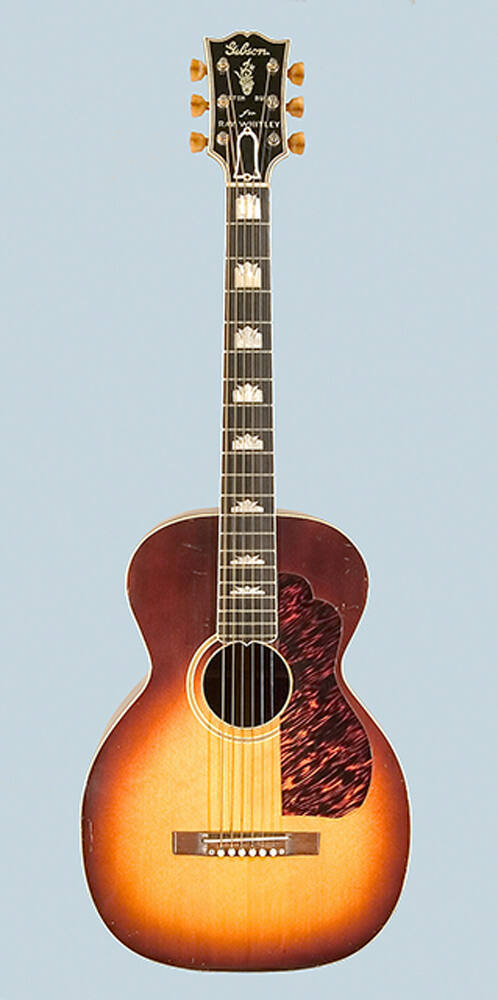
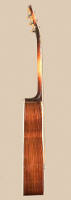
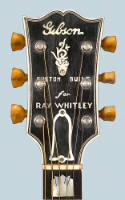
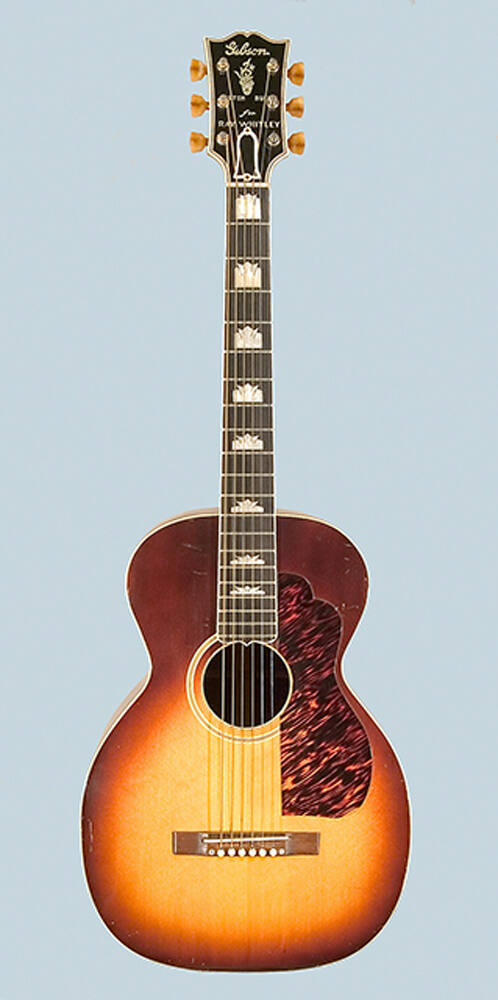
SignedInlaid onto headstock, inlaid in mother-of-pearl: (script) Gibson / [flower pot] / CU (text obscured by tuning peg) STOM BUILT / (script) for / RAY WHITLEYMarkingsStamped in black ink on neck block, the number 1 penciled in red: 923-F / 1 DescriptionThis Gibson flat-top guitar was custom-built for Ray Whitley, the cowboy movie star and writer of Gene Autry's theme song, Back in the Saddle Again. Whitley was involved with Gibson’s Super Jumbo 200 guitar from its inception, having worked with Gibson during the production of several prototypes.Stringing: six steel strings
Soundboard: two-piece spruce: medium grain broadening toward the sides
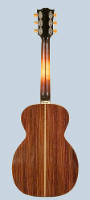
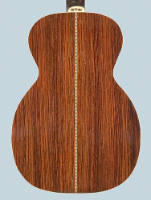
Back: two-piece rosewood; light and dark hardwood backstrip consisting of alternating angled light and dark hardwood surrounded on each side by smaller light and dark hardwood angled in opposite direction, enclosed in light strips
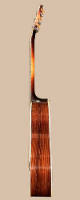
Ribs: two-piece rosewood; no end graft
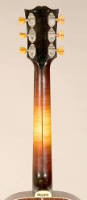
Head: dark-brown lacquered maple veneered with black lacquered maple, bounding ivory celluloid with four-ply ivory and black celluloid strip trim; "Gibson" and "CUSTOM BUILT for RAY WHITLEY" inlaid in mother-of-pearl inlay; decorative foliate mother-of-pearl inlay; white and black plastic bell-shaped truss rod cover secured to face with two nickel-plated steel, domed Philips-head screws; two screw holes in back of head near upper edge, possibly from earlier strap loop
Neck: dark-brown-to-gold sunburst lacquered maple with medium curl; integral with head; rosewood stripe on back of neck
Heel cap: ivory celluloid with light and dark celluloid trim along inside
Binding: ivory celluloid
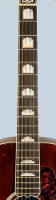
Fretboard: rosewood bound in ivory celluloid with light and dark celluloid strip trim on sides; 20 nickel-silver T-frets; large geometric mother-of-pearl fret markers behind 12st, 3rd, 5th, 7th, 9th, 12th, 15th, and 17th frets; single imitation tortoise-shell celluloid side dots behind 1st, 3rd, 5th, 7th, 9th, 15th and 17th frets; double imitation tortoise-shell celluloid side dots behind 12th fret
Nut: bone
Bridge: rosewood; two mother-of-pearl dots inlaid, one each inlaid beside bridge pins; angled bone saddle; ivory plastic bridge pins
Tuners: six nickel-plated steel Kluson worm-gear machine tuners with amber marbleized plastic heads
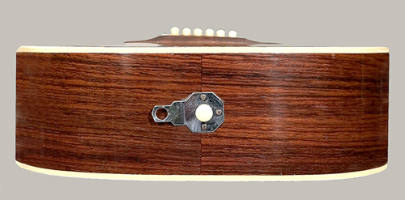
Endpin: ivory plastic; extends through chrome-plated steel strap holder secured to rib with three nickel-plated steel Philips head screws; corresponding steel strap loop secured to heel plate with two steel Philips head screws
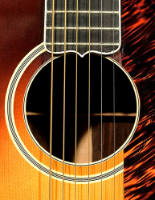
Rosette: 7-ply ivory and black plastic strips, the outer two ivory strips wider; sound hole bound in ivory celluloid with two-ply (black-white) celluloid purfling strips;
Pick guard: imitation tortoise-shell celluloid; overlaps rosette but not soundhole trim and binding
Lacquer: dark red-brown sunburst with fine craquelure on top; clear on back and ribs; dark red-brown sunburst; dark brown on head
Linings: kerfed mahogany
Neck block: mahogany; beveled edges
End block: mahogany; beveled edges
Top braces: spruce X-brace, the joint of main cross brace reinforced with white cloth; transverse and finger braces with tapered ends; maple bridge plate, screws through bridge into bridge plate
Back braces: maple back graft; four spruce back braces with tapered ends
Rib grafts: 10 spruce grafts with tapered ends on inside of ribsDimensionsTotal guitar length: 984 mm (38-3/4″)
Back length: 483 mm (19-1/32″)
Upper bout width: 251 mm (7-13/16″)
Waist width: 198 mm (10-1/2″)
Lower bout width: 345 mm (13-19/32″)
Rib height (including edging) at heel: 90 mm (3-17/32″)
Rib height, at waist: 97 mm (3-13/16″)
Rib height, at end block: 108 mm (4-1/4″)
Head length: 172 mm (6-25/32″)
Head width, top: 90 mm (3-17/32″)
Head width, bottom: 82 mm (3-7/32″)
Neck length (nut to ribs): 329 mm (13-15/16″)
Neck width, nut: 45 mm (1-25/32″)
Neck width, heel: 56 mm (2-3/16″)
Soundhole diameter: 89 mm (3-1/2″)
Vibrating string length (nut to bridge edge): high E: 661 mm (26-1/32″); low E: 663 mm (26-3/32″)
Scale length: 660 mm (25-31/32″)ProvenanceIn 1940, Whitley received from Gibson this special, custom-made guitar that resembled the SJ-200, but on a smaller scale. He called this instrument his "Party Guitar," and it appeared with him on the 1940 RKO comedy short, Bar Buckaroos. In 1944, Whitley sold it to Glenn Strange, best known as Sam the Bartender on the TV series, Gunsmoke. Purchased from Gruhn Guitars, Nashville, Tennessee, 1996.Published ReferencesFeatured on cover and described on pp.4-5 of Gruhn Guitar flyer, December 1995
André P. Larson, "Legends of the American West . . . Museum Acquires Cowboy Singer Ray Whitley's Party Guitar," America's Shrine to Music Museum Newsletter 25, No. 5 (November 1998), pp. 1-2.
“Ray Whitley’s 1940 Gibson ‘Party Guitar’,” Vintage Guitar Magazine, Vol. 9, No. 8 (May 1995).
Credit LineArne B. and Jeanne F. Larson Fund, 1996
Object number05991
On View
On view