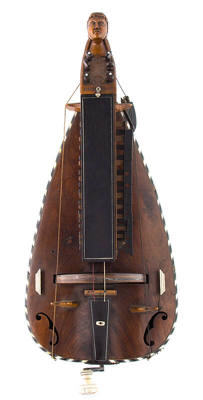
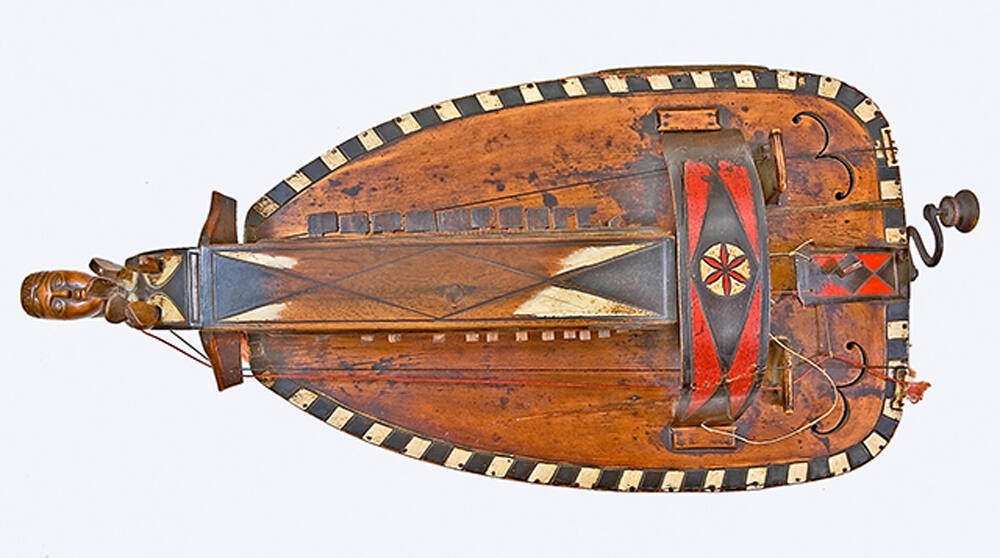


Vielle à roue en luth
ALTERNATE NAME(S)
- Hurdy-gurdy
Date1880-1920 ca.
Place MadeSavoy, France, Europe
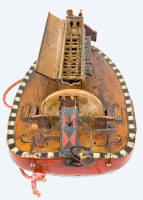
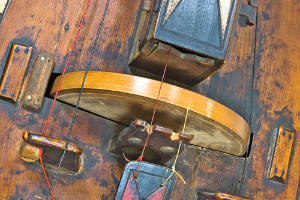
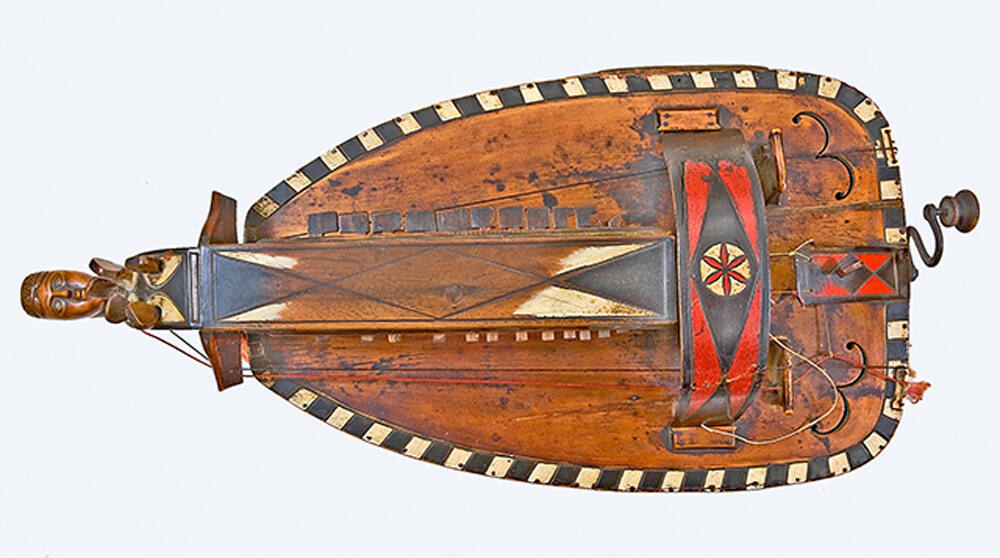
SignedNoneDescriptionThe vielle à roue, or hurdy gurdy, employs a rosined wheel to sound the strings. The combination of melody and drone strings resembles a bagpipe in sound. This example is a folk instrument made in the late 19th or early 20th century with only diatonic keys.Lute-shaped body
Stringing: two melody strings; three drone strings, two on bass side and one on treble
Soundboard: maple; slightly arched; decorative edging comprised of alternating black and white painted blocks, incised along the borders; top is nailed to body
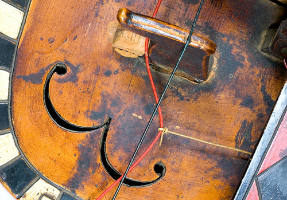
Soundholes: two "3"-shaped soundholes in lower bouts
Bowl: bent hardwood, possibly maple; structure is concealed under white, yellow and back striped paint and duct tape
Clasp: integral with bowl, structure is concealed with red paint
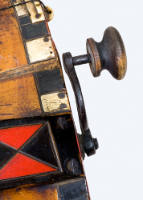
Crank: iron; black painted light hardwood handle
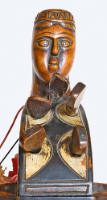
Head: maple; decoratively carved young male head; front of pegbox incised with crossed decoration, painted white and black
Keybox: yellow-painted light hardwood
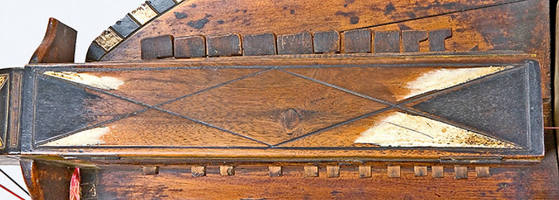
Keybox cover: walnut with X-shaped incised decoration, painted white and black
Keys: 12 walnut diatonic keys
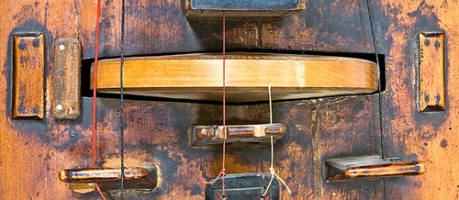
Wheel: light hardwood, possibly linden
Wheel cover: three pieces of bent walnut; crossed line and pinwheel incised decoration, painted white, red, and black
Bridge and string supports: maple
Tailpiece: maple veneered with ebony, with bone stringing around perimeter; bone peg with ivory pin mounted through face and coming in contact with top
Pegs: five light hardwood, possibly linden
Strap button: light hardwood on bass sideDimensionsTotal length: 669 mm
Body length: 495 mm
Maximum body width: 329 mm
Body depth: 98 mm
Length of keybox: 312 mm
Melody string length: 336 mm
Drone string length: 391 mm
ProvenanceAcquired by Laurel E. Anderson in Barbizon, France, in 1926. Published ReferencesSusan Palmer, The Hurdy-Gurdy. David & Charles: London, 1980, p. 30.
Credit LineGift of Laurel E. Anderson, 1988
Object number04340
On View
Not on view