
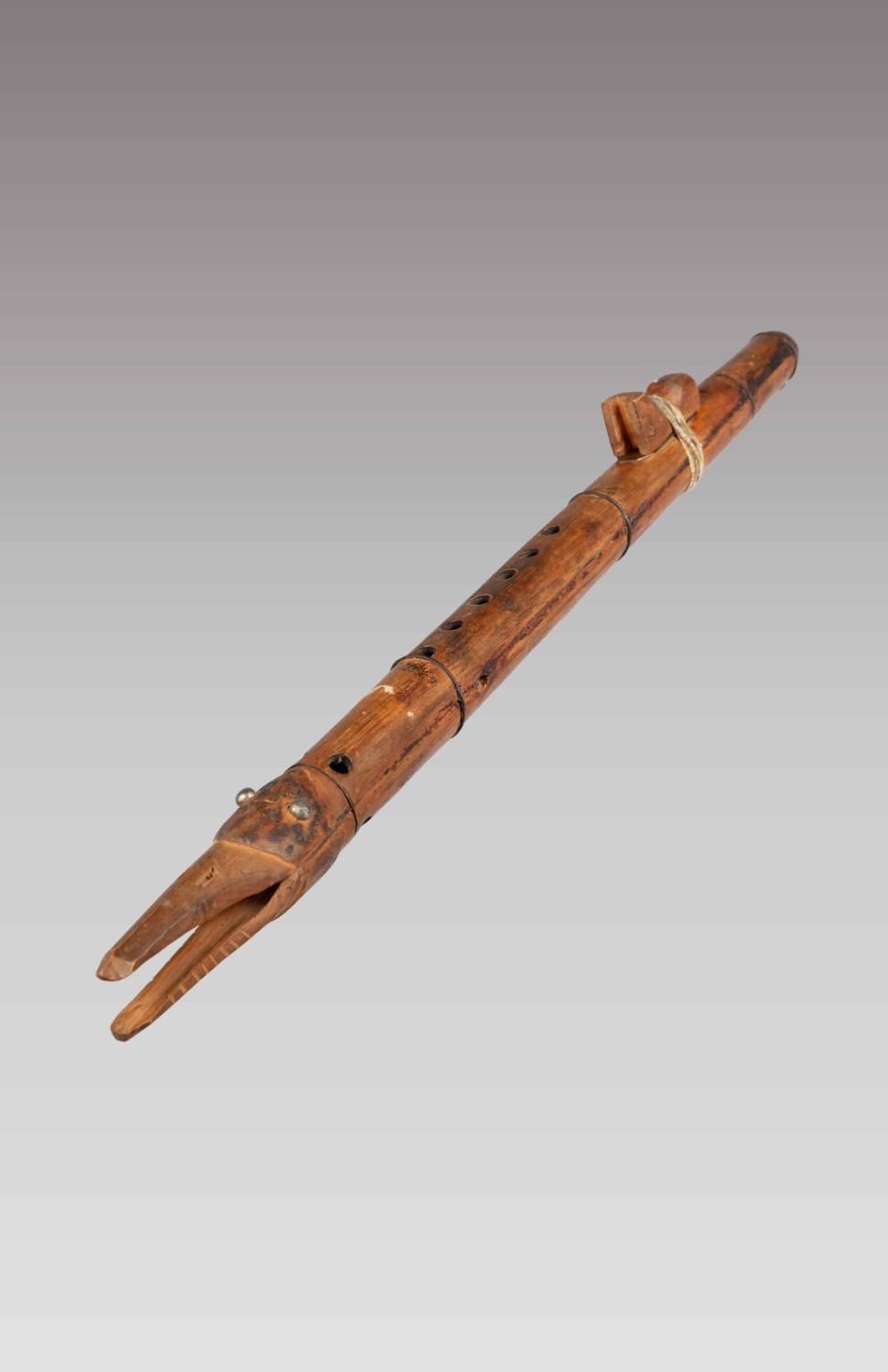
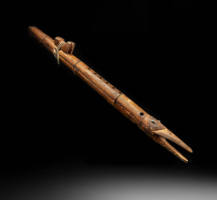


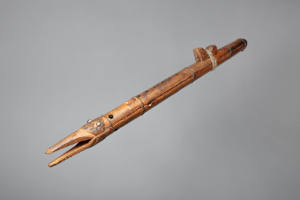
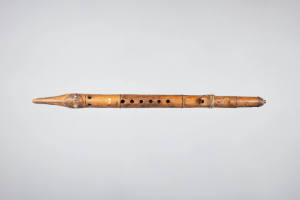

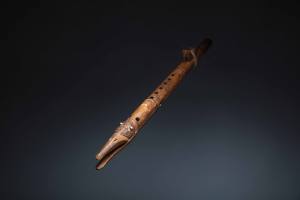

End-blown flute
ALTERNATE NAME(S)
- Courting flute
- Native American flute
Maker
Native American Indian
Date1885-1915 ca.
Place MadeNorthern Plains, United States, North America
Serial No.None
SignedNoneMarkingsText stamped on visible end of bullet casing: WRA.CO / 25-20 W.C.F.Written in pencil on back of shaft, opposite finger holes: $5.00
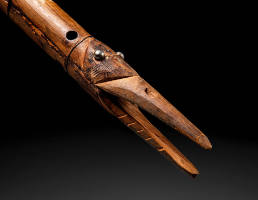
Remnants of white adhesive label on front of shaft below sixth finger hole, between the fourth and fifth wire ringsDescriptionIndigenous people across North America have used flutes and whistles for generations. Some play only one or two pitches, but others can play many. These songs might express deep emotions, offer prayer, or even signal romantic interest. Inspired by wildlife on the Plains, it depicts a water bird. Perhaps, the flute’s maker used the image of a sandhill crane to summon the birds’ courting skills. Notice the use of materials — the wire bindings, the brass tack eyes, and a bullet casing where the player blows into the flute. These may have been the maker’s preference, or the materials available at the time.
End-blown with external duct. Wood with bullet casing as mouthpiece; carved wood saddle and stylized bird bell. Six tone holes.
Dimensionslength: 650 mm (25.6 in)
diameter: increasing from 31 mm (1.22 in) to 43 mm (1.7 in)
length of mouthpiece: 7.5 mm (0.3 in)
mouthpiece bore: 4.7 mm (0.19 in)
chamfer length: 67.6 mm (2.67 in)
chamfer width: 24 mm (0.95 in)
distance between finger holes: ranges from 14.4 mm (0.57 in) to 15.8 mm (0.62 in)
diameter of finger holes: 10 mm (0.4 in)ProvenanceNo known provenance. Published ReferencesSilva, Ana Sofia. "Digging the Fifties: A Curatorial Perspective on 50 Objects from the NMM Collections." NMM Notes (October 2023): 17-18.
Arianna Van Kley and Michael Suing. _Of Thee I Sing: Origin, Heritage, and Patriotism_. National Music Museum, 2026: 16-17.
Credit LineArne B. Larson Collection, 1979
Object number04050
On View
On view
1850-1875 ca.
1973 ca.
1973 ca.
1900 ca.