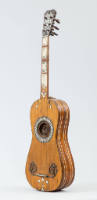
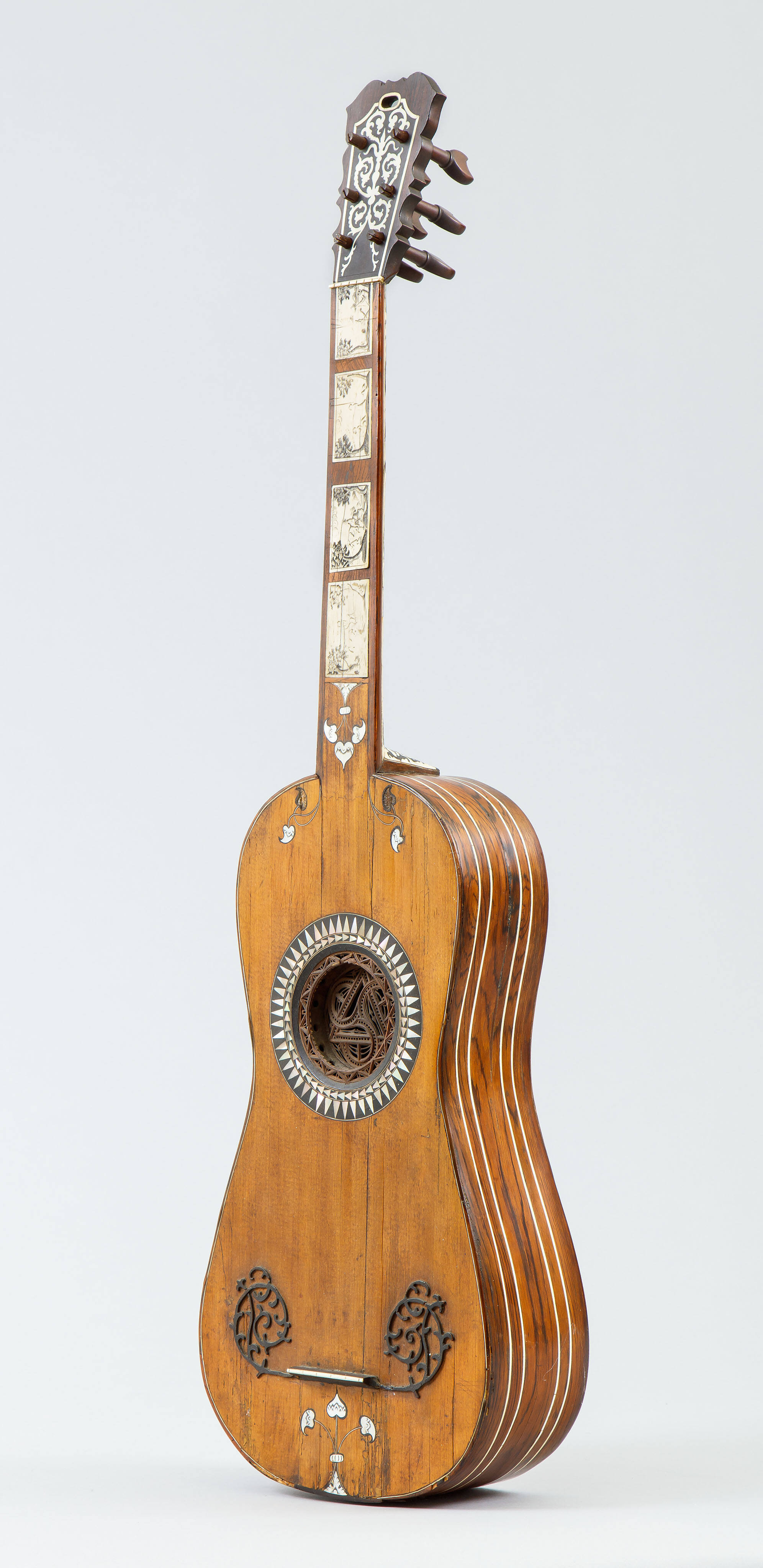
Guitar
Date1650 ca.
Place MadeItaly, Europe
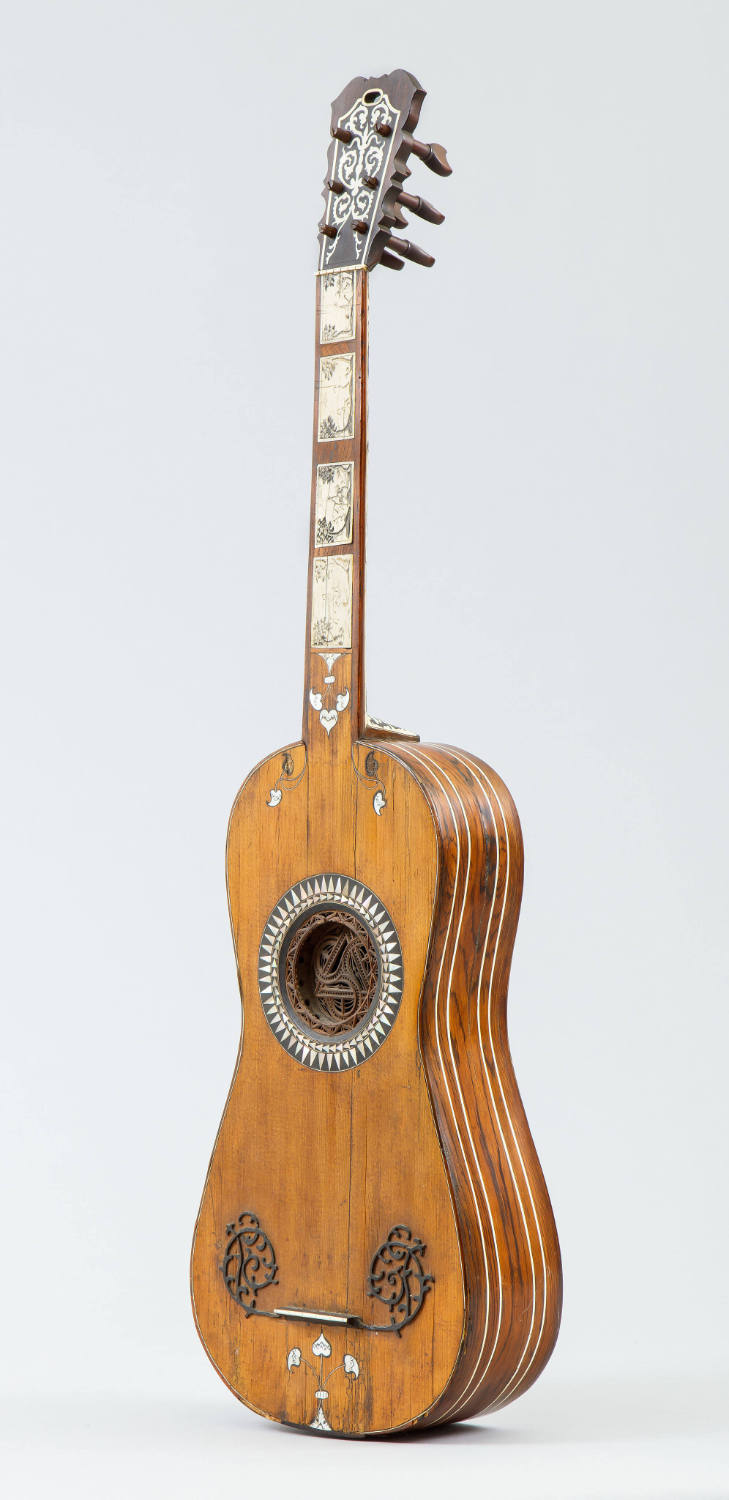
SignedWritten in black ink on paper label: Io Giovani Mariapo da Nine / la Cornolai in Cadore li 27 go: / i731DescriptionThis guitar is of an unknown maker, though likely in the Venetian tradtion. It has been converted to a six-string guitar in the nineteenth century and received a later back, but preserves its original, delicately constructed parchment rose.Stringing: originally five double courses, converted to six single strings
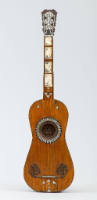
Top: two-piece spruce: fine grain, wood of top extends 58 mm over neck; edge veneered in rosewood with two-ply rosewood and ivory strip trim
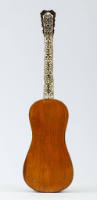
Back: one-piece cypress with black mastic filled line around edges; possibly later
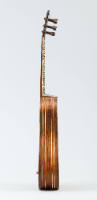
Ribs: 5 rosewood ribs, the center and outer two wider, interspersed with ivory strips; later dark-brown-stained clasp with six string holes and festooned lower edge
Head: poplar veneered with rosewood and scroll cut vine-type ebony and ivory; festooned outline; later, for six-string setup
Neck: veneered with ebony and ivory vine marquetry on back; bordered with two-ply rosewood and ivory strip trim
Fingerboard: rosewood with four ivory plaques with ink-filled engraving, all of rural scenes; scene closest to body effaced; next scene is hunter on horse, next is two women, one seated, and a bird; plaque closest to head cut shorter, with man on a gondola and man fishing from shore
Nut: ivory
Bridge: later ebony bridge with ivory saddle, over which strings pass to be secured in lower rib; original black-stained light hardwood vine moustaches
Pegs: six later rosewood with concave ends and ivory pins
End button: none
Rose: rose comprised of three layers and two tiers; top layer of fruitwood and lower two layers of parchment; parchment recess sides
Rosette: two layers of pink and green abalone triangles facing 90 degrees to one another, set into black mastic; two-ply rosewood and ivory strips on outside and dividing layers of triangles, and three-ply ivory-rosewood-ivory strip trim on inside edge
Top decoration: incised and black mastic filled vine and spear inlay, with three-ply rosewood-ivory-rosewood strip stems, at upper and lower parts of topProvenanceLaurence Witten acquired the guitar from a music store in New York City, 1970.
Purchased by the National Music Museum from Laurence Witten family, New Haven, Connecticut, 1984.Published ReferencesAndré P. Larson, “Early Italian Plucked Stringed Instruments at the Shrine to Music Museum,” Lute Society of America Newsletter, Vol. XX, No. 1 (February 185), p. 8.
Credit LineWitten-Rawlins Collection, 1984
Object number03438
On View
Not on view
1720-1740 ca.