
Devil’s fiddle
ALTERNATE NAME(S)
- Teufelsgeige
Maker
Hal Rammel
Date1989
Place MadeCedarburg, Wisconsin, United States, North America
Serial No.None
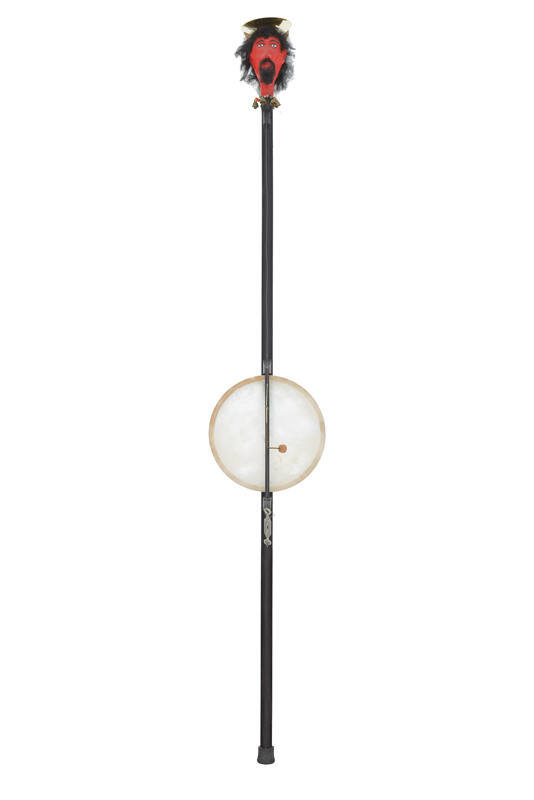
SignedNoneDescriptionThe Devil’s Fiddle (Hal Rammel)Hal Rammel: "The devil’s fiddle (or bumbass, bladder and string, etc.), defined principally by a small pair of cymbals perched atop a tall pole with a drum sounded by bowing - with a notched stick - a string stretched across its surface, appeared in my arsenal as part of research on these instruments for an article in Experimental Musical Instruments."
Hal Rammel: "As I improvised with an instrument originally designed for raucous carnival or streetcorner percussion (with a history extending back several hundred years), I realized, beyond the limitations of its curious drumroll effect and lumbering thud (the high-hat is sounded by hitting the instrument’s ‘foot’ against the floor), I was offered a way to approach percussion not so very different from the way I play the triolin. The left hand manipulates the body of the instrument against a mallet or bow in the right. The second devil’s fiddle I built added a multitude of sounding elements (bells, woodblocks, scrappers, a larger drum) as this technique made it possible to juxtapose wood, metal, and skin sounds in a wide range of timbres with great ease. The work of John Stevens, Paul Lovens, and Paul Lytton pointed me in directions such combinations might take. In this instrument I found percussion pitched squarely in the dynamic range I frequented in acoustic improvisation and played in much the same manner as I had explored in my handheld instruments. Exploring multidimensional percussion (to borrow a phrase from Jerome Cooper) in a relatively quiet musical context (with acoustic guitar and violin in the trio Van’s Peppy Syncopators) directed me to design an array of new mallets and notched bows and to rearrange the numerous sounding devices mounted on the devil’s fiddle’s five-foot stalk."
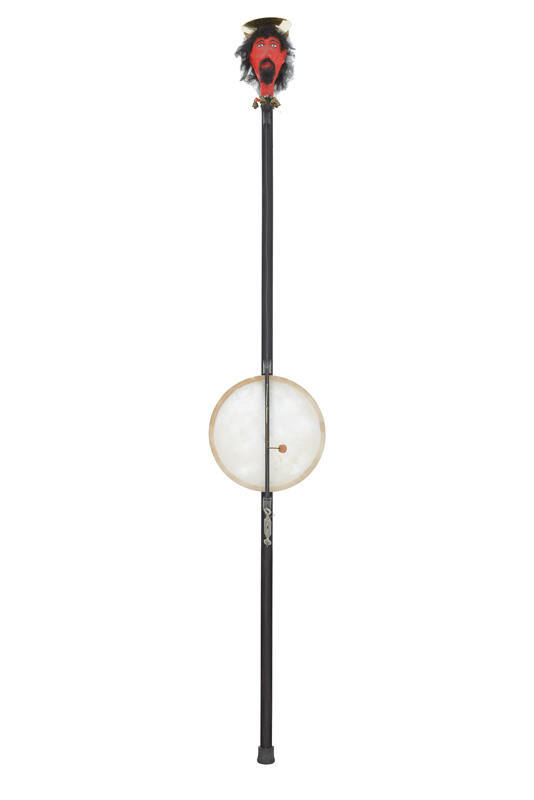
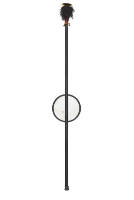
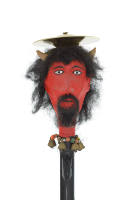
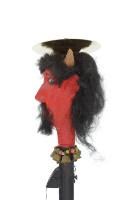
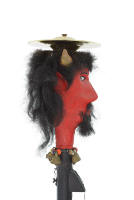
Also known as a bumbass or bladder and string, the devil’s fiddle is a long pole, topped with a red ‘devil’s head’ with a set of cymbals on top of the head, attached loosely with a screw, and 6 small bells around the ‘neck’. At the bottom end of the stick is a rubber crutch tip. A wire runs through the stick below the head, with a block of wood that acts as a bridge close to the top of the string with another at the bottom of the string. The string runs to within about a foot of the bottom end of the stick, attached at the bottom with a turnbuckle.
In about the middle of the stick is a small frame drum that is tapped with a small plastic object which is attached to the string by bent wire. The ‘bow’ is dragged across the string to activate the drum beater. The speed of the bow determines the speed of the drumming.
Bow. A piece of 1/8th in. wood, cut in ‘teeth’ resembling a hack saw blade. It is painted flat black and has a hole in one end.DimensionsFiddle:
Overall Length: 71 in
Length from bridge to bridge: 39 in
Height of head (top of cymbals to bells: 8 in
Cymbals diameter:5 in
Length from top bridge to edge of drum: 24 ½ in
Diameter of drum: 11 in
Distance from bottom of drum to bottom of stick: 26 in
Bow:
Overall: 23 1/8 in x 1 in
Length of handle: 5 in
Teeth: 1 in x ½ inProvenanceNo known provenance. Published ReferencesRammel, Hal. “History of the Devil’s Fiddle, Part 1.” Experimental Musical Instruments Volume VII #3. Nov. 1991. 12-15
Rammel, Hal. “History of the Devil’s Fiddle, Part 2.” Experimental Musical Instruments Volume VII #4. Jan. 1992. 15-19.
Credit LineGift of Hal Rammel, 2013
Object number14733
On View
Not on view
1950-1970 ca.
1926-1928 ca.