Mayuri veena
ALTERNATE NAME(S)
- Taus
- Long-neck lute, bowed
Date1850-1875 ca.
Place MadeIndia, Asia
Serial No.None
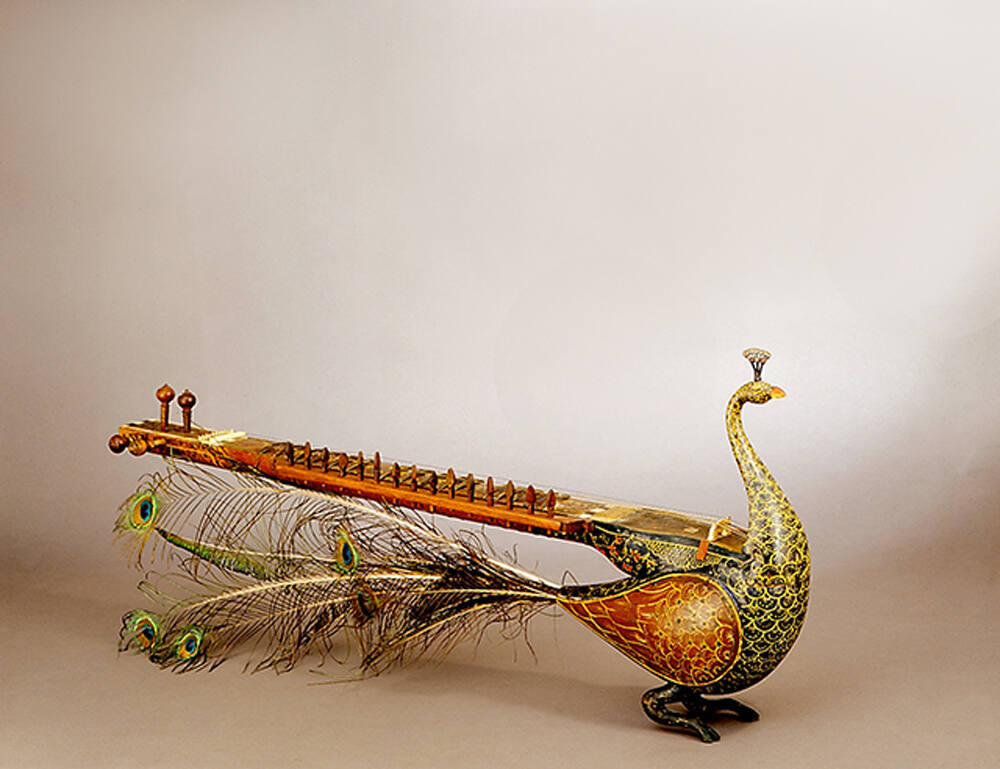
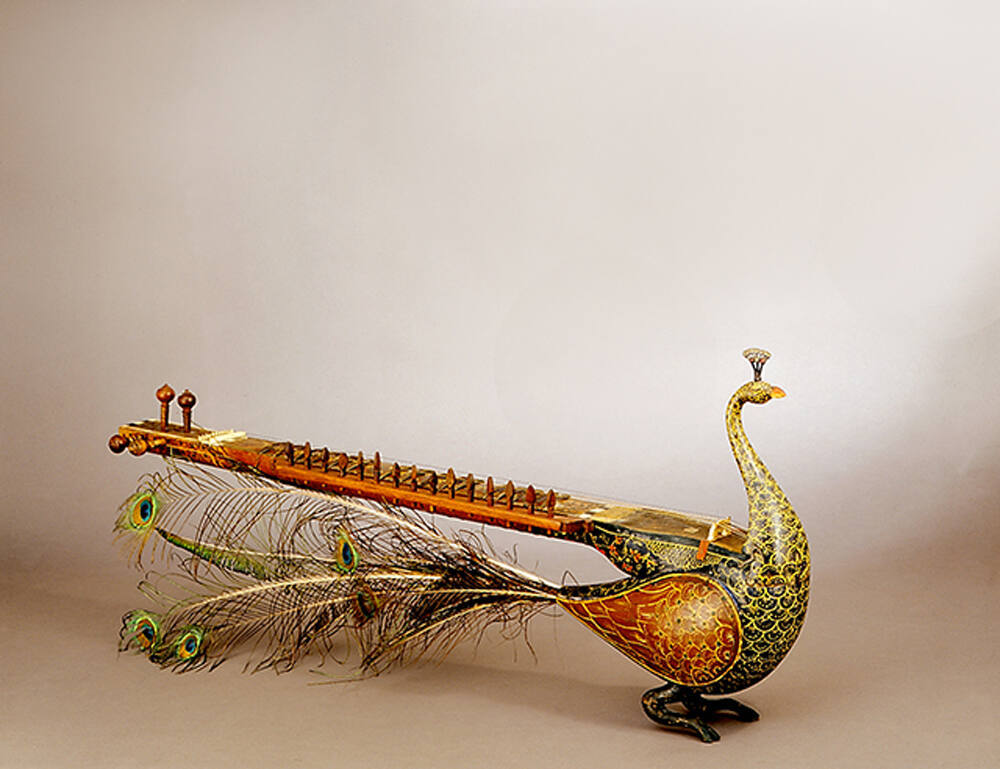
SignedNoneDescriptionThe mayuri veena (or taus) is a peacock-shaped, bowed instrument that was popular in the Indian courts of the 19th century. It is closely related to the dilruba and esraj, which have a similar construction but lack the ornate decoration. In Sihk traditions, it is said the taus was invented by a guru in the 17th century. It is common for such instruments to have real tail feathers, adding to the already fantastic illusion. The mayuri, or peacock, is a symbol of India; it is associated with Saraswati, the goddess of music; and, is also a symbol of courtship. Sixteen frets, four melody strings, and fifteen sympathetic strings.
Peacock-shaped, bowed, long-necked lute with movable frets.
Materials: wood body and pegs; skin sound table; bone bridge, nut, string guide, and decoration; copper and steel strings; brass frets and hooks; gut fret ties; lead crest (peacock head feathers), peacock beak and feathers.
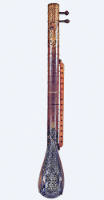
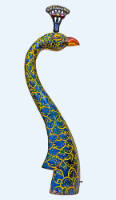
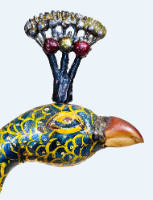
Body: Three main parts: upper body, lower body, and neck. The body shell is in two conjoined parts. The top of the body has wasted sides and is similar to the shape of an esraj (bowed string instruments from India); this section has a skin sound table attached with metal nails. The end of the top of the body bluntly terminates and forms an L-shaped drop. This cut-out section of the body has two pegs for the strings to attach; it is also where the peacock head attaches to the body. The lower body shell is shaped like a peacock body complete with legs. The lower body is hollowed out and has an open hole at the end of the tail. Peacock feathers are inserted into the hole. The instrument neck is hemispherical and hollowed. The pegbox is linear to the neck with two pegs in the front and two on the side. An additional pegbox is screwed to the left side of the neck. It is a long piece of wood with fifteen pegs for the sympathetic strings running parallel to the melody strings. The three parts appear to be carved from one piece of wood. Detachable peacock head and neck carved from wood with actual peacock bill. Three metal hooks secure peacock head to instrument body.
Bridge, nut and string guide: Bone bridge resting on red-colored, sheepskin strip slightly below center of sound table. Bridge has indentations for melody strings on the top and fifteen holes for the sympathetic strings. Bone nut has smooth top – possibly a replacement. Bone string guide has serrated top with eleven points. Ten holes for melody strings. Melody strings are currently passing through the second, fourth, fifth and eighth guide holes.
Strings and pegs: Four brass melody strings pass over frets and fifteen steel sympathetic strings angle from the bridge to the left side of the neck. Four melody string pegs with round turners. Fifteen sympathetic strings pegs, five are replacements made by Gary Stewart. Pegs have teardrop-shaped turners.
Frets: sixteen brass moveable frets. Each fret is tied to neck with thin gut strings.
Decoration: Highly decorative. Peacock head and body painted blue with yellow and green accents; wings painted red; red floral design at neck heel; peg box has floral design, bone and ebony inlay around the top of the peghead; fretboard has gold floral design; peacock head has a removable cast metal crest; peacock feathers used as tail.DimensionsOverall length: 1110 mm
Overall height (not included peacock head or bridge): 225 mm
Height of bridge: 20 mm
Sounding length of melody strings: 820 mm
ProvenanceBefore 1981, previously owned by Clifford A. Allanson, Delmar, New York. In 1981, sold at auction by John Blaine Warner, II, Cohoes, New York, Lot No. 509, to the National Music Museum.Published ReferencesThomas E. Cross, Instruments of Burma, India, Nepal, Thailand and Tibet, The Shrine to Music Museum Catalog of the Collections, Vol. II, André P. Larson, editor (Vermillion: The Shrine to Music Museum, 1982), p. 12.
Thomas E. Cross, Instruments of Burma, India, Nepal, Thailand and Tibet, M.M. Thesis, University of South Dakota, May 1983, p. 26, plate IX.
"Behind the Scenes . . . The Art of the Conservator," Shrine to Music Museum, Inc. Newsletter 9, No. 4 (July 1982), pp. 1, 3-4.
André P. Larson, The National Music Museum: A Pictorial Souvenir (Vermillion: National Music Museum, 1988), pp. 9 and 29.
Ido Abravaya, Music at First Sight II: Musical Instruments (Ramat-Aviv, Israel: The Open University of Israel, 2006), front cover.
Ted Muenster, “South Dakota’s shrine to musica,” Prairie Fire, Vol. 3, Number 4 (April 2009), pages 12-15. (mislabeled as a vertical slit drum)
Credit LinePurchase funds gift of Lydia and Edwin Downie, 1981
Object number02903
On View
Not on view
1885-1900 ca.
1900-1925 ca.
1875-1925 ca.