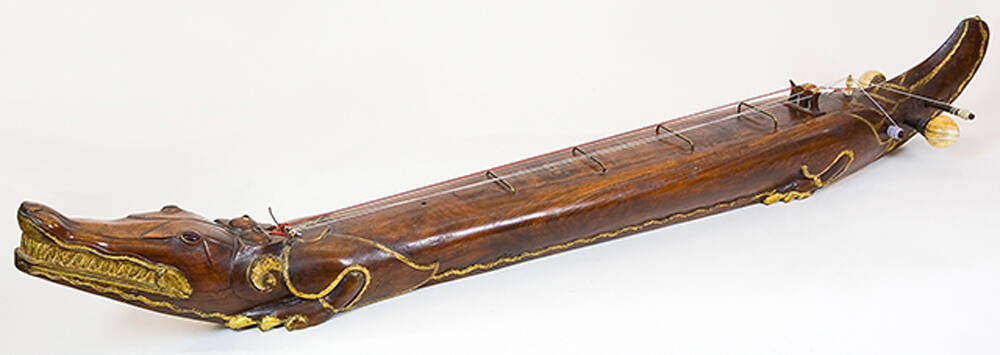
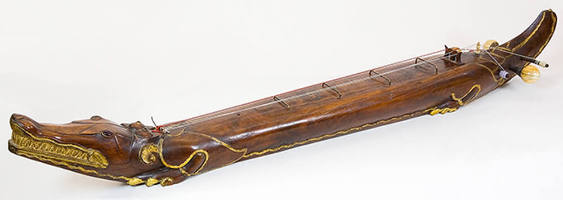

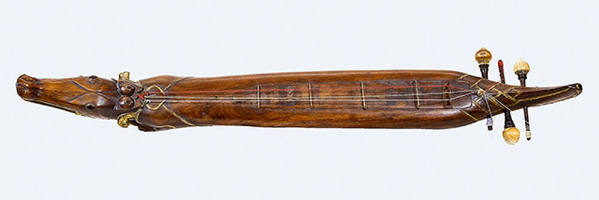
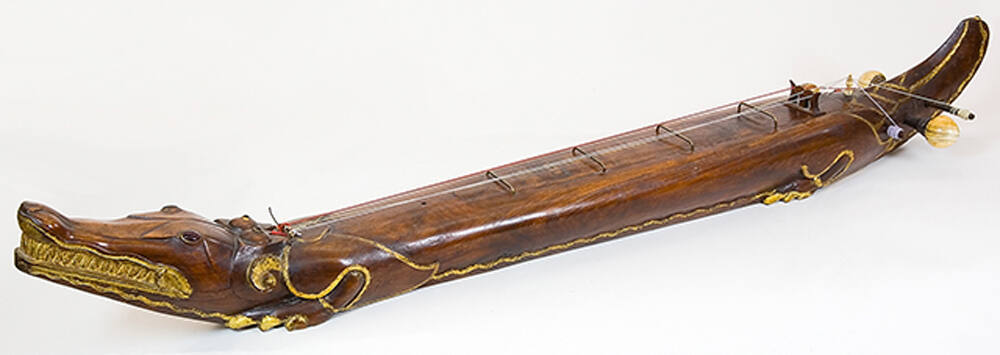
Mi-gyaung
ALTERNATE NAME(S)
- Kyam
- Crocodile zither
- Mi-gyaun
- Megyaun
Date1860-1885 ca.
Place MadeMyanmar (Burma), Asia
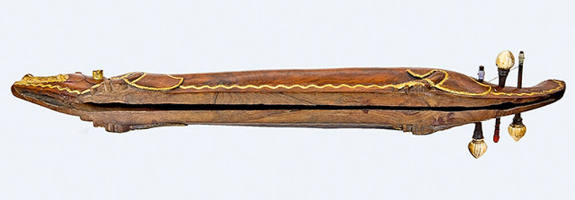
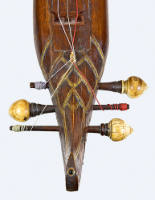
SignedNoneDescriptionElegantly carved teak wood body with gold leaf embellishments throughout. Three wooden pegs with ivory tips resembling lotus flower buds.Sometimes referred to as a crocodile zither, this instrument is known for its characteristic buzzing sound, said to emulate a crocodile's mating call. Often, when an instrument mimics an animal, it is believed one can access qualities inherent to the animal, in this case, strength and ability to easily move from land to water. This may be associated with passage between the lands of the living and the dead.
The instrument likely originated with the Mon people, an ethnic group that inhabited the Irrawaddy River delta, believed to be among the earliest civilizations in the area. Later, as power and territory shifted, the Mon were divided between Myanmar (Burma) and Thailand. It may be for this reason that similar zithers can be found in Thailand and neighboring Cambodia.
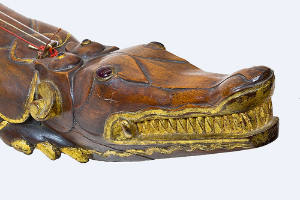
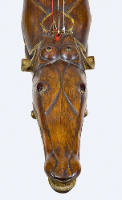
Rosewood carved in shape of a crocodile with slit opening on underside; 3 rosewood pegs with large ogee ivory tips at the tail end; ruby glass eyes with stars impressed on underside, set into gilded brass bezels; two addition cabochon ruby glass decorations on top of crocodile head, and one on tail, all set into gilded brass bezels.
Outlines of the body, feet and teeth are gilded; 3 strings; 4 brass wire frets; possibly additional frets glued to top, now missing. Rosewood bridge. Head crack repaired with drilled holes and brass wire.DimensionsTotal mi-gyaung length: 1088 mm
Maximum depth: 170 mm
Maximum body width: 120 mm
Maximum body depth: 73 mm
Vibrating string length: 555 mmProvenancePurchased in 1979, from Wurlitzer-Bruck, New York, New York, who purchased it at Sotheby's, London, England, lot 52, 19 June 1979.Published ReferencesThomas E. Cross, Instruments of Burma, India, Nepal, Thailand, and Tibet, Shrine to Music Catalog Vol. II (1982), p. 3.
Thomas E. Cross, Instruments of Burma, India, Nepal, Thailand, and Tibet in the
Collections of the Shrine to Music Museum, MM Thesis, University of South Dakota,
1983, p. 54, plate XXII.
Credit LineBoard of Trustees, 1979
Object number02618
On View
Not on view
1950-1970 ca.
1950-1970 ca.
1960 ca.
1990
1950-1975 ca.