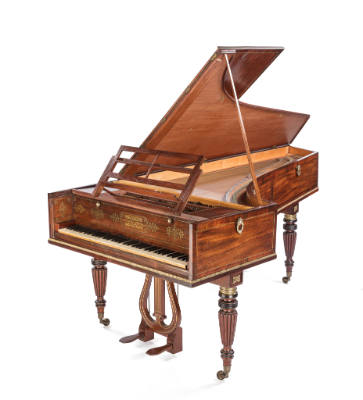
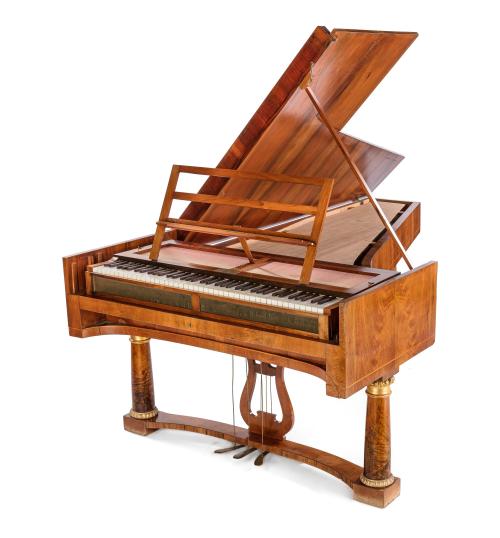




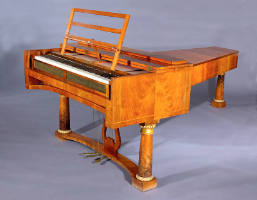

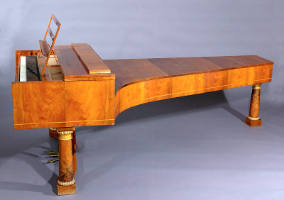


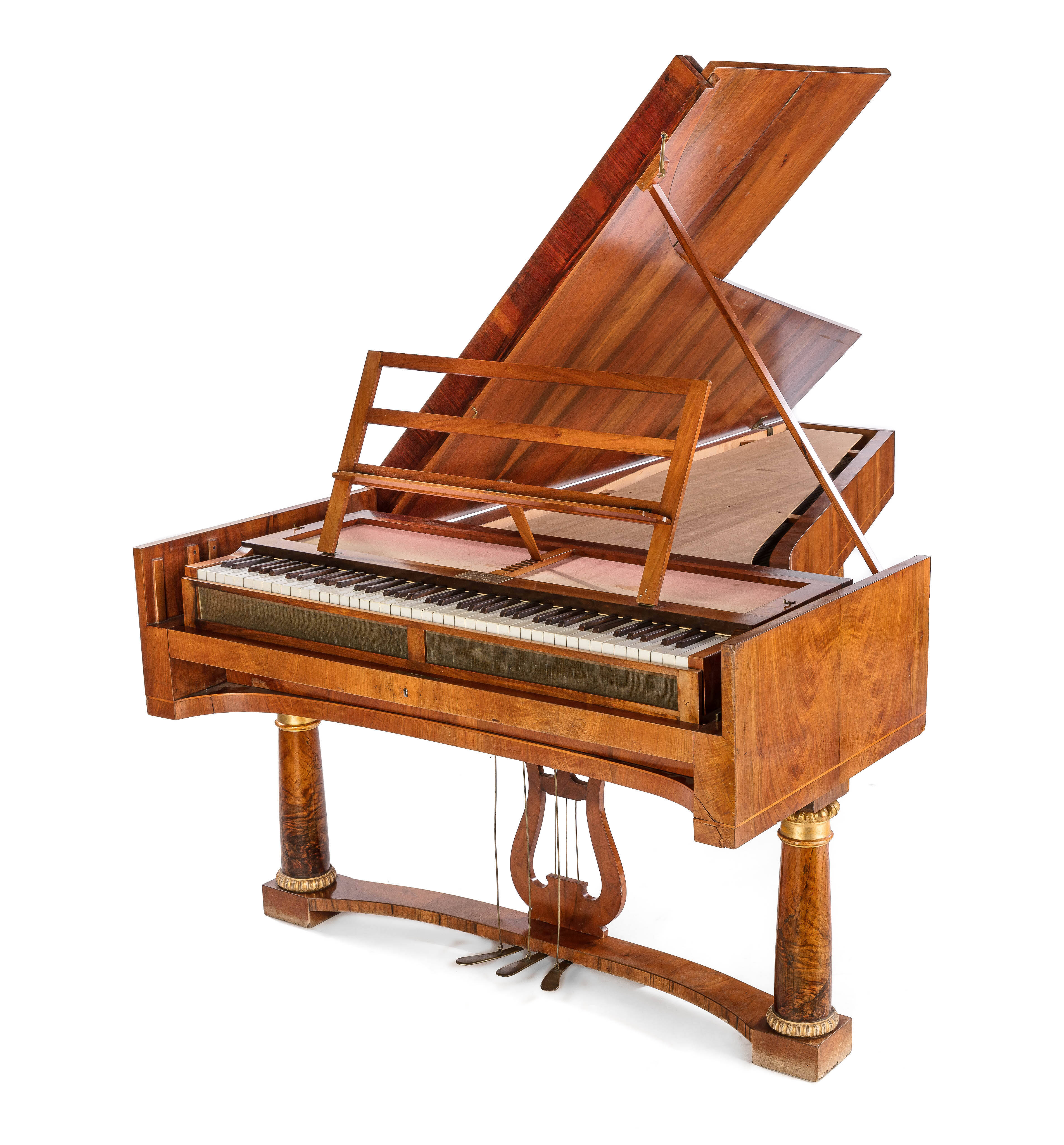
Grand piano
Date1829
Place MadeVienna, Austria, Europe
Serial No.2316 in Streicher's total production, no. 136 of this model
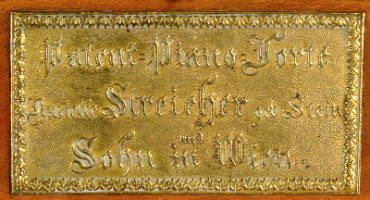
SignedEmbossed gilt metal plate on the music desk: Patent=Piano=Forte / Nannette Streicher geb: Stein [the "n in the maker's first name has a line over it, a common abreviation for double "nn"] / und / Sohn in Wien.Oval paper label printed from an engraved plate, with numerals written in black ink, on the soundboard: Nro [the "ro" superscript] / STREICHER geb. Stein / und / SOHN / WIEN, 1829 / 136MarkingsRectangular blue paper label, lithographically printed:
Englische und Wiener Forte=Piano Handlung. / VON / F.H. Lütgert in Hamburg.DescriptionThis immaculately preserved piano represents a glorious moment in the history of instrument making. A radically re-designed new model with a downstriking action, of which the NMM’s example is one of the earliest in existence and undoubtedly the best preserved, it was patented in 1823 by Johann Baptist Streicher, Nanette’s son, the same year that he joined the firm as a partner. The Streichers maintained a long and very cordial association with Beethoven. The downstriking model, expensive to produce, was the top of their line.
Compass CC to f4 (6-1/2 octaves).
CC-DD# 2 strings; rest 3 strings
Brass strung from CC to E; iron from F# to f4
Three pedals: una corda, due corde, dampers
Downstriking action, as patented by Johann Baptist Streicher.
Biedermeier-style case, veneered in mahogany; but in maple around the soundboard. Spruce dust-cover over the soundboard. Three legs in the form of unfluted classical columns with gilded ornamental bases and capitals; the two front legs with a stretcher to hold the pedal lyre. DimensionsOverall dimensions:
Length: 2438 mm; 8 feet
Width: 1268 mm; 50-1/2 inches
Height at cheek: 320 mm
Height at tail: 185 mm
String lengths, diameters:
CC: 1971 mm; 1.94 mm diameter, gauge 12/0; 186 mm strike point
FF: 1875 mm; 1.37 mm diameter, gauge 8/0; 168 mm strike point
C: 1645 mm; 1.03 mm diameter, gauge 5/0; 138 mm strike point
F: 1360 mm; .87 mm diameter, gauge 4/0-1/2; 113 mm strike point
c: 1080 mm; .80 mm diameter, gauge 3/0; 90 mm strike point
f: 813 mm; .80 mm diameter, gauge 3/0; 75 mm strike point
c1: 538 mm; .77 mm diameter, gauge 3/0-1/2; 58 mm strike point
f1: 406 mm; .77 mm diameter, gauge 3/0-1/2; 47 mm strike point
c2: 278 mm; .77 mm diameter, gauge 3/0-1/2; 32 mm strike point
f2: 210 mm; .72 mm diameter, gauge 2/0; 24 mm strike point
c3: 140 mm; .72 mm diameter, gauge 2/0; 16 mm strike point
f3: 105 mm; .65 mm diameter, gauge 2/0-1/2; 12 mm strike point
c4: 73 mm; gauge 0-1/2; 9 mm strike point
f4: 56 mm; gauge 1/2: 7 mm strike pointPublished References[Banks, Margaret Downie]. [Caption to photograph of Nannette Streicher piano at the NMM]. _National Music Museum Newsletter_ 45, no. 1 (Winter 2021): 3.
Koster, John. "Downstriking Grand Piano by Nannette Streicher and Son." Journal of the Westfield Center 16, No. 1 (May 2003). Pages 3-5.
Larson, André P.. Beethoven & Berlioz, Paris & Vienna: Musical Treasures from the Age of Revolution & Romance 1789-1848. With essay by John Koster. Exhibition catalog, Washington Pavilion, Sioux Falls, South Dakota, September 12-November 2, 2003. Vermillion: National Music Museum 2003. Pages 17, 78-79.
Larson, André P., "Four Centuries of Great Keyboard Instruments: What They Tell Us." National Music Museum Newsletter 30, No. 1 (February 2003). Pages 1-2.
Larson, André P.. "NMM to Host International Meeting of AMIS, Galpin Society, and ICOM's CIMCIM," National Music Museum Newsletter 33, No. 1 (February 2006). p. 3.
Credit LinePurchase funds gift of Tom and Cindy Lillibridge, 2003
Object number10298
On View
Not on view