
![Fife in B-flat [A-flat]](/internal/media/dispatcher/98330/preview)
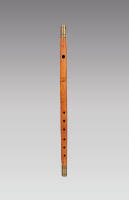
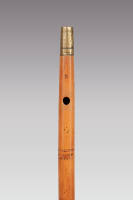
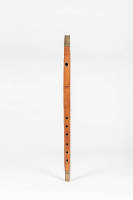
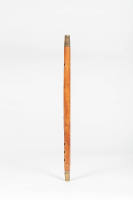
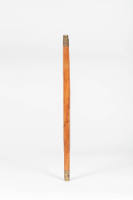

![Fife in B-flat [A-flat]](/internal/media/dispatcher/98330/full)
Fife in B-flat [A-flat]
Date1803-1818 ca.
Place MadeBoston, Massachusetts, United States, North America
Serial No.None
SignedStamped: Wm. CALLENDER / 62 MIDDLE ST / BOSTONMarkingsStamped between top ferrule and embouchure hole: BStamped between embouchure hole and signature, and between signature and first fingerhole: [illegible mark - might be sunburst/unicorn?]
Hand-scribed on body: "Lufo" or "Lufu" (in script)
Hand-scribed just above bottom ferrule: 1806DescriptionWood turners use lathes to make tools and other items, which include instruments like this fife. Callender is the first known American born woodwind maker who studied with an American teacher, Isaac Greenwood. By 1769, Greenwood had advertised his wood working services in the Boston Gazette, specifically mentioning fifes “and many other things in the turner’s way, cheap for cash.” During the Revolutionary War, the Board of War established the Boston Laboratory as a workshop, storage, and distribution center for the Continental Army. Historic documents prove that Callender worked there under Greenwood, making fifes and drumsticks for the war effort. Later, he served under Colonel Paul Revere and continued turning fifes until his death in 1839.
One-piece body of light-colored wood, with seamed brass ferrules. Cylindrical bore. Tapered profile with swell after embouchure, and fingerholes of uniform size. Oval embouchure hole.DimensionsOverall length: 431mm
Acoustical length: 346mm
Maximum swell diameter: 20.1mm
Bore: 10mmProvenanceNo known provenance.Published Referenceshttps://fifemuseum.com/william-callender-7/
Arianna Van Kley and Michael Suing. _Of Thee I Sing: Origin, Heritage, and Patriotism_. National Music Museum, 2026: 40-41.
Credit LineGift of Lynn and Steve Dillon, 2023
Object number15448
On View
On view
![Fife in B-flat [A-flat]](/internal/media/dispatcher/97096/thumbnail)
![Fife in C [B-flat]](/internal/media/dispatcher/95973/thumbnail)

1920-1935 ca.
![Fife in C, B-flat [B-flat, A-flat]](/internal/media/dispatcher/97464/thumbnail)
1850-1950 ca.
![Fife in C [B-flat]](/internal/media/dispatcher/96636/thumbnail)