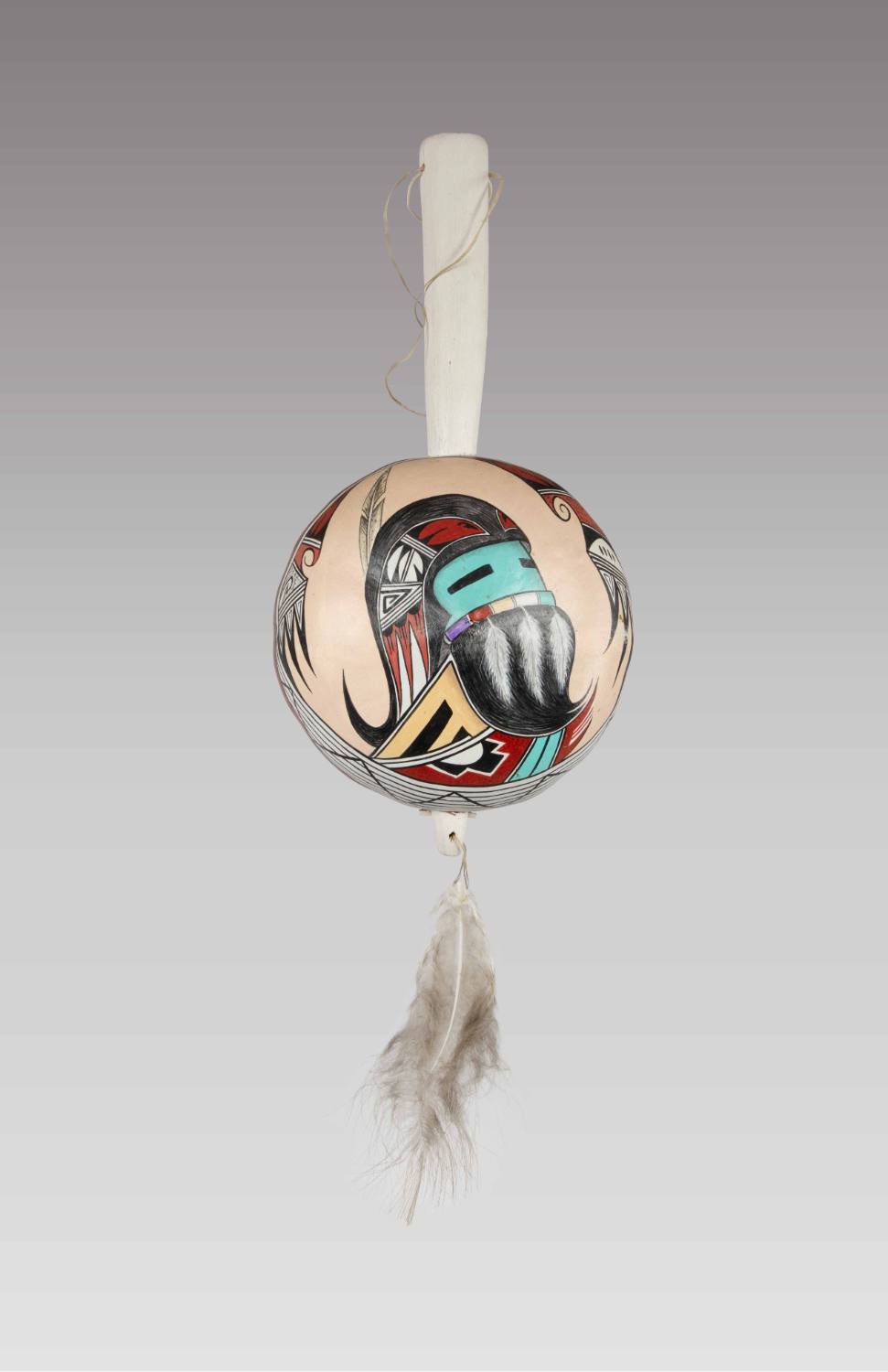
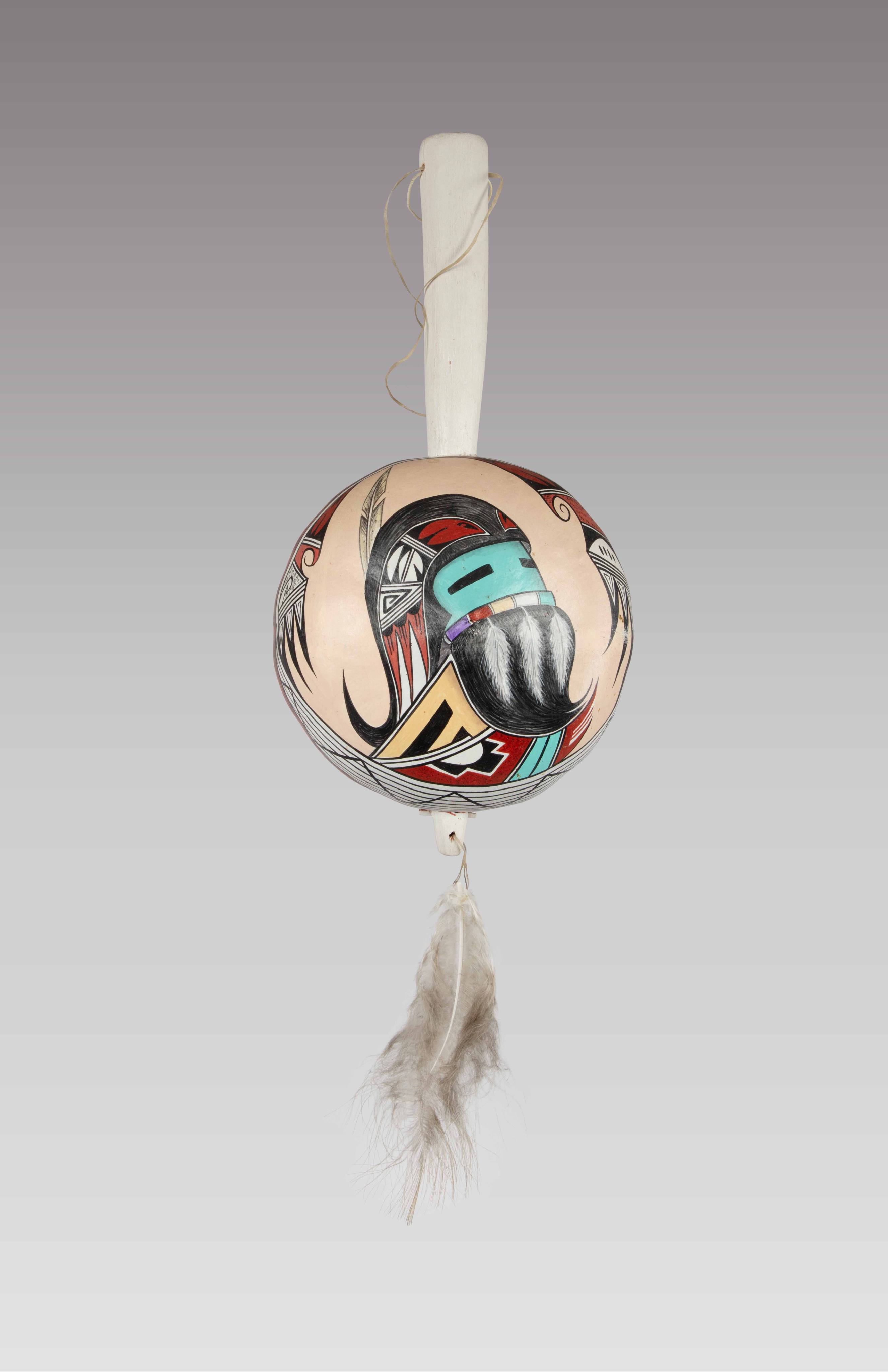
Gourd rattle
ALTERNATE NAME(S)
- Squash rattle
Maker
Frank Poolheco
Hopi Tewa
Date1989
Place MadeWinslow, Arizona, United States
Serial No.None
SignedHand-written near narrow end of handle, at top of rattle: F. Poolheco '89' Hopi-TewaMarkingsA spider is drawn when the handle is cut at the wide end.DescriptionRattles and other sound effects are common in Native American soundscapes. Sometimes, they are held by the player; other times, they are attached to a dancer’s clothing or shoes. In the Southwest, rattles can be made of dried gourds or rawhide, usually with corn and other seeds inside them. They are made and used for specific purposes, including ceremonies closed to outsiders. This rattle, however, was made for the thriving Native art market. Poolheco used Katsina figures on this painted gourd rattle, which represent helpful village-guiding spirits. The traditional colors and patterns are inspired by his parents’ artistry, but he decorated it in his own graphic style. Resonator consists of a dried and hollowed squash of unknown variety - short, flat, round and un-ribbed/smooth
Hand-carved wooden stick, traditionally cottonwood or a vegetal stalk inserted through the gourd; tapered end protrudes from opposite side of gourd, secured with small wooden peg through the handle; so friction fit on wide end, pinned at narrow end; wide end of handle with small suspension cords (sinew and cotton/synthetic) passing through a hole; narrow end of handle with sinew cord attaching a grayish-white fluff feather
Painted white throughout, then elaborated with two framed figures (one each front and back), surrounded by geometric designs in bands of white and brownish red, outlined in black
Depicts two Kachinam (plural of Kachina/Katsina), in blue, blue-green, green, black, red, white and yellow, as below:
1 - Angak (Angak'china), also known as Long Hair, Longhair or Longed Hair Kachina (Katsina), depicted with long flowing black hair and beard (both symbolic of rain); three fluff feathers (traditionally eagle) hang form his beard, representing clouds; he wears a ceremonial robe with geometric designs along the border; the blue-green/turquoise color of his face is symbolic of the west/southwest, which is associated with the spirit realm
2 - Mana Kachina (Kachina/Katsina Mana, Kachin Mana) or Maiden Spirit, depicted with squash blossom whorl hairstyle in figure-eights, traditional of unmarried Hopi girls; a manta (ceremonial robe) with wide red and blue stripes and narrow green and red stripes; she wears a mask with fringed beard and three fluff feathers, symbolic of rain and clouds; invoking her is a prayer for corn, for good harvest.
These two figures (Long Hair and the Maiden Spirit) often appear together in stories and depictions. Typically, when more of their bodies are visible, they hold items in their hands to identify themselves more specifically. The Maiden Spirit is typically a White, Yellow or Blue Corn Maiden. Someone versed in Hopi and Kachina symbolism may be able to specifically identify them.DimensionsLength: 13 in (not including pendant feather)
Width: 6.5 in
Height: 4 inProvenancePurchased from Jack's Antique, Flagstaff, Arizona.Published ReferencesArianna Van Kley and Michael Suing. _Of Thee I Sing: Origin, Heritage, and Patriotism_. National Music Museum, 2026: 18-19.
Credit LinePurchase funds gift of the Clayton & Odessa Lang Ofstad Foundation, Bank of America, N.A., Co-Trustee, 2022
Object number15669
On View
On view

1900 ca.