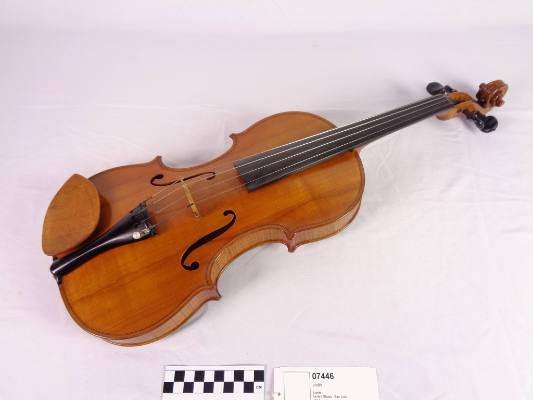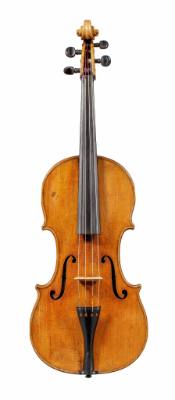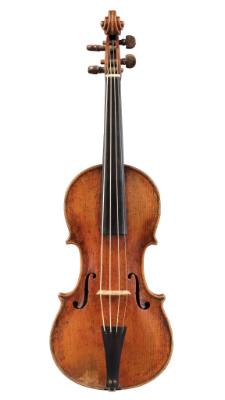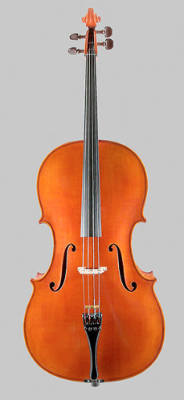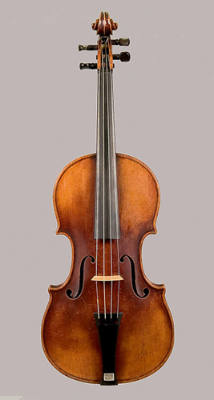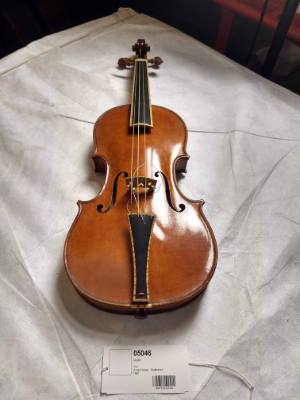
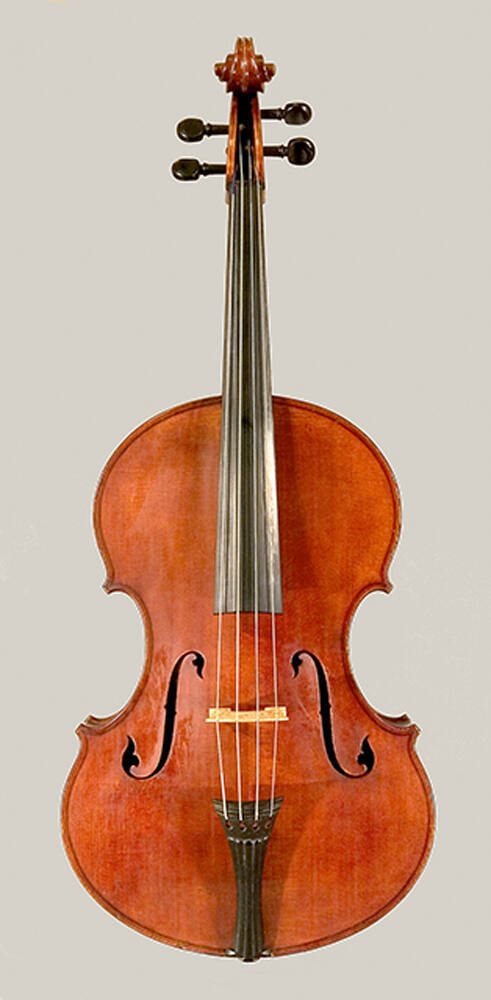
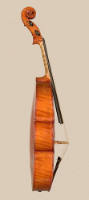

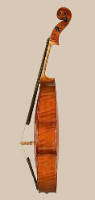
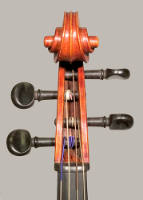
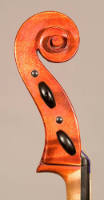
Violotta
Maker
August Paulus
Date1896/12
Place MadeDresden, Saxony, Germany, Europe
ModelStelzner
Serial No.325
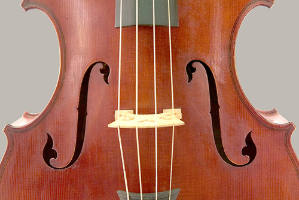
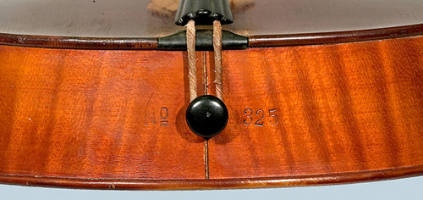
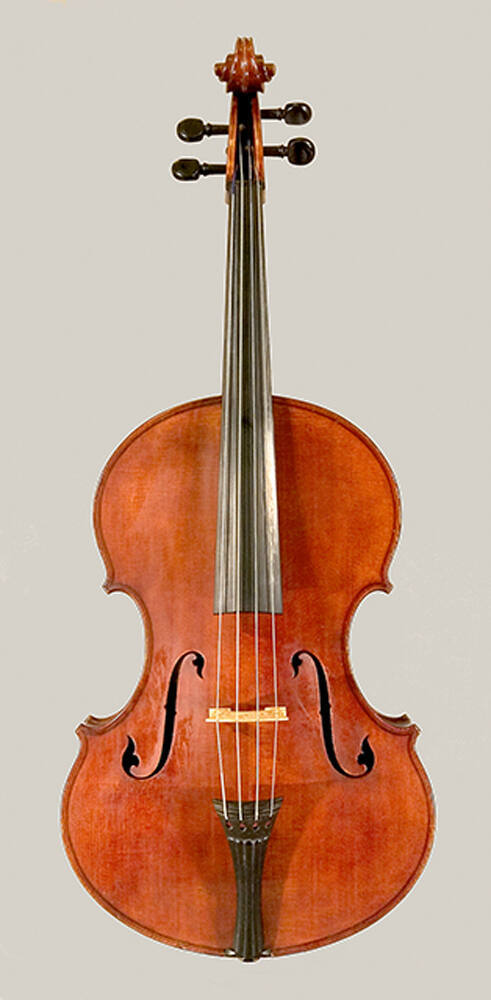
SignedWritten in black ink on brown paper label: No 325. Dresden, Dec.[dot over line over “ec”] 96. / Dr. Alfred Stelzner inv.Branded on inside of back above label, the first line of text curved downward at each end: NACH Dr ALFRED STELZNER’S / — ∙ — / SYSTEMMarkingsBranded on lower rib near endpin, under varnish: No [to bass side of endpin] [“o” underlines incised] / 3 2 5 [each number branded with separate die]DescriptionViolin body patented in 1891 by Dr. Alfred Stelzner (German patent, class 51, number 69012), on the premise that an outline designed with parabolic and elliptical geometry would result in a better sound than one with traditional, circle-based violin geometry. The ribs are tapered to be higher at the center, so that the upper rib edge forms a parabola, and the top and bottom blocks are triangular with concave, parabolic sides. The f-holes are also non-standard, with leaf-shaped cutouts in lieu of round or oval eyes, increasing the lengths of the wings, and therefore their freedom to vibrate, which Stelzner thought was important for sound. Stelzner’s design was applied to the violin, viola, violoncello, and double bass, as well as two new instruments he added to the family: the violotta, tuned an octave below the violin, and the cellone, tuned two octaves below the violin (a fourth below the violoncello).
Invented by Dr. Alfred Stelzner (d. 1906), Dresden, 1891. One of only 4 such instruments known to survive.
Covered by U.S. Patent No. 492,948, applied for Sept. 3,1891, awarded Mar. 7, 1893.
Top: two-piece, quarter-cut spruce: narrow grain broadening toward the flanks
Back: two-piece, quarter-cut maple: broad curl descending from center joint
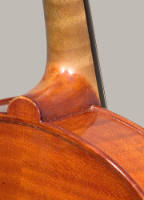
Ribs: quarter-cut maple: broad curl angled to right on bass side, angled to left of treble side; lower ribs divided by purfling strip; rib corners chamfered
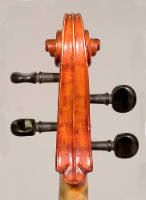
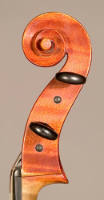
Head and neck: maple: very broad curl; long pegbox with shoulders; neck angled steeply back
Edging: re-curve extends close to edge, forming ridge
Varnish: dark red with fine craquelure
Fingerboard: ebony; beveled at G-string position
Nut: ebony
Tailpiece: ebony; fluted face with scalloped lower edge; molded saddle carved rather than inlaid
Tailgut: plain gut
Pegs: varnished ebony
Saddle: ebony
Endpin: ebony
Bridge: tall bridge with fancy heart, small circular kidneys below angled, fancy kidneys, and tall, violoncello-bridge-style feet
F-holes: leaf-shaped eyes; rounded wings; notch corners rounded
Linings: light hardwood; extend over corner blocks
Corner blocks: spruce
Top block: spruce; triangular with concave sides
Bottom block: spruce; triangular with concave sidesDimensionsTotal violotta length: 709 mm
Back length: 422 mm
Upper bout width: 225 mm
Center bout width: 148 mm
Lower bout width: 275 mm
Upper rib height: 44-60 mm
Center rib height: 60-62 mm
Lower rib height: 56-62 mm
Neck length (bottom of nut to ribs): 164 mm
Stop length: 236 mm
Vibrating string length: 407 mmProvenanceNo known provenance. Published ReferencesMargaret Downie Banks, “A Physicist’s Unfulfilled Prophecy: Alfred Stelzner’s Experiment in Violin Reform,” America's Shrine to Music Museum Newsletter 26, No. 2 (May 1999), pp. 4-5.
James Christensen, “Dr Stelzner’s Original Instruments,” The Strad 112 No. 1338 (October 2001) p. 1125
Credit LineGift of Larry and David Folland Anderson, 1998
Object number06719
On View
Not on view